


Last updated on August 3rd, 2026

For manufacturing leaders, inventory management is ultimately a question of capital efficiency, operational resilience, and scalability. As production networks expand and inventory requirements become more complex, the decision is not whether inventory should be managed effectively, but whether keeping every inventory function in-house continues to deliver the best financial and operational return. For CEOs and business owners, evaluating inventory management outsourcing can help determine where specialized external support can improve performance without compromising control or supply chain visibility.
According to industry research, annual inventory carrying costs account for 20 to 30 percent of total inventory value across industrial networks. Managing complex multi-facility supply chains internally often ties up capital and strains back-office planning teams. Evaluating inventory management outsourcing services provides enterprise decision-makers with a structured framework to reduce holding expenses while stabilizing production schedules.
The Hidden Cost of Managing Inventory Internally
Operating internal inventory planning teams without specialized external support often creates hidden cost multipliers across plant networks. Many enterprise manufacturers absorb substantial operational drag by attempting to maintain obsolete back-office processes internally.
Partnering with established inventory management outsourcing companies allows manufacturing leaders to transform fixed labor expenses into scalable operational capabilities. Evaluating the systemic inefficiencies in internal inventory control highlights direct opportunities for margin recovery and risk reduction through specialized outsourcing of inventory management for manufacturing.
- Working capital constraints: Tying up capital in buffer stock reduces available cash flow needed for capital expenditures and facility expansion. Over-buffering inventory limits corporate liquidity and increases short-term financing costs across global operations.
- Manual planning processes: Relying on disconnected spreadsheets to track safety stock levels leads to human calculation errors and operational delays. Manual data entry consumes valuable engineering time while failing to reflect real-time production requirements.
- Forecasting inaccuracies: Outdated static demand models fail to account for lead time volatility, seasonal spikes, and component supply shifts. Unreliable forecasts force procurement teams to place emergency purchase orders, inflating landed material costs.
- Staffing shortages: High turnover among experienced inventory planners disrupts daily replenishment workflows and weakens institutional knowledge. Recruiting and training specialized supply chain talent internally requires significant time and financial investment.
- Increasing SKU complexity: Managing custom component variations and engineering changes expands inventory records exponentially across global facilities. High SKU proliferation overwhelms internal planning bandwidth and increases the risk of component obsolescence.
- Multi-warehouse challenges: Lacking unified cross-facility visibility results in unbalanced stock distribution across regional distribution centers. Uncoordinated inventory allocation forces expensive inter-warehouse transfers and creates localized material shortages.
Five Signs Your Inventory Operation Has Outgrown Your Internal Team
Enterprise manufacturing organizations frequently encounter an operational inflection point where internal planning bandwidth can no longer support growing operational scale. Identifying these operational indicators early enables leadership to transition non-core administrative functions to external specialists before performance degrades further.
Deploying specialized inventory management outsourcing services addresses systemic operational bottlenecks before customer fill rates and profitability suffer. Recognizing key warning signs helps operations leaders justify back-office modernization initiatives to executive boards.
Inventory Carrying Costs Continue to Rise
Holding expenses continue to climb as storage fees, insurance premiums, and material handling costs escalate across regional facilities. When capital tied up in stock restricts strategic growth initiatives, internal holding strategies require immediate financial re-evaluation. Engaging expert inventory management consulting provides objective benchmarks to identify excessive stock buffers across complex supply chains.
Stockouts and Excess Inventory Occur Simultaneously
Manufacturing plants frequently experience severe material shortages for critical production lines while simultaneously holding excessive reserves of dead stock. This inventory distortion signals that internal planning logic relies on static assumptions rather than dynamic consumption signals. Rebalancing network buffers requires advanced analytical capabilities that internal teams rarely possess.
ERP Data Quality Is Deteriorating
Landed cost discrepancies, ghost inventory records, and uncoordinated bill of materials updates degrade confidence in core enterprise software outputs. Planners lose trust in system-generated purchase recommendations and revert to manual offline overrides that compound data inaccuracies. Engaging with top inventory control solutions providers restores data integrity and aligns software parameters with actual plant workflows.
Planning Cycles Are Becoming Slower
Monthly master production scheduling and safety stock recalibration routines require excessive preparation time across cross-functional departments. Delayed planning cycles prevent purchasing managers from responding rapidly to upstream supplier disruptions or sudden customer demand shifts. Sluggish decision-making leads to missed production deadlines and inflated freight costs.
Teams Spend More Time on Administration than Optimization
Supply chain analysts spend the majority of their daily schedules compiling manual reports, reconciling purchase order discrepancies, and chasing vendor updates. High administrative burden prevents talent from focusing on strategic supplier negotiations and lead time optimization projects. Shifting routine recordkeeping to an external partner frees up internal capacity for high-value strategic initiatives.
What Inventory Functions Should Manufacturers Outsource First?
Outsourcing inventory management functions does not require relinquishing strategic control over core supply chain operations or production scheduling. Operations leaders achieve the highest initial return on investment by delegating repetitive, data-intensive administrative tasks to external specialists.
Leading inventory management outsourcing companies provide modular support architectures that seamlessly integrate with existing corporate governance frameworks. Delegating specific transactional functions to specialized inventory management outsourcing services establishes immediate process standardization and operational stability.
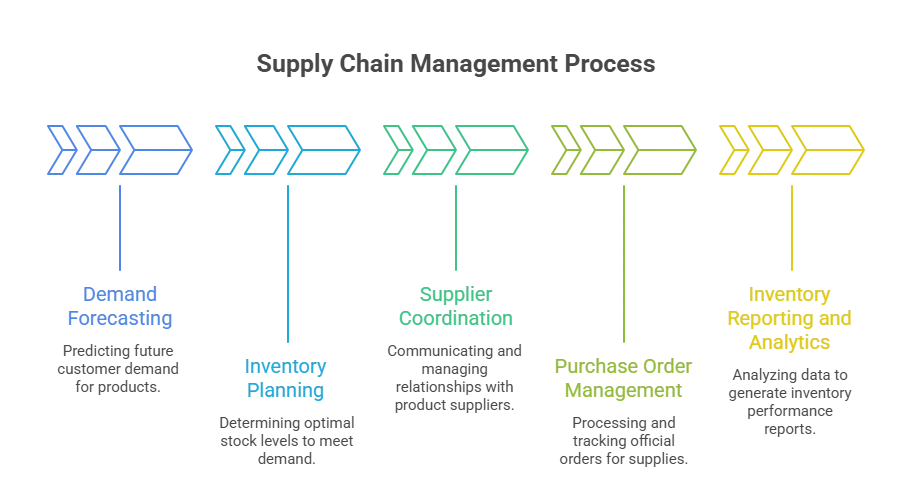
Demand Forecasting
External data specialists analyze historical consumption patterns, market trends, and customer backlog data to generate high-accuracy demand projections. Utilizing advanced statistical modeling reduces forecast error rates and eliminates manual bias from purchasing decisions. Transitioning forecasting workflows to outsourced inventory management services improves safety stock precision across complex product portfolios.
Inventory Planning
Specialized planning teams continuously calculate dynamic reorder points, economic order quantities, and safety stock buffers across multi-echelon networks. Automated replenishment logic prevents overstocking while ensuring raw materials are available for scheduled production runs. Outsourcing routine planning calculations allows internal supply chain leaders to focus on strategic network expansion.
Supplier Coordination
External vendor managers track purchase order acknowledgments, monitor production lead times, and expedite critical component shipments directly with global suppliers. Proactive supplier coordination mitigates upstream supply risks and improves overall vendor delivery performance metrics. Outsourcing routine vendor follow-ups ensures complete operational transparency across Tier-1 and Tier-2 supply networks.
Purchase Order Management
Delegating purchase order creation, line-item verification, and invoice matching to external transactional teams eliminates administrative backlogs. Automated order processing ensures accurate pricing compliance and reduces processing cycle times significantly. Utilizing specialized inventory management streamlines back-office transactional workflows while maintaining strict financial approval controls.
Inventory Reporting and Analytics
External analytical teams deliver custom performance dashboards that track inventory turnover rates, carrying costs, and fill rate performance in real time. Standardized reporting modules provide executive leadership with clear operational visibility without requiring internal IT resources. Clear data insights enable faster, evidence-based strategic decision-making across global business units.
How to Evaluate an Inventory Management Outsourcing Partner
Selecting an external operating partner requires a rigorous evaluation framework that assesses technical expertise, software integration capabilities, and industry specialization. Operations leaders must verify that prospective vendors possess the technical depth needed to support complex manufacturing requirements.
Evaluating prospective inventory management outsourcing companies through structured criteria ensures seamless operational alignment and long-term risk mitigation. Evaluating core partner capabilities protects corporate capital while accelerating time-to-value across global plant networks.
- Manufacturing experience: Evaluate whether the partner understands complex bill-of-materials structures, engineering change orders, and industrial production lead times. Deep manufacturing domain expertise guarantees that external teams comprehend your specific operational environment.
- ERP expertise: Verify proven technical capability in configuring and managing your specific enterprise resource planning software and warehouse tools. Direct software compatibility prevents integration delays and maintains data synchronization across internal platforms.
- Data governance capabilities: Audit the vendor’s cybersecurity standards, data encryption protocols, and compliance frameworks to protect proprietary operational information. Robust data governance mitigates legal liabilities and safeguards sensitive corporate information assets.
- Performance metrics: Establish clear contractual key performance indicators covering forecast accuracy, inventory turnover improvements, and purchase order processing speeds. Defensible performance benchmarks hold external service providers accountable to specific operational outcomes.
- Reporting cadence: Require structured communication frameworks, including weekly operational syncs and monthly executive business reviews. Transparent reporting protocols maintain operational alignment between internal leaders and external service managers.
- Scalability: Ensure the service provider maintains the resource capacity and global infrastructure needed to support future business acquisition or facility expansion. Flexible service models allow your organization to scale back-office support rapidly during demand surges.
- Industry specialization: Prioritize service providers that possess specialized experience within your specific manufacturing sub-sector or industrial distribution model. Industry familiarity accelerates team onboarding and ensures immediate alignment with market standards.
Conclusion
Managing modern manufacturing supply chains requires balancing strict working capital limits against aggressive customer fulfillment benchmarks. Continuing to rely on overworked internal teams and manual spreadsheet calculations exposes enterprise operations to severe financial drag and supply risk.
Partnering with established inventory management outsourcing services allows manufacturing leaders to modernize back-office capabilities without expanding fixed overhead. Outsourcing routine planning, forecasting, and transactional tasks restores operational focus and optimizes cash flow across global production networks.
Are you ready to optimize your working capital and eliminate back-office planning bottlenecks? Contact Vserve Solution today to evaluate how our tailored inventory services can transform your manufacturing operations.
Frequently Asked Questions
Enterprise decision-makers frequently analyze strategic risks, data security, and operational controls when evaluating external inventory management support models. Below are direct answers to primary operational questions regarding outsourced inventory control frameworks.
1. What are inventory management outsourcing services?
Inventory management outsourcing services involve delegating specialized back-office inventory functions, such as demand forecasting, purchase order management, and safety stock calculation, to external experts. These specialized solutions optimize working capital, restore data accuracy, and lower holding costs for industrial manufacturers.
2. How do inventory management outsourcing companies protect proprietary data?
Established inventory management outsourcing companies implement strict SOC 2 compliance standards, encrypted data pipelines, and role-based access controls within client enterprise systems. Secure operational protocols ensure proprietary manufacturing specifications and customer records remain completely confidential.
3. Will outsourcing inventory management cause a loss of operational control?
No, outsourcing transactional administrative tasks restores executive control by providing accurate, real-time data dashboards and standardized operational reporting. Internal leadership retains complete authority over purchasing approvals, supplier contracts, and strategic inventory policy decisions.
4. What is the typical ROI timeline when outsourcing inventory control?
Most enterprise manufacturers achieve positive returns within three to six months through reduced carrying costs, eliminated expedited freight, and improved labor productivity. Streamlining back-office workflows quickly frees up capital and stabilizes production fulfillment schedules.