

Multi-Echelon Inventory Optimization: How Supply Chain Leaders Reduce Inventory Costs

Last updated on August 4th, 2026

Inventory is one of the largest sources of tied-up capital in a supply chain, yet reducing stock indiscriminately can create service failures, production delays, and dissatisfied customers. For CEOs and supply chain leaders, the real challenge is finding the right balance between carrying enough inventory to protect service levels and avoiding excess stock that erodes cash flow and margins. As supply networks span multiple suppliers, plants, distribution centers, and markets, achieving that balance requires a more sophisticated approach than optimizing inventory at individual locations.
Global supply networks are becoming increasingly complex, forcing operations leaders to balance strict working capital budgets against high customer service expectations. Dynamic MEIO can significantly reduce excess inventory. By applying segmented Multi-Echelon Inventory Optimization, organizations have achieved inventory value reductions of up to 63%, unlocking millions in working capital while maintaining targeted service levels. Working alongside specialized supply chain outsourcing services enables enterprises to modernize legacy planning models and unlock significant cash flow across multi-tier networks.
Table of Contents
Why Traditional Inventory Planning Breaks Down in Complex Supply Networks
How MEIO Is Used Across the Supply Chain
The Executive Framework for Evaluating Multi-Echelon Inventory Optimization
Implementation Risks That Delay ROI
How Leading Manufacturers and Distributors Approach MEIO Deployment
Why Traditional Inventory Planning Breaks Down in Complex Supply Networks
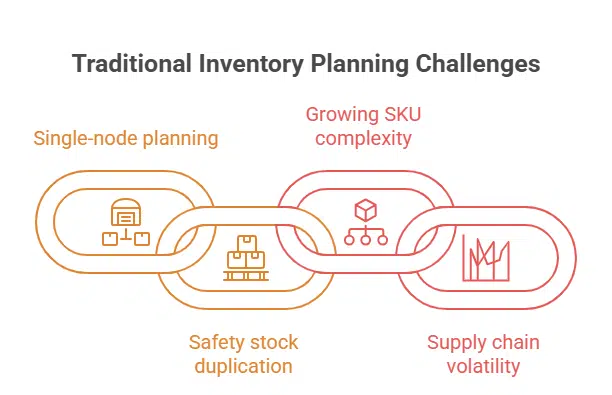
Legacy inventory management relies heavily on isolated calculations performed at individual warehouses or retail nodes. This localized perspective fails to account for interdependencies across the broader distribution ecosystem, leading to systemic overstocking.
Single-node planning limitations
Single-site planning tools evaluate demand and lead times strictly within the boundaries of a single location. Consequently, planners lack visibility into upstream supply buffers and downstream demand shifts occurring across adjacent distribution centers.
Safety stock duplication
When each node independently calculates safety stock requirements to buffer against demand uncertainty, excess inventory accumulates rapidly across the network. This compounding effect creates redundant buffer stock that locks up working capital without increasing end-customer service levels.
Growing SKU complexity
Modern businesses manage thousands of distinct product variants across multiple distribution channels simultaneously. Managing extensive SKU portfolios using static spreadsheets makes it impossible to dynamically balance inventory buffers between central hubs and regional locations.
Supply chain volatility
Unpredictable lead times, transport bottlenecks, and fluctuating customer buying habits frequently disrupt historical demand patterns. Isolated planning models cannot adjust dynamically to systemic disruptions, forcing companies to hold expensive emergency buffer inventory.
How MEIO Is Used Across the Supply Chain
Implementing multi-echelon inventory optimization allows organizations to analyze demand signals, lead times, and holding costs across every level of the supply chain concurrently. By holistically positioning stock across central hubs, regional distribution centers, and retail outlets, enterprises can minimize network-wide inventory while ensuring high product availability.
The Executive Framework for Evaluating Multi-Echelon Inventory Optimization
Adopting advanced inventory optimization requires a thorough assessment of operational readiness, network architecture, and technological maturity. Executives must analyze several core operational dimensions to determine the strategic scope and expected ROI of their implementation.
Network complexity
The physical structure of a distribution network directly determines how inventory buffers should be positioned across different tiers. Organizations operating multiple central warehouses, regional hubs, and fulfillment centers gain the highest financial returns from holistic optimization software.
Service-level targets
Setting uniform service targets across all SKUs and locations often leads to inefficient capital allocation and unnecessary carrying costs. A robust evaluation framework differentiates target service levels based on SKU profitability, lead time constraints, and customer criticality.
Demand variability
Products with highly volatile demand patterns require different stocking logic than stable, fast-moving items. Evaluating demand variability helps planners determine whether to centralize slow-moving inventory or position buffer stock closer to end customers.
Supplier reliability
Lead time uncertainty from upstream vendors significantly influences the amount of safety stock required across distribution nodes. Factoring supplier performance historical metrics into inventory calculations enables companies to build resilient buffer strategies.
Technology maturity
Deploying advanced inventory optimization algorithms requires clean historical data, integrated ERP platforms, and real-time data ingestion pipelines. Assessing current technology maturity helps leaders identify necessary data infrastructure upgrades before software rollout.
Implementation Risks That Delay ROI
Transitioning from traditional inventory planning to multi-tier network optimization involves organizational, technical, and operational shifts. Identifying potential project pitfalls early allows business leaders to establish proactive mitigation strategies.
- Data inconsistencies: Inaccurate inventory records, missing supplier lead times, or fragmented data silos prevent optimization algorithms from generating reliable stocking recommendations.
- Organizational resistance: Planners who are accustomed to manual safety stock overrides may resist automated recommendations without structured change management programs.
- Weak governance structures: Lacking clear cross-functional ownership between procurement, logistics, and finance teams delays decision-making and stalls system integration.
- Integration challenges: Connecting new optimization engines with legacy ERP systems can create technical friction if data pipelines are not properly architected.
How Leading Manufacturers and Distributors Approach MEIO Deployment
Successful supply chain solutions rely on a structured, phased methodology rather than an immediate full-scale system replacement. Leading organizations follow a disciplined deployment roadmap to minimize operational risk and validate financial returns early.
Pilot program design
Initiating deployment with a targeted pilot program allows teams to test optimization algorithms on a specific product line or geographical region. Demonstrating early working capital reductions in a controlled environment builds organizational confidence and refines system settings.
Phased implementation
Following a successful pilot, companies gradually roll out multi-echelon inventory optimization solutions across additional product categories and distribution tiers. This phased expansion ensures that planning teams adapt to automated workflows while maintaining daily order fulfillment operations.
Continuous optimization
Inventory optimization is an ongoing operational process that requires regular parameter tuning and algorithm calibration. Leading distributors continuously feed fresh sales data, lead time changes, and market shifts into their planning engines to maintain high model precision.
Conclusion
Managing complex supply networks with legacy, single-node inventory planning tools inevitably leads to excessive holding costs and frequent stockouts. Transitioning to a holistic multi-echelon strategy enables enterprises to optimize working capital while consistently exceeding customer service expectations.
Organizations that combine advanced planning technology with expert supply chain outsourcing services position themselves for long-term operational resilience. By streamlining network-wide stocking levels, enterprise leaders can unlock substantial cash flow to fund future growth initiatives.
Frequently Asked Questions
1.What is multi-echelon inventory optimization?
Multi-echelon inventory optimization is an advanced supply chain strategy that simultaneously calculates inventory targets across all levels of a distribution network. Unlike single-site planning, it determines the optimal balance of safety stock across suppliers, central hubs, and regional outlets.
2. How does MEIO differ from single-echelon inventory optimization?
Single-echelon optimization evaluates each warehouse or retail store in isolation, often resulting in duplicated safety stock across the network. MEIO analyzes the interdependencies between all nodes concurrently, placing inventory where it provides the maximum network-wide service benefit.
3. What cost savings can organizations expect from MEIO?
Enterprises implementing multi-tier optimization typically reduce total inventory holding costs by 15 to 30 percent. Additionally, companies experience higher order fill rates and reduced emergency freight costs due to smarter buffer stock placement.
4. Can supply chain outsourcing services help with MEIO implementation?
Partnering with supply chain outsourcing services provides access to specialized domain experts, data engineers, and advanced planning software without massive capital investments. External experts help accelerate implementation, cleanse legacy data, and manage ongoing planning operations.
5. What types of businesses benefit most from MEIO?
Manufacturers, wholesale distributors, and retail enterprises with multi-tiered supply chains derive the highest financial value from MEIO. Any business managing complex product portfolios across multiple fulfillment locations can achieve significant working capital savings.