

Physical AI in Supply Chain Operations: Benefits, Use Cases, Challenges & Implementation Guide

Last updated on July 31st, 2026

The integration of artificial intelligence with physical machinery is revolutionizing modern logistics, moving operational systems from digital screens directly onto the warehouse floor. While software algorithms have optimized data management for years, combining advanced robotics with sensory AI enables machines to autonomously perceive, reason, and act in physical environments. Understanding physical AI in supply chain management enables enterprise leaders to automate complex material-handling workflows while maintaining maximum operational flexibility.
As global supply chains face labor shortages and volatile customer demands, static automated systems can no longer keep pace with daily operational friction. Integrating physical intelligence into physical assets establishes a dynamic operational foundation that adapts to real-time environment changes. Exploring modern technology used in supply chain management reveals how intelligent hardware elevates fulfillment speed, worker safety, and overall inventory accuracy.
What Is Physical AI?
Physical AI refers to artificial intelligence models embedded directly into physical machines, robots, and sensory hardware, enabling them to navigate and manipulate the real world independently. Unlike purely digital software applications that analyze spreadsheet data, physical intelligence continuously perceives physical surroundings, computes decisions on edge hardware, and executes precise physical actions. Deploying these intelligent assets transforms static logistics equipment into responsive, autonomous systems capable of complex physical task handling.
Understanding physical AI in supply chain helps enterprise leaders bridge the gap between digital software insights and physical execution. Modern supply chain management leverages this hardware intelligence to keep pace with changing market conditions.
Why Supply Chains Need Physical AI
Modern supply networks face unprecedented structural pressures that traditional operational frameworks can no longer resolve effectively. The rapid acceleration of global commerce demands unprecedented operational speed, flexibility, and physical precision across all logistics touchpoints.
- Labor shortages: An aging workforce and high turnover rates leave fulfillment centers continuously understaffed, threatening daily operational capacity.
- Rising costs: Escalating labor wages, commercial real estate rents, and energy expenses erode net profit margins across global transport networks.
- Customer expectations: Consumer demand for same-day delivery requires error-free, rapid order processing that exceeds human speed limitations.
- Supply chain disruptions: Unpredictable geopolitical delays, weather events, and material shortages require flexible, real-time physical rerouting capability.
- Inventory complexity: Expanding stock keeping unit counts strains manual picking workflows, increasing warehouse inventory error rates.
- Safety requirements: Strict occupational safety regulations require removing human workers from hazardous material handling environments and heavy machine traffic lanes.
Core Technologies Behind Physical AI
Modern physical intelligence systems rely on a sophisticated ecosystem of hardware components and software engines to perceive and manipulate physical environments.
- Computer vision: Advanced camera arrays and image processing algorithms that allow machinery to recognize, classify, and track objects in real time.
- Robotics: Mechanical manipulators, robotic arms, and end-effectors equipped with tactile sensors to grasp diverse package shapes precisely.
- Autonomous mobile robots (AMRs): Intelligent transport units that navigate dynamic warehouse environments without physical floor tracks or magnetic tape guidance.
- Automated guided vehicles (AGVs): Heavy-duty material handling trucks used for moving large pallets along fixed, predictable facility transport routes.
- IoT sensors: Distributed environmental monitoring hardware that collects real-time operational data like temperature, vibration, and location metrics continuously.
- RFID: Radio-frequency identification systems that track tagged inventory units automatically as they move through facility portals.
- LiDAR: Laser-based light detection and ranging technology that maps physical three-dimensional spaces, enabling precise obstacle avoidance.
- Digital twins: Virtual digital models of physical supply chains that simulate scenarios and optimize physical robotic workflows continuously.
- Edge AI: High-performance onboard processing chips that compute machine intelligence algorithms locally, eliminating network latency delays.
- Machine learning: Adaptive algorithms that analyze historical sensor data to refine robotic movement precision and predictive maintenance accuracy over time.
- AI agents: Autonomous decision engines embedded in physical assets that coordinate complex, multi-machine workflows to achieve operational targets.
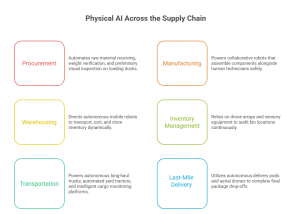
Physical AI Across the Supply Chain
Integrating physical intelligence across global supply channels unites digital planning with real-world physical execution. This multi-layered deployment ensures seamless material flow across every stage of the supply chain lifecycle.
Procurement
Physical intelligence in procurement automates raw material receiving, weight verification, and preliminary visual inspection on loading docks. Intelligent receiving hardware scans incoming freight automatically, verifying shipments against purchase orders without human intervention.
Manufacturing
On factory floors, physical intelligence powers collaborative robots that assemble components alongside human technicians safely. These intelligent machines adjust their positioning dynamically based on human movement, preventing physical collisions and manufacturing bottlenecks.
Warehousing
Physical intelligence optimizes facility operations by directing autonomous mobile robots to transport, sort, and store inventory dynamically. These systems analyze real-time order flows to relocate high-demand items closer to packing stations automatically.
Inventory Management
Automated inventory tracking relies on drone arrays and sensory equipment to audit bin locations continuously without interrupting active warehouse operations. Intelligent scanning equipment updates central enterprise databases instantaneously, eliminating human manual counting errors.
Transportation
In freight transport, physical intelligence powers autonomous long-haul trucks, automated yard tractors, and intelligent cargo monitoring platforms. Onboard processing units continuously evaluate road conditions, weather patterns, and vehicle telemetry to ensure safe, fuel-efficient transit.
Last-Mile Delivery
Last-mile delivery networks utilize physical intelligence via autonomous delivery pods and aerial drones to complete final package drop-offs smoothly. These delivery assets navigate urban obstacles, traffic signals, and residential environments to deliver orders to customer doorsteps.
Reverse Logistics
Managing customer returns requires intelligent robotic sorters that evaluate product conditions, scan barcodes, and route items for restocking or recycling. Physical intelligence speeds up return processing cycles, returning sellable inventory to available stock pools rapidly.
Adopting physical AI in supply chain operations across these functional pillars maximizes process visibility while cutting operational expenses.
Top Physical AI Use Cases
Applying physical intelligence to specific operational bottlenecks delivers rapid efficiency gains across fulfillment, yard management, and inventory control.
Autonomous Picking
Autonomous picking systems utilize computer vision and flexible robotic arms to pick diverse items from storage bins into shipping cartons. These intelligent arms adjust their grip force dynamically based on item fragility, packaging type, and weight distributions. Deploying autonomous picking machines drastically reduces manual labor reliance while increasing daily order fulfillment throughput.
Predictive Maintenance
Predictive maintenance leverages onboard IoT vibration, temperature, and acoustic sensors to monitor physical machinery health in real time. Embedded machine learning models analyze subtle sensory changes to predict component failures days before mechanical breakdowns occur. Implementing predictive maintenance prevents costly unexpected downtime, extending the operational lifespan of expensive facility equipment.
Smart Quality Inspection
Smart quality inspection platforms combine high-resolution cameras with edge AI algorithms to audit manufacturing and packaging quality at high line speeds. These systems identify micro-defects, missing labels, and structural damage that human inspectors routinely overlook during long shifts. Automating quality inspection ensures only flawless products leave production facilities, preserving customer satisfaction.
Selecting the right operational technology used in supply chain management allows facilities to deploy these use cases seamlessly.
Benefits of Physical AI
Deploying intelligent physical machinery delivers compounding operational improvements that extend far beyond simple labor cost reductions.
- Faster fulfillment: Accelerated picking, sorting, and transport cycles reduce overall order processing times from hours down to minutes.
- Improved accuracy: Precise computer vision and sensor fusion eliminate human picking, packing, and sorting errors across warehouse operations.
- Lower labor costs: Automating physically demanding and repetitive tasks lowers overall payroll expenses and minimizes costly workplace injury claims.
- Better safety: Removing human workers from hazardous heavy machinery lanes and cold-storage facilities lowers overall workplace incident rates dramatically.
- Greater resilience: Autonomous machines operate continuously through seasonal demand surges, labor shortages, and regional disruptions without operational fatigue.
- Real-time visibility: Embedded IoT hardware streams precise physical location and equipment operational data directly to central analytics dashboards.
- Increased scalability: Modular robotic fleets allow facilities to scale operational handling capacity quickly by adding units during peak seasons.
Challenges and Risks
While the operational advantages of physical intelligence are significant, implementing complex physical machinery presents unique organizational and technical hurdles.
- High implementation costs: Purchasing advanced robotic hardware, sensor arrays, and edge computing infrastructure requires substantial upfront capital outlays.
- Legacy system integration: Connecting modern physical machinery with outdated enterprise resource planning tools creates complex software integration bottlenecks.
- Data quality: Incomplete or noisy sensor data can cause physical intelligent machines to misinterpret environmental surroundings, leading to operational errors.
- Workforce adoption: Employees may resist adopting automated hardware due to job security concerns or inadequate technical training programs.
- Cybersecurity: Connecting physical machinery to digital networks introduces vulnerabilities to malicious hacking, equipment hijacking, and data theft.
- AI governance: Establishing clear accountability protocols for decisions made independently by physical machinery remains a complex legal challenge.
- Safety and compliance: Meeting strict international industrial safety standards requires rigorous real-world testing before public facility deployment.
Leveraging physical AI in supply chain operations requires addressing these integration risks through structured, phased implementation frameworks.
Future of Physical AI in Supply Chains
The evolution of physical intelligence will usher in fully autonomous, self-optimizing logistics networks that operate with minimal human oversight. Future fulfillment centers will function as dark warehouses, where intelligent robotic fleets manage receiving, storage, picking, and shipping entirely in unlit environments. Human-robot collaboration will become seamless, with lightweight exoskeletons and adaptive cobots providing real-time physical assistance to human technicians.
Multi-agent orchestration platforms will enable thousands of heterogeneous robots from different manufacturers to communicate and share task spaces safely. Self-healing supply chains will deploy autonomous repair drones and predictive procurement bots to fix mechanical parts and reorder stock automatically. As sensory hardware costs decline, physical intelligence will become standard infrastructure across global logistics, redefining speed and efficiency standards worldwide.
Frequently Asked Questions
1. What is Physical AI?
Physical AI refers to artificial intelligence embedded in physical hardware, machines, and robots that allows them to perceive, navigate, and manipulate the real world independently. Unlike pure digital software, it combines edge processing, computer vision, and mechanical actuation to perform physical work.
2. How is it different from robotics?
Traditional robotics relies on rigid, pre-programmed code to perform repetitive movements within strictly controlled, static environments. Physical intelligence equips machines with adaptive sensors and machine learning, allowing them to navigate dynamic, unpredictable environments safely.
3. Is Physical AI the same as Agentic AI?
No, agentic AI refers to autonomous software agents that execute digital multi-step tasks to achieve specific goals inside virtual environments. Physical intelligence embeds these goal-oriented decision-making capabilities directly into physical mechanical bodies to perform physical work.
4. Which industries benefit most?
Industries with high material throughput, complex fulfillment operations, and intensive logistics benefit most, including ecommerce, retail, automotive, pharmaceutical, and third-party logistics. Manufacturing plants and heavy industrial facilities also achieve rapid safety and productivity gains.
5. How expensive is implementation?
Initial implementation expenses vary based on facility size and automation scale, often requiring significant capital investments for hardware and system integration. However, modular Robotics-as-a-Service business models now allow companies to deploy hardware with lower upfront operating costs.
6. Can SMEs adopt Physical AI?
Yes, small and medium enterprises adopt physical intelligence by deploying scalable, modular solutions like autonomous mobile robots or vision-based sorting stations. Leveraging subscription models allows smaller brands to access advanced technology without massive capital expenditures.
7. What KPIs measure success?
Key metrics include order picking accuracy, fulfillment cycle time, labor cost per unit, equipment uptime, injury incidence rates, and overall return on investment. Tracking these indicators verifies that automated machinery improves operational throughput effectively.
8. What technologies are required?
Core technologies include computer vision, LiDAR, edge AI processing chips, IoT sensors, autonomous navigation algorithms, and cloud integration platforms. Modern technology used in supply chain management binds these components into a unified operational ecosystem.
Conclusion
Understanding physical AI in supply chain operations is essential for enterprise leaders aiming to build resilient, fast, and cost-effective logistics operations. Bridging the gap between software intelligence and physical hardware enables automated machines to navigate dynamic environments and solve complex fulfillment challenges.
Deploying state-of-the-art technology used in supply chain management transforms traditional warehouses into agile, intelligent fulfillment networks. Embracing physical intelligence today ensures your supply chain remains competitive, adaptable, and capable of meeting future commercial demands.