

Tail Spend Management: How to Reduce Costs, Improve Control, and Optimize Procurement Operations

Last updated on August 5th, 2026

Tail spend management refers to controlling the smaller, fragmented purchases that often make up a large portion of procurement complexity but a small portion of total spend value. Organizations that invest in a tail spend management strategy often reduce hidden costs and improve procurement visibility.
The U.S. Federal Acquisition Regulation (FAR) establishes structured procurement requirements for federal agencies, emphasizing controlled purchasing processes, accountability, and consistent oversight to ensure efficient and compliant acquisition activities across all categories of spend.
This principle is critical when implementing tail spend management services, especially in large enterprises dealing with thousands of low-value transactions.
Table of Contents
What Tail Spend Really Means in Practice
Why Tail Spend Becomes a Hidden Cost Problem
Day-to-Day Operations in Tail Spend Management
Operating Models: In-House, Outsourced, and Hybrid
Step-by-Step Tail Spend Optimization Framework
Real-World Example in Procurement Transformation
Tail Spend KPIs and Success Metrics
What Tail Spend Really Means in Practice
Tail spend is not just “small purchases.” It includes unmanaged transactions such as ad-hoc supplier orders, one-time vendors, and non-contracted procurement activity.
Modern tail spend management solutions help organizations categorize this fragmented spend into controllable segments. Many companies use automation tools to identify recurring patterns and reduce inefficiencies.
Without structure, companies rely heavily on reactive purchasing, increasing leakage and reducing compliance.
Why Tail Spend Becomes a Hidden Cost Problem
The main challenge is not volume but fragmentation. When procurement teams lack visibility, costs increase across suppliers, contracts, and approvals.
Organizations using spend management outsourcing often report improved visibility and reduced maverick spending. Similarly, spend management solutions allow centralized control over decentralized purchasing.
This is where tail spend management services become essential, especially for scaling enterprises and global operations.
Simplify fragmented supplier bases and automate low-value transactions with digital tail spend management solutions
Day-to-Day Operations in Tail Spend Management
Effective tail spend management is not only strategic but operational. After identification, procurement teams must manage daily activities such as:
- Supplier onboarding and verification
- Purchase requisition processing
- Purchase order (PO) creation and tracking
- Vendor communication and issue resolution
- Invoice validation and reconciliation
- Continuous spend monitoring and reporting
These operational workflows define successful tail spend management solutions.
Teams using structured tail spend management strategies often automate these steps to reduce manual workload. Some companies integrate digital procurement platforms to streamline these processes.
Even in industries like retail, retail tail spend management ensures fast-moving inventory purchases are still controlled and compliant.
Operating Models: In-House, Outsourced, and Hybrid
Organizations today face increasing pressure to control costs, improve procurement visibility, and eliminate inefficiencies across fragmented purchasing activity, particularly within tail spend. As transaction volumes grow and supplier ecosystems become more complex, selecting the right operating model becomes a critical decision that directly impacts efficiency, governance, and long-term procurement performance.
There is no single “best” approach to managing tail spend. Instead, organizations typically choose an operating model based on their internal capability, digital maturity, cost structure, and strategic priorities. The three primary models—in-house, outsourced, and hybrid—represent different levels of control, scalability, and external dependency, allowing businesses to align their procurement structure with operational needs.
1. In-House Model
Companies manage everything internally using procurement teams.
- Pros: Full control, strong governance
- Cons: High workload, requires skilled staff
This model is common in firms with mature procurement systems and strong tail spend management strategy.
2. Outsourced Model
Companies rely on tail spend management services or external providers.
- Pros: Cost efficiency, scalability, expertise
- Cons: Less direct control
This model is widely used by organizations adopting spend management outsourcing approaches.
3. Hybrid Model
A combination of internal oversight and external execution.
- Pros: Balanced control and efficiency
- Cons: Requires coordination between teams
Many enterprises prefer this approach when implementing spend management outsourcing solutions.
Step-by-Step Tail Spend Optimization Framework
Tail spend often represents a small percentage of total procurement value, but it can account for a disproportionately large share of transactions, suppliers, and administrative effort. Without proper control, it leads to fragmented purchasing behavior, hidden costs, and reduced procurement visibility across the organization.
A structured approach is essential to effectively manage and optimize tail spend. By following a systematic framework, organizations can reduce inefficiencies, improve supplier governance, and unlock measurable cost savings while strengthening overall procurement performance.
Step 1: Spend Analysis
The first step is to identify fragmented and low-value transactions using procurement data. This involves analyzing purchasing patterns across departments, categories, and suppliers to uncover hidden inefficiencies.
A detailed spend analysis helps organizations understand where tail spend is occurring and how frequently it happens. It also provides the baseline needed to design targeted optimization strategies.
Step 2: Supplier Segmentation
In this step, vendors are classified into strategic, preferred, and tail suppliers based on spend volume, frequency, and business criticality. This segmentation helps organizations prioritize supplier relationships more effectively.
By clearly defining supplier categories, procurement teams can focus resources on high-value suppliers while controlling or consolidating low-value vendor activity. This improves both cost efficiency and operational clarity.
Step 3: Policy Design
Organizations must implement clear procurement rules, approval workflows, and purchasing guidelines. These policies ensure that tail spend is managed in a controlled and standardized manner across all departments.
Well-designed policies reduce maverick spending and enforce compliance with procurement standards. They also create accountability by clearly defining who can purchase what, from which suppliers, and under what conditions.
Step 4: Tail Spend Management Execution Models
At this stage, businesses choose between in-house management, outsourced support, or a hybrid operating model using tail spend management services. The decision depends on internal capability, cost structure, and scalability requirements.
Selecting the right execution model ensures that tail spend is managed efficiently without overburdening internal procurement teams. It also allows organizations to balance control with external expertise where needed.
Step 5: Automation and Integration
Organizations deploy tail spend management solutions to automate requisitioning, purchase orders, and invoice processing. These tools reduce manual intervention and improve process speed and accuracy.
Integration with ERP and procurement systems ensures real-time visibility across all transactions. This enables better control, faster approvals, and improved compliance with procurement policies.
Step 6: Continuous Monitoring
The final step involves tracking compliance, savings, and process efficiency using dashboards and performance KPIs. Continuous monitoring ensures that tail spend remains controlled and does not drift back into inefficiency.
Regular performance reviews help organizations refine policies and optimize supplier behavior over time. This ongoing improvement cycle is essential for sustaining long-term procurement value.
Real-World Example: Digital Procurement Transformation in the Public Sector
A more recent and relevant example of procurement standardization can be seen in the ongoing digital procurement transformation initiatives adopted by several national governments and public sector organizations post-2022. These programs focus on fully digitizing procurement workflows through centralized e-procurement platforms, supplier databases, and automated approval systems.

For example, many government procurement bodies have shifted toward integrated procurement ecosystems that unify sourcing, purchasing, and supplier management into a single digital environment. This reduces manual intervention, improves compliance tracking, and ensures that even low-value purchases are processed through standardized and auditable workflows.
These modern systems also incorporate analytics dashboards and AI-driven monitoring tools to identify spending patterns, including fragmented and repetitive low-value transactions similar to tail spend behavior. As a result, procurement teams gain real-time visibility into purchasing activity and can enforce policy compliance more effectively across departments.
This approach reflects how large organizations are evolving toward structured procurement operating models that closely align with tail spend management principles. By centralizing procurement data and automating routine transactions, institutions significantly reduce maverick spending, improve governance, and achieve greater efficiency across high-volume procurement environments.
Tail Spend KPIs and Success Metrics
Measuring performance is essential for effective tail spend optimization and long-term procurement success. Without clear KPIs, organizations struggle to identify inefficiencies, track savings, and ensure compliance across fragmented purchasing activity. By defining the right success metrics, businesses can better align tail spend management efforts with broader operational and financial goals.
- Spend under management percentage
- Procurement cycle time reduction
- Supplier consolidation rate
- Cost savings achieved
- Invoice processing accuracy
- Compliance rate
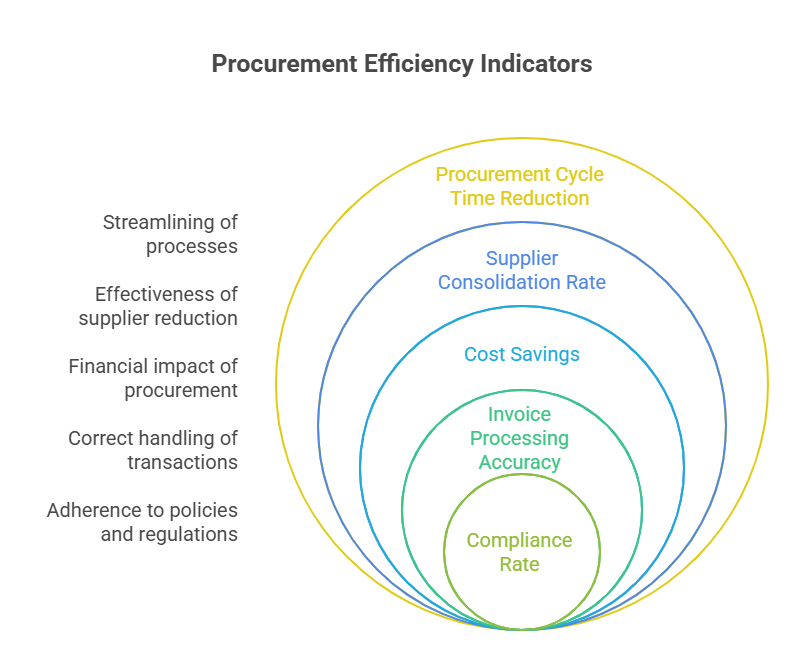
Organizations using tail spend management solutions and tail spend management services often link these KPIs to broader business outcomes like operational efficiency and procurement scalability.
Common Challenges and How to Overcome Them
Managing tail spend effectively comes with several operational and structural challenges that can significantly impact procurement efficiency if left unaddressed. These challenges often arise from fragmented supplier networks, inconsistent processes, and limited visibility into low-value transactions. By identifying these issues early and applying targeted solutions, organizations can strengthen control, improve compliance, and optimize overall procurement performance.
1. Fragmented Supplier Base
A fragmented supplier base occurs when organizations rely on a large number of small or duplicate vendors for similar goods and services. This creates inefficiencies in pricing, negotiation power, and supplier management.
To overcome this, businesses should implement a tail spend management strategy focused on vendor consolidation. Reducing the number of suppliers improves purchasing leverage and simplifies procurement operations.
Over time, supplier rationalization leads to better pricing agreements, stronger supplier relationships, and improved operational efficiency.
2. Poor Visibility
Poor visibility arises when procurement data is scattered across multiple systems or managed manually, making it difficult to track spending patterns. This often leads to missed opportunities for cost optimization and control.
The solution is to deploy digital tail spend management solutions that centralize procurement data. These platforms provide real-time dashboards and reporting capabilities.
Improved visibility enables organizations to identify inefficiencies quickly and make data-driven procurement decisions.
3. Maverick Spending
Maverick spending occurs when employees bypass approved procurement processes and purchase directly from unapproved suppliers. This undermines procurement policies and increases cost leakage.
The solution is to enforce strict procurement policies supported by automated approval workflows. This ensures all purchases follow defined guidelines and approval hierarchies.
Consistent enforcement reduces uncontrolled spending and strengthens procurement governance.
4. Data Quality Issues
Data quality issues arise when procurement records are incomplete, inconsistent, or duplicated across systems. This affects reporting accuracy and weakens decision-making.
To resolve this, organizations should standardize procurement systems and reporting tools. Clean and structured data improves transparency and analytical accuracy.
High-quality data also supports better forecasting, supplier evaluation, and performance tracking.
5. Limited Procurement Bandwidth
Limited procurement bandwidth occurs when internal teams are overwhelmed with high volumes of low-value transactions. This reduces their ability to focus on strategic sourcing activities.
A practical solution is to use spend management outsourcing or tail spend management services. External support helps handle routine procurement tasks efficiently.
This allows internal teams to focus on strategic initiatives such as supplier negotiations and category management.
6. Compliance Gaps
Compliance gaps emerge when procurement activities do not consistently follow internal policies or regulatory requirements. This increases operational risk and potential financial exposure.
To address this, organizations should implement structured workflows supported by spend management outsourcing solutions. These workflows ensure every transaction follows approved processes.
Stronger compliance frameworks improve audit readiness, reduce risk, and enhance overall procurement discipline.
Conclusion
Tail spend is often underestimated, but it significantly impacts procurement efficiency, cost control, and operational visibility. Organizations that adopt a structured tail spend strategy supported by a capable management solutions service provider gain stronger control over fragmented purchasing.
Whether through in-house systems, spend management outsourcing, or hybrid models, companies that actively manage tail spend outperform those that ignore it. With the right framework and support from tail spend management companies, procurement can evolve from reactive processing to strategic value creation.
FAQ
1. How long does it take to implement a tail spend program?
Implementation timelines vary depending on organizational size and data readiness. Most companies take three to six months to establish baseline visibility, integrate systems, and fully deploy a structured tail spend management framework.
2. What industries benefit most from tail spend optimization?
Industries with high supplier fragmentation, such as manufacturing, healthcare, retail, and logistics, benefit significantly. These sectors often rely on structured procurement systems to reduce inefficiencies and improve cost visibility across multiple locations.
3. Can tail spend management improve supplier relationships?
Yes. By consolidating vendors and standardizing procurement, organizations improve communication, reduce friction, and create predictable purchasing patterns. This strengthens long-term supplier relationships and improves service consistency.
4. What role does automation play in tail spend control?
Automation reduces manual procurement effort by handling requisitions, approvals, and invoicing. It also improves accuracy, reduces cycle time, and enables better compliance tracking across decentralized purchasing environments.