
Last updated on June 16th, 2026
Many procurement teams still struggle to answer basic spend questions quickly when data sits across ERPs, P-cards, AP systems, and inconsistent taxonomies. I’ve watched CFOs ask “What did we spend on MRO last quarter?” in quarterly reviews. The silence is the problem.
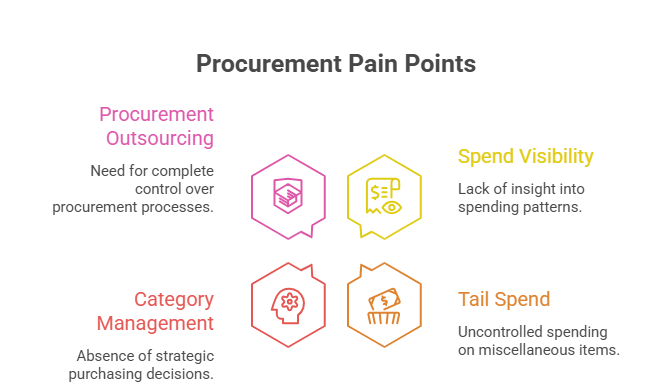
Most blogs list procurement outsourcing services like a menu. That’s backwards. You don’t buy a service. You need a solution that solves your pain. This guide flips it: four specific procurement pains, matched to the four services that actually solve them. No vendor comparison tables. No feature matrices. Just: Here’s your pain. Here’s the service. Here’s what a typical 90-day pilot looks like.
Quick Answer: 4 Pains, 4 Services, 1 Match
| Your Pain | Service That Solves It | Typical 90-Day Pilot Outcomes (Internal Benchmarks) |
| “Zero spend visibility / maverick spend / duplicate vendors” | Spend Management Outsourcing | 95%+ classification accuracy, 2x faster savings identification, 30-40% cost reduction potential |
| “Tail spend is the Wild West / 200+ vendors for 5% of spend” | Tail Spend Management Services | 70% visibility improvement, 2x consolidation speed, 40-50% tail cost reduction potential |
| “No category strategy / supplier dependency / contract leakage” | Category Management Outsourcing | High category accuracy, 30-40% sourcing delay reduction, 50% sourcing expense reduction potential |
| “Need full procurement ownership / team bandwidth zero / transformation mandate” | End-to-End Procurement BPO | 12-hr team deployment, 30-50% cost reduction potential, $10M+ annual savings potential |
Internal benchmarks from Vserve engagements; outcomes vary by data quality, stakeholder buy-in, category maturity, and contract timing.
Decision rule: Pick the pain that keeps your CFO awake. Start there. Add adjacent services later.
The 4 Procurement Pains: Which Is Yours?
Pain 1: “We have zero spend visibility”
Root cause: Fragmented ERP data, no unified taxonomy, GL codes don’t map to categories.
Business impact: Maverick spend averages 15-20% of addressable spend (industry estimates). Duplicate vendors = paying 2-3x for same item.
Trigger: New CFO, ERP migration, audit finding, budget overrun.
Service match: spend management outsourcing, spend management consultants
Pain 2: “Our tail spend is the Wild West”
Root cause: 80% of vendors = 20% of spend. No governance below the strategic threshold. P-card abuse, catalog gaps.
Business impact: Compliance risk, inflated unit costs (30-50% premium on unmanaged categories), supplier sprawl unmanageable.
Trigger: Audit findings, P-card abuse, vendor consolidation mandate, compliance violation.
Service match: tail spend management services, tail spend management consulting company, tail spend management consultants, tail spend management consulting
Pain 3: “Category strategy doesn’t exist, we just buy”
Root cause: Internal team is tactical (POs, invoices). No deep category expertise (IT, MRO, logistics, packaging).
Business impact: Suboptimal contracts, missed market shifts, single-source dependency, contract leakage.
Trigger: Contract renewals, cost overruns, supplier consolidation, new category emergence, maverick spend.
Service match: category management outsourcing, category management services, category management consultants, category management consulting
Pain 4: “We need full procurement ownership”
Root cause: Transformation mandate, PE ownership, new facility, M&A, team bandwidth zero.
Business impact: Operational paralysis, cost leakage across S2C and P2P, no strategic bandwidth.
Trigger: New CPO, PE investment, rapid scaling, digital transformation, supply chain disruption.
Service match: procurement outsourcing services, procurement outsourcing companies in usa, procurement outsourcing companies, procurement outsourcing providers
Service Comparison Matrix: What Each Actually Solves
| Criteria | Spend Management | Tail Spend Management | Category Management | End-to-End BPO |
| Primary Pain Solved | Visibility & classification | Consolidation & compliance | Strategy & negotiations | Full operational ownership |
| Scope | Analytics, dashboards, savings ID | Vendor rationalization, catalog enablement | Category strategy, supplier portfolio, negotiations | S2C + P2P end-to-end |
| AI Role | Classification, anomaly detection, taxonomy | Pareto analysis, catalog mapping, savings detection | Demand forecasting, supplier clustering, pricing analysis | Orchestration across all workflows |
| Human Roleย | Validate insights, prioritize savings, build business case | Negotiate consolidations, manage suppliers, compliance | Strategic negotiations, category planning, stakeholder alignment | Dedicated specialists per function |
| Deployment | 2-4 weeks analytics setup | 12-24 hrs specialists, 8-12 wks consolidation | 6-8 weeks strategy + execution | 12 hrs team, 90 days steady state |
| Typical Buyerย | CFO, Finance Director | Procurement Manager, P2P Lead | Category Director, CPO | CPO, COO, PE Operating Partner |
| Pricing Model | Project / Retainer | FTE / Outcome-based / Gain-share | Retainer / Project / Hybrid | FTE / Retainer / Outcome-based |
| What’s NOT Included | No negotiations, no PO execution | No category strategy, no strategic sourcing | No P2P execution, no invoice processing | No corporate strategy, no CPO replacement |
| Vserve Differentiatorย | Custom taxonomy + UNSPSC mapping | AI catalog enablement + Pareto roadmap | Vertical-specialized analysts (IT/MRO/Logistics) | 40% faster ERP integration |
Internal benchmarks; actual timelines vary by environment complexity.
When You Need End-to-End Procurement BPO
The Pain: “We need full procurement ownership”
Trigger events: PE ownership, rapid M&A, new facility launch, CPO vacancy, digital transformation mandate.
The Solution: What End-to-End BPO Actually Delivers
Vserve’s End-to-End Procurement BPO combines Source-to-Contract (S2C) and Procure-to-Pay (P2P) under one managed service. Not “staff augmentation.”
| S2C Functions | P2P Functions |
| Supplier identification & evaluation | PO creation & expediting |
| RFQ/RFP management | Invoice processing & vendor reconciliation |
| Category strategy & spend optimization | AP intake & exception routing |
| Supplier risk & compliance | PO tracking & supplier follow-ups |
AI + Human Loop: AI orchestrates workflows (supplier discovery, RFQ distribution, PO routing, exception flagging). Human specialists validate, negotiate, and manage relationships. 40% faster ERP integration via pre-built connectors (SAP, Oracle, Coupa, Ariba, NetSuite, Dynamics).
Internal benchmark; integration speed depends on ERP landscape and data readiness.
Example Client Scenario: Multi-ERP Retailer: Get Visibility to Control in ~90 Days
Situation: $850M retailer, 3 ERPs (post-acquisition), 4-person procurement team, zero spend visibility, 200+ unmapped vendors.
Engagement Diary (Illustrative):
– Week 1: Pain diagnosis โ full ownership mandate + visibility gap = E2E BPO + Spend Mgmt
– Week 2: Rapid team deployment (8 specialists: Sourcing 2, P2P 2, Analytics 2, Category 1, Lead 1)
– Week 4: Spend analytics live โ high classification accuracy, duplicate spend identified
– Week 8: S2C workflows running โ sourcing cycle time reduction
– Week 12: P2P steady state โ invoice exception reduction, faster PO cycle
Typical 90-Day Outcomes: Multi-million addressed savings. The team scaled to 14 FTEs. CFO gains real-time dashboard.
When You Need Category Management Outsourcing
The Pain: “Category strategy doesn’t exist, we just buy”
Trigger events: Contract renewals, cost overruns, supplier consolidation, new category emergence, maverick spend.
The Solution: What Category Management Actually Delivers
Category management โ strategic sourcing. Sourcing is an event. Category management is ongoing ownership.
| Ongoing Ownership Includes | One-Time Sourcing Does Not |
| Category strategy & roadmap | RFQ execution only |
| Supplier portfolio optimization | Single negotiation |
| Spend visibility management | No ongoing tracking |
| Performance reporting & KPIs | No governance |
| Continuous market intelligence | Point-in-time data |
| Contract compliance monitoring | File and forget |
Vserve’s Vertical-Specialized Analysts:– IT/Software: License optimization, SaaS governance, cloud spend
– MRO/Industrial: Reliability data, vendor consolidation, warranty management
– Logistics/Freight: Carrier scorecards, lane optimization, mode shift
– Packaging: Spec standardization, sustainability compliance, cost modeling
– Professional Services: Rate benchmarking, scope control, delivery governance
Example Client Scenario: Industrial Manufacturer – IT Category Optimization
Situation: $2B industrial manufacturer, $12M annual IT/software spend, zero licensing expertise, 40+ SaaS vendors, auto-renewals at 15% uplift.
Engagement Diary (Illustrative):
– Month 1: Category assessment โ significant unused licenses, duplicate tools, no governance found
– Month 2-3: License optimization + vendor consolidation โ tools rationalized, contracts renegotiated
– Month 4-6: SaaS governance framework + renewal calendar โ auto-renewals brought under control
– Month 7-8: Cloud spend optimization (rightsizing, reserved instances) โ cloud cost reduction
Typical Results: Significant annualized savings. High category accuracy. Internal team upskilled on governance.
When You Need Tail Spend Management Services
The Pain: “Our tail spend is the Wild West”
Trigger events: Audit findings, P-card abuse, vendor consolidation mandate, compliance violation, cost reduction mandate.
The Solution: What Tail Spend Management Actually Delivers
Tail spend โ small spend. It’s unmanaged spend, typically 80% of vendors, 20% of dollars, 100% of compliance headaches.
| Tail Spend Problem | Typical Solution | Mechanism |
| Vendor sprawl (200+ for same category) | Consolidation roadmap | Pareto analysis โ top 20% vendors = 80% tail spend |
| No catalog = maverick buying | AI-powered catalog enablement | Auto-classify requisitions โ route to approved catalog |
| P-card abuse / policy violations | Compliance monitoring + controls | Real-time policy engine + exception routing |
| No visibility = can’t negotiate | Spend analytics + benchmarking | UNSPSC + custom taxonomy โ market price comparison |
| Manual PO processing for $50 orders | Tactical buying desk | Centralized assessment โ bulk discounts + efficient fulfillment |
AI + Human Loop: AI classifies requisitions, maps to catalog, detects anomalies. Human buying desk executes consolidations, negotiates, manages suppliers.
Example Client Scenario: Healthcare System – Vendor Consolidation
Situation: Regional health system, $180M annual spend, 1,200 active vendors, 200+ in tail (MRO, office, lab supplies), P-card chaos, audit finding.
Engagement Diary (Illustrative):
– Week 1-2: Spend classification โ tail vendors identified = ~10% of spend, 80% of vendors
– Week 3-6: Pareto analysis โ Top vendors = majority of tail spend. Consolidation contracts negotiated.
– Week 7-10: Catalog enablement โ majority of tail requisitions auto-routed to approved vendors.
– Week 11-14: Compliance monitoring live โ P-card violations reduced, policy adherence improved.
Typical Results: Significant tail spend visibility improvement. Faster consolidation speed. Unit cost reduction on consolidated categories. Audit finding resolved.
When You Need Spend Management Outsourcing
The Pain: “We have zero spend visibility”
Trigger events: New CFO, ERP migration, budget overruns, audit findings, cost reduction mandate, digital transformation.
The Solution: What Spend Management Actually Delivers
Spend analysis is a diagnostic. Spend management is the ongoing capability. Most vendors sell the diagnostic. Vserve builds the capability.
| Spend Analysis (Diagnostic) | Spend Management (Capability) |
| One-time data cleanse | Continuous data governance |
| Static spend cube | Live dashboards + alerts |
| Savings report | Savings pipeline + tracking |
| Taxonomy applied once | Taxonomy evolves with business |
| Delivered as PDF/PPT | Embedded in your ERP/BI |
The Process (AI + Human):
- AI-enabled extraction: Pull spend from ERP, P-card, AP, contracts (any format)
- Automated duplicate/anomaly detection: Flag same vendor/different name, split POs, price variance
- Supplier normalization & taxonomy mapping: UNSPSC + custom hierarchy โ your GL codes
- Category benchmarking & pricing analysis: Market data + internal history โ savings hypotheses
- KPI reporting & dashboard visibility: Real-time in Power BI / Tableau / your BI tool
- Human review: Specialists validate insights, prioritize savings, build business cases
Example Client Scenario: Wholesale Distributor – Multi-ERP Spend Visibility
Situation: $3B wholesale distributor, 3 ERPs (legacy acquisitions), 47 cost centers, no unified spend view, CFO mandate: “Show me the money in 30 days.”
Engagement Diary (Illustrative):
– Week 1: Data extraction from 3 ERPs + P-card + AP โ millions of lines, thousands of vendors
– Week 2: AI classification โ high UNSPSC L4 accuracy. Human validation on edge cases.
– Week 3: Custom taxonomy built (GL โ Category โ Sub-category) โ CFO dashboard live
– Week 4: Savings pipeline: multi-million identified (duplicate vendors, volume consolidation, contract leakage)
Typical Results: High classification accuracy. Faster savings identification. Significant procurement cost reduction potential. CFO answers “what did we spend?” in seconds.
Decision Matrix: Match Your Pain to the Right Service
| If Your Top Pain Is… | Start With This Service | Add This Adjacent Service | Typical Pilot Scope (8 Weeks) |
| Zero spend visibility / maverick spend | Spend Management | Tail Spend (if vendor sprawl) | 1 ERP, 3 cost centers, top 10 categories |
| Tail spend chaos / vendor sprawl / compliance | Tail Spend Management | Spend Mgmt (if no baseline) | Top 5 tail categories, 50 vendors |
| Category gaps / supplier dependency / contract leakage | Category Management | Strategic Sourcing (if immediate events) | 1-2 strategic categories, full supplier base |
| Full procurement ownership / transformation / scale | End-to-End BPO | None needed (includes all) | 1 business unit, S2C + P2P waveform |
Decision Rules (Guidelines, Not Absolutes):
– One pain โ one service โ one pilot. Piloting multiple services simultaneously dilutes signal clarity.
– Pain 1 (visibility) is often foundational for Pains 2 & 3. Fix data first, but tail-spend control and category strategy can start with partial visibility โ industry guidance emphasizes phased analysis over all-or-nothing thresholds.
– Pain 4 (full ownership) typically includes Pains 1-3. Don’t layer services โ choose E2E if mandate is broad.
– Geography matters. US-based buyer? procurement outsourcing companies in usa = Vserve (EST/PST overlap from Coimbatore/Pasig).
Self-Assessment (Pick One):
- “I can’t answer basic spend questions” โ Spend Management
- “My tail vendors are a compliance risk” โ Tail Spend Management
- ย “We have no category strategy for key spend” โ Category Management
- “Procurement is a bottleneck to growth” โ End-to-End BPO
ROI in 90 Days: What Each Service Delivers (Illustrative)
| Service | 90-Day Savings Addressed | Ongoing Annual Savings | Indicative Deployment Cost | Typical Payback |
| Spend Management | $500K-$2M (duplicates, leakage, classification) | 30-40% procurement cost reduction | $15K-$40K (project) | 3-6 months |
| Tail Spend Management | $200K-$1M (consolidation, catalog, compliance) | 40-50% tail spend cost reduction | $20K-$60K (FTE/outcome) | 2-4 months |
| Category Management | $1M-$5M (strategic negotiations, consolidation) | 15-25% category spend reduction | $30K-$80K (retainer/project) | 4-8 months |
| End-to-End BPO | $2M-$10M+ (full S2C+P2P optimization) | 30-50% total procurement cost reduction | $100K-$300K+ (FTE fleet) | 6-12 months |
Illustrative pilot economics based on internal benchmarks; actual results depend on data quality, stakeholder buy-in, category maturity, contract renewal timing, and scope.
Caveats (Trust):
– Savings depend on: data quality, stakeholder buy-in, category maturity, contract renewal timing
– Vserve guarantees process excellence
– Pilot (8 weeks) de-risks: you see signal before scaling
– No long-term lock-in: 90-day exit, knowledge transfer standard
Quick Calculator:
- Your addressable spend ร 30% (conservative) = Annual savings potential
- Annual savings รท 12 ร 3 (90 days) = 90-day addressed savings
- Service cost (90 days) = ~15-20% of 90-day savings
5 Implementation Pitfalls (And How Vserve Addresses Them)
Pitfall 1: Treating Analytics as a Project, Not a Capability
What happens: Client buys “spend analysis project.” Gets PDF report. Six months later, data is stale, taxonomy broken, no one owns it.
Vserve approach: We build the capability. Continuous data pipeline + live dashboards + dedicated analyst ownership. You’re not buying a report โ you’re hiring a function.
Pitfall 2: Piloting Too Broad (The “Test Everything” Trap)
What happens: “Let’s pilot E2E + Category + Tail simultaneously.” 8 weeks later: no clear signal, mixed results, can’t isolate what worked.
Vserve approach: One pain, one service, 8 weeks.We refuse multi-service pilots. Signal clarity > coverage breadth.
Pitfall 3: No Internal Owner (The “Vendor Will Handle It” Myth)
What happens: Client delegates completely. No stakeholder reviews. Requirements drift. Vendor optimizes for their metrics, not yours.
Vserve approach: Mandatory internal sponsor + monthly QBR + shared OKRs. We don’t start without your named owner. Governance model in SOW.
Pitfall 4: Expecting AI to Negotiate (The “Magic Button” Fallacy)
What happens: “AI will find savings and negotiate contracts.” AI classifies, flags, forecasts. Humans negotiate. Vendors don’t sign AI-generated terms.
Vserve approach: Explicit AI+Human role definition in every SOW.AI = classification, anomaly detection, taxonomy, forecasting. Human = negotiation, relationship, judgment.
Pitfall 5: Skipping Change Management (The “Process Plug-and-Play” Fantasy)
What happens: New workflows deployed. Internal team resists. Adoption < 30%. Old workarounds persist. ROI never materializes.
Vserve approach: Change management built into deployment. Training, runbooks, super-users, adoption tracking. 90-day adoption target in every engagement.
FAQ
Diagnose Stage (Before You Engage)
1. How do I know which service I actually need?
Use the self-assessment in the Decision Matrix. Pick the pain keeping your CFO awake. If multiple pains, start with Spend Management (data foundation) or E2E BPO (if mandate is broad).
2. Can I just buy the AI analytics without the human specialists?
We don’t sell AI-only. Garbage in/garbage out is real. Our model: AI does the heavy lifting (classification, anomaly detection, taxonomy). Humans validate, prioritize, negotiate. The loop is the product.
3. What’s the minimum engagement size?
Spend Management: 1 ERP, 3 cost centers (~$15K project). Tail Spend: 50 vendors, top 5 categories (~$20K). Category Mgmt: 1 strategic category (~$30K). E2E BPO: 1 business unit (~$100K+). All include an 8-week pilot option.
Evaluate Stage (Comparing Options)
1.ย How does Vserve differ from Big 4 / Strategy firms?
Big 4 = $500K+, junior staff, strategy decks. Vserve = $6/hr, senior specialists, execution + analytics, rapid deploy. We’re the “do it” layer, not the “think about it” layer.
2.ย How does Vserve differ from SaaS spend analytics tools (Simfoni, Coupa, etc.)?
Tools give you dashboards. We give you savings. Tool: “Here’s your spend.” Vserve: “Here’s duplicate vendors, and our specialists are consolidating them this week.”
3. What if I’m outside the US?
60%+ clients are US mid-market. Teams operate EST/PST overlap from Coimbatore (India) and Pasig (Philippines). Global vendor networks supported.
Pilot Stage (De-Risking)
1. What does an 8-week pilot actually look like?
Week 1: Deploy + data access. Week 2-3: Baseline + quick wins. Week 4-6: Core workflows live. Week 7-8: Results review + scale decision. Go/No-Go at Week 8.
2. What if the pilot doesn’t work?
90-day exit clause. Knowledge transfer. Data export in your format. No penalty. We only want clients who see value.
3. How do I sell this internally to my CFO/CEO?
We give you the “Pain โ Service โ 90-Day ROI” one-pager. Your CFO speaks numbers. We translate: “Current state: $X leakage. Pilot: $Y investment. 90-day signal: $Z addressed savings. Scale: 5-10x ROI.”
Scale Stage (Post-Pilot)
1. Can we transition from one service to another?
Yes and many do. Typical path: Spend Mgmt โ Tail Spend โ Category Mgmt โ E2E BPO. Data foundation first, then specialization, then full ownership.
ย 2. What happens to our internal procurement team?
They shift from tactical (POs, invoices, vendor follow-up) to strategic (category strategy, supplier relationships, stakeholder alignment). Vserve executes; you lead.
3. How do you handle data security and IP?
ISO 27001:2013 certified. GDPR-aligned. Data never leaves your ERP/environment, we connect via secure APIs/VPN. Your data, your control.
Wrapping Up: Diagnostic Next Step
You didn’t read this far to compare features. You read it because one of those four pains sounded familiar.
Don’t guess. Take the 3-minute pain assessment.
- Which pain keeps your CFO awake?
- What’s your addressable spend?
- What’s your internal bandwidth?
We’ll send you the exact service match + 90-day pilot scope + indicative investment. No sales pitch. Just the diagnostic.