

What Is Strategic Sourcing? Process, Benefits, Frameworks & Best Practices

Last updated on July 27th, 2026

Modern enterprise organizations face continuous market pressure to optimize their vendor networks and lower operational overhead. Relying on transactional purchasing methods often leads to unpredictable supply disruptions and highly volatile pricing structures. Transitioning toward a structured framework of strategic sourcing allows companies to align their purchasing activities directly with long-term corporate growth.
Implementing these modern supply chain practices requires looking past the initial price tag of raw goods to evaluate lifetime supplier value. Successfully blending strategic sourcing and procurement principles enables procurement leaders to build durable, high-yield supplier relationships. This guide delivers a complete breakdown of processing steps, analytical frameworks, and technological advancements reshaping global procurement operations.
Table of Contents
Strategic Sourcing vs Procurement vs Purchasing
Why Strategic Sourcing Matters
The Strategic Sourcing Process
Strategic Sourcing Frameworks and Methodologies
Key Benefits of Strategic Sourcing
Common Strategic Sourcing Challenges
Strategic Sourcing KPIs and Metrics
How AI Is Transforming Strategic Sourcing
Strategic Sourcing Best Practices
What Is Strategic Sourcing?
Strategic sourcing in procurement represents a continuous, data-driven methodology used to optimize an organization’s total external expenditures. Instead of executing quick purchasing transactions, this disciplined process focuses on long-term supplier partnerships, market intelligence, and cost-reduction frameworks. Deploying strategic sourcing changes the way a business interacts with the global marketplace by prioritizing value creation over simple price reduction.
The core objective of this methodology is to minimize total acquisition costs while maximizing overall supply security and quality. By evaluating internal demand and historical spending patterns, corporations can negotiate high-value contract agreements that support comprehensive corporate goals. Incorporating modern strategic sourcing in supply chain management structures ensures that your business can survive sudden economic shifts without experiencing inventory shortages.
Strategic Sourcing vs Procurement vs Purchasing
Corporate executives often use transactional supply chain terms interchangeably, which creates significant confusion within procurement departments. Understanding the exact boundaries between buying actions, overarching acquisition strategies, and supplier management cycles is crucial for organizational clarity.
Key differences
Purchasing focuses exclusively on the transactional execution of buying goods, such as issuing purchase orders and processing vendor payments. Procurement expands on this operational workflow by managing the tactical end-to-end cycle of sourcing, contracting, and acquiring necessary business items. Meanwhile, strategic sourcing operates at a higher corporate level, focusing entirely on market analysis, long-term contract negotiation, and systemic supplier relationship development.
When each applies
Purchasing methods apply best to routine, low-risk administrative buys where item costs are standard and vendor options are highly abundant. Operational procurement frameworks apply to the daily management of regular inventory replenishment and immediate company department requests. Organizations implement deep strategic sourcing and procurement strategies when managing high-risk, high-value supply contracts that directly impact long-term corporate profitability.
Why do businesses often confuse the terms?
Most professionals confuse these concepts because they all share the ultimate operational goal of acquiring corporate goods and services. Additionally, smaller companies often combine these distinct corporate responsibilities into a single internal purchasing department due to resource limitations. This lack of structural division makes it difficult for teams to separate high-level strategy from routine clerical buying tasks.
Why Strategic Sourcing Matters
Failing to analyze your comprehensive corporate expenditure patterns regularly can obscure hidden source inefficiencies and expensive vendor waste. Taking a structured approach to supplier management helps your business navigate volatile market conditions safely and profitably.
Cost optimization
Traditional purchasing tactics only lower expenses temporarily by demanding aggressive, short-term price cuts from existing vendors. Utilizing strategic sourcing helps companies uncover permanent savings by consolidating fragmented company-wide purchase volumes with preferred vendors. This concentrated buying power allows corporate procurement teams to secure massive volume discounts and favorable long-term payment terms.
Supplier performance improvement
Relying on unverified suppliers can introduce serious product quality variations and costly logistical delivery delays. Integrating continuous strategic sourcing in supply chain management models requires establishing strict vendor performance benchmarks and clear service level agreements. This ongoing monitoring incentivizes suppliers to maintain exceptional quality standards and optimize their manufacturing timelines continuously.
Risk reduction
Modern supply networks are highly vulnerable to sudden supplier financial failures, regional labor strikes, and unexpected regulatory shifts. A methodical sourcing process requires evaluating individual vendor health, operational capacities, and geopolitical exposure before contract execution. This extensive initial screening helps protect corporate supply infrastructure from sudden operational bottlenecks or unexpected vendor bankruptcies.
Supply chain resilience
Unpredictable global disruptions can instantly compromise an organization’s ability to deliver goods to its final consumers. Developing a diversified, strategic vendor network ensures your company possesses reliable alternative production options when primary suppliers experience delays. This structural agility allows your operations to maintain stable production volumes even during major international transit crises.
The Strategic Sourcing Process
Executing a successful sourcing campaign requires moving away from informal, ad-hoc vendor selection routines. Organizations must follow a sequential, data-driven roadmap to secure optimal commercial terms and ensure complete operational alignment.
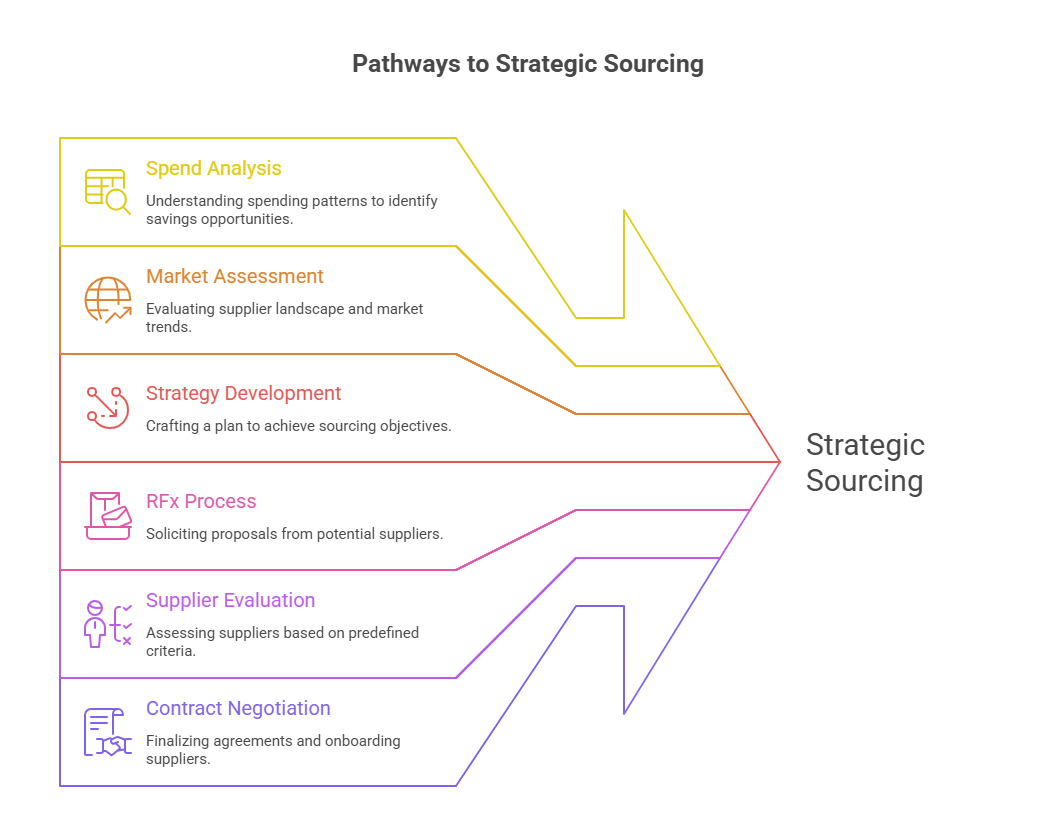
Analyze Spend and Business Requirements
The initial step requires compiling all internal historical expenditure data across every corporate department. Procurement teams review this financial data to identify exactly where capital is leaking and where purchase orders are fragmented. This detailed review clarifies internal business needs and establishes a baseline for future cost-reduction measurements.
Assess the Supplier Market
Understanding the current global supplier landscape helps procurement teams evaluate their relative purchasing leverage. Researchers examine active marketplace dynamics, vendor manufacturing capacities, and emerging regulatory trends within the target industry. This market intelligence prevents companies from setting unrealistic contract expectations or partnering with outdated manufacturing networks.
Develop a Sourcing Strategy
Organizations must decide on the exact vendor structure that best protects their financial and operational goals. Leadership determines whether to utilize a single-source partnership for deep collaboration or a multi-vendor network to minimize dependency risks. This step establishes a clear blueprint for negotiating with vendors and managing future supply demands.
Issue RFIs, RFPs, and RFQs
Procurement teams draft formal documentation to solicit structured proposals from qualified global supply candidates. Request for Information (RFI) documents gather baseline vendor capabilities, while Request for Proposal (RFP) files explore technical project solutions. Finally, Request for Quote (RFQ) sheets demand precise, itemized pricing structures to facilitate direct cost comparisons.
Evaluate and Select Suppliers
Evaluating incoming vendor proposals requires using a balanced scoring matrix rather than looking only at the lowest bid. Evaluation teams assess technical engineering expertise, financial stability metrics, sustainability practices, and cultural alignment simultaneously. This thorough screening ensures the chosen manufacturing partner can scale their operations alongside your long-term corporate growth.
Negotiate Contracts and Onboard Suppliers
Finalizing the corporate partnership requires drafting detailed legal contracts that clearly define performance expectations and pricing metrics. Legal teams establish strict payment terms, quality benchmarks, liability limits, and dispute resolution processes within the final text. Once signed, the formal onboarding process introduces the vendor to internal company workflows and communication systems.
Monitor Performance and Continuously Improve
The sourcing lifecycle continues long after the initial contract is signed and uploaded to your corporate database. Managers use routine performance scorecards to evaluate supplier delivery speeds, product accuracy ratings, and overall communication efficiency. This constant feedback loop helps discover minor operational friction points early before they damage your consumer pipeline.
 Strategic Sourcing Frameworks and Methodologies
 Strategic Sourcing Frameworks and Methodologies
Kraljic Portfolio Matrix
This classic supply chain framework categorizes corporate purchase items based on supply risk and total financial impact. The matrix divides goods into four distinct quadrants: strategic, bottleneck, leverage, and non-critical items. Mapping assets this way helps procurement teams design custom negotiation styles and risk mitigation plans for different product classes.
Total Cost of Ownership (TCO)
Evaluating an asset based solely on its initial purchase price can hide significant long-term operational expenses. The TCO methodology calculates all lifetime costs, including initial shipping fees, storage overhead, operational maintenance, and final disposal costs. This comprehensive financial view allows companies to choose vendors that deliver true, long-term profitability.
Supplier Segmentation
Not all vendors require the same level of executive management, communication frequency, or legal oversight. Segmentation strategies divide your supplier database into strategic partners, core transactional vendors, and commodity providers. This division allows procurement teams to focus their energy on high-value corporate relationships while automating routine supply lines.
Spend Analysis
This foundational data methodology extracts, cleanses, and categorizes transaction records from internal enterprise resource planning software. Spend analysis uncovers Maverick spending patterns, identifies duplicate vendor listings, and highlights immediate volume consolidation opportunities. This ongoing data analysis provides the empirical evidence needed to negotiate much stronger corporate discount agreements.
Key Benefits of Strategic Sourcing
Transitioning your company from an ad hoc buying model to a unified procurement framework provides immediate competitive advantages. Deploying a modern strategic sourcing matrix ensures your financial resources are utilized with maximum efficiency.
- Cost savings are generated continuously by consolidating fragmented purchasing volumes and eliminating expensive Maverick buying habits.
- Better supplier relationships develop as corporate buyers move away from adversarial price haggling toward long-term collaborative partnerships.
- Increased visibility into total corporate expenditures allows chief financial officers to forecast annual cash flows with extreme precision.
- Improved compliance with corporate spending rules keeps your procurement workflows fully aligned with active audit mandates.
- Greater agility and resilience allow your distribution networks to adapt swiftly to sudden geopolitical changes or regional supply shortages.
Common Strategic Sourcing Challenges
While the financial advantages of structured buying are undeniable, implementing these advanced processes introduces specific operational hurdles. Organizations must recognize these friction points early to protect their supply chains from disruption.
- Poor spend visibility caused by fragmented accounting software and unorganized receipt databases makes it difficult to analyze expenditures.
- Stakeholder alignment issues happen when independent department heads resist shifting to centralized corporate procurement agreements.
- Supplier dependency risks increase when a company relies too heavily on a single vendor for critical raw materials.
- Data quality concerns arise when manual entry mistakes corrupt inventory logs, leading to flawed market projections.
- Market volatility caused by sudden currency shifts and changing trade tariffs can quickly complicate long-term pricing agreements.
Strategic Sourcing KPIs and Metrics
To verify that your corporate vendor investments are yielding maximum value, you must monitor performance data consistently. Tracking these metrics helps validate that your strategic sourcing in supply chain management structures is optimizing organizational cash flow.
- Cost savings achieved track the direct reduction in procurement expenses secured through formal corporate negotiations.
- Spend under management measures the total percentage of corporate procurement handled through authorized sourcing channels.
- Supplier performance scorecards monitor real-time vendor delivery speeds, product defect rates, and invoice accuracy levels.
- Contract compliance tracking monitors the percentage of department purchases made using pre-approved corporate vendor agreements.
- Procurement cycle time measures the total days required to progress from the initial request to final item delivery.
How AI Is Transforming Strategic Sourcing
The rapid integration of artificial intelligence is fundamentally changing how modern corporations interact with the global supply market. Advanced software tools allow small teams to process massive amounts of market data and manage global supply networks with extreme precision.
- Supplier discovery and evaluation software scans global business registries to identify high-quality supply candidates instantly.
- Spend analytics engines automatically clean, categorize, and flag anomalies across millions of multi-department transaction rows.
- Risk monitoring tools track global news feeds and weather channels to alert managers to transit threats early.
- Contract intelligence platforms read dense legal files to highlight hidden pricing penalties and track auto-renewal deadlines.
- Predictive sourcing insights project future material price changes, allowing companies to buy inventory before market rates spike.
Strategic Sourcing Examples
Different commercial sectors use advanced buying methodologies to resolve unique operational pressures and supply vulnerabilities. Reviewing these industry-specific applications highlights the massive flexibility of modern strategic sourcing and procurement systems.
Manufacturing
A global automotive manufacturer utilized structured spend analytics to evaluate its extensive multi-tier component supply line. By consolidating its steel purchases with a few certified production plants, the corporation secured protected volume pricing during market volatility. This corporate move lowered production costs while ensuring an uninterrupted flow of parts during regional factory shutdowns.
Retail and Ecommerce
An international online fashion brand faced severe margin compression due to rising textile costs and unorganized shipping routes. The firm implemented a total cost of ownership model to analyze their product manufacturing and international air freight pipelines. Shifting production to regional manufacturing hubs dramatically reduced their total transit times and minimized warehousing overhead.
Healthcare
A large regional hospital network struggled with highly fragmented purchasing across multiple independent medical clinics. By deploying centralized procurement software, the network funneled all medical supply orders through a unified vendor contract. This volume consolidation drastically reduced item acquisition costs and guaranteed the steady availability of critical patient care products.
Strategic Sourcing Best Practices
Successfully operating an enterprise-level sourcing program requires establishing disciplined management routines across your entire corporate structure. Follow these proven implementation strategies to ensure your procurement campaigns deliver a strong return on investment.
- Cross-functional collaboration ensures that technical engineering teams and financial analysts design product specifications together.
- Data-driven decision-making prevents corporate buyers from selecting manufacturing partners based on personal relationships rather than performance data.
- Continuous supplier evaluation keeps your active vendors fully aligned with modern product quality standards and strict delivery windows.
- Risk management planning provides clear backup sourcing options for critical materials before international logistics emergencies happen.
- Technology adoption streamlines mundane administrative data tasks, allowing your core team to focus entirely on high-value vendor negotiations.
Strategic Sourcing Outsourcing: When Does It Make Sense?
Many expanding enterprises lack the internal infrastructure, specialized analytical software, and market experience required to build a world-class procurement network. Partnering with a specialized external service provider gives your firm immediate access to trained global category experts. This strategic choice allows mid-sized brands to enjoy the same volume discounts and deep market insights as massive multinational conglomerates.
Outsourcing applies best to companies facing sudden, rapid scaling demands or those entering entirely unfamiliar international manufacturing markets. When selecting a procurement partner, organizations must thoroughly review the provider’s technical security history, data protection tools, and vendor network connections. Entrusting your secondary spending categories to a certified expert frees up your internal resources to focus completely on core business goals.
Conclusion
Implementing a data-driven sourcing model is essential for achieving sustainable profitability in today’s volatile international marketplace. Shifting away from basic, short-term price haggling toward comprehensive value optimization protects your company from unexpected supply disruptions. This structured operational upgrade lowers your monthly overhead while building an agile supply framework that adapts to shifting economic trends.
Frequently Asked Questions
1. What is the difference between strategic sourcing and procurement?
Procurement is the tactical, end-to-end operational cycle used to handle daily business acquisitions, clear invoices, and manage immediate purchasing requests. In contrast, strategic sourcing is a high-level analytical process focused on long-term supplier relationship development and comprehensive market research. It provides the strategic foundation that shapes your broader corporate buying guidelines and vendor contracts.
2. What are the 7 steps of strategic sourcing?
The process begins with analyzing internal corporate spend data, followed by conducting extensive supplier market research to assess available inventory options. Next, teams create a clear sourcing strategy and issue formal RFPs to gather structured pricing proposals from global vendors. Finally, managers evaluate responses, execute detailed legal contracts, and continuously monitor real-time vendor performance using data-driven scorecards.
3. What are the key benefits of strategic sourcing?
Implementing this structured framework generates sustainable cost savings by consolidating fragmented company purchasing volumes with top-tier vendors. It also strengthens supplier collaboration, drastically reduces supply chain risks, and provides complete visibility into enterprise expenses. These operational improvements help modern businesses build the supply chain resilience needed to survive unexpected international market crises.
4. What tools are used in strategic sourcing?
Procurement teams rely on advanced spend analysis software, automated RFP distribution portals, and digital supplier relationship management dashboards. They also utilize enterprise resource planning (ERP) platforms, electronic contract repositories, and data visualization tools to monitor real-time vendor performance data. Integrating these various digital applications keeps your company-wide supply chain workflows highly transparent and efficient.
5.How does AI support strategic sourcing?
Artificial intelligence supports modern procurement by automating time-consuming data cleansing tasks and instantly identifying high-value global supplier candidates. Machine learning algorithms analyze historical transaction columns to flag maverick spending habits and predict future raw material price jumps. This predictive intelligence allows corporate teams to adjust their purchasing strategies safely before market conditions change.