


Product Data Quality: Definition, Importance, Best Practices & Improvement Strategies

Last updated on July 27th, 2026

In the modern digital retail ecosystem, the accuracy of your catalog information serves as the structural foundation for all corporate sales initiatives. Online brands can no longer rely on unverified, incomplete, or disorganized descriptions and expect to maintain buyer loyalty across highly competitive marketplaces. Failing to actively monitor your inventory records creates deep operational bottlenecks, skews your analytics dashboards, and drives shoppers directly to your competitors.
Building a scalable online presence requires shifting your focus away from basic data collection toward continuous excellence in Product Data Quality. When enterprise leadership prioritizes high informational standards, they immediately unlock greater conversion rates and improves cross-channel inventory visibility. This comprehensive guide outlines the critical operational frameworks, core descriptive metrics, and automated workflows required to build an entirely optimized, compliant, and highly profitable digital commerce catalog.
Table of Contents
Why Product Data Quality Matters
The Six Core Dimensions of Product Data Quality
Common Product Data Quality Problems
Root Causes of Poor Product Data
Business Impact of Poor Product Data
Product Data Quality Lifecycle
Best Practices to Improve Product Data Quality
How PIM, MDM, ERP, and PLM Support Product Data Quality
Measuring Product Data Quality
AI and Automation in Product Data Quality
Common Challenges and How to Overcome Them
What is Product Data Quality?
Product data quality defines the overall accuracy, completeness, and reliability of the informational records that describe your corporate inventory assets. It measures how effectively your technical specifications, marketing headlines, pricing tables, and media assets match the physical items stored inside your fulfillment centers. Maintaining a high standard ensures that both internal sales channels and external customer shopping platforms operate using the exact same catalog foundations.
Why Product Data Quality Matters
High data standards directly influence whether an online shopper clicks the buy button or abandons their shopping cart out of frustration. When online listings lack detailed measurements or clear material descriptions, buyers feel anxious and choose to look elsewhere. Maintaining clean records removes this friction and naturally creates a more transparent, confident customer experience.
Furthermore, optimized digital catalogs provide a powerful boost to your organic search engine optimization and significantly maximize digital channel revenue. Search algorithms naturally reward highly complete records with better indexing placement, making your storefront far more visible to active online shoppers. Reliable information also reduces customer product returns, protects regulatory compliance records, and dramatically improves daily internal operational efficiency.
The Six Core Dimensions of Product Data Quality
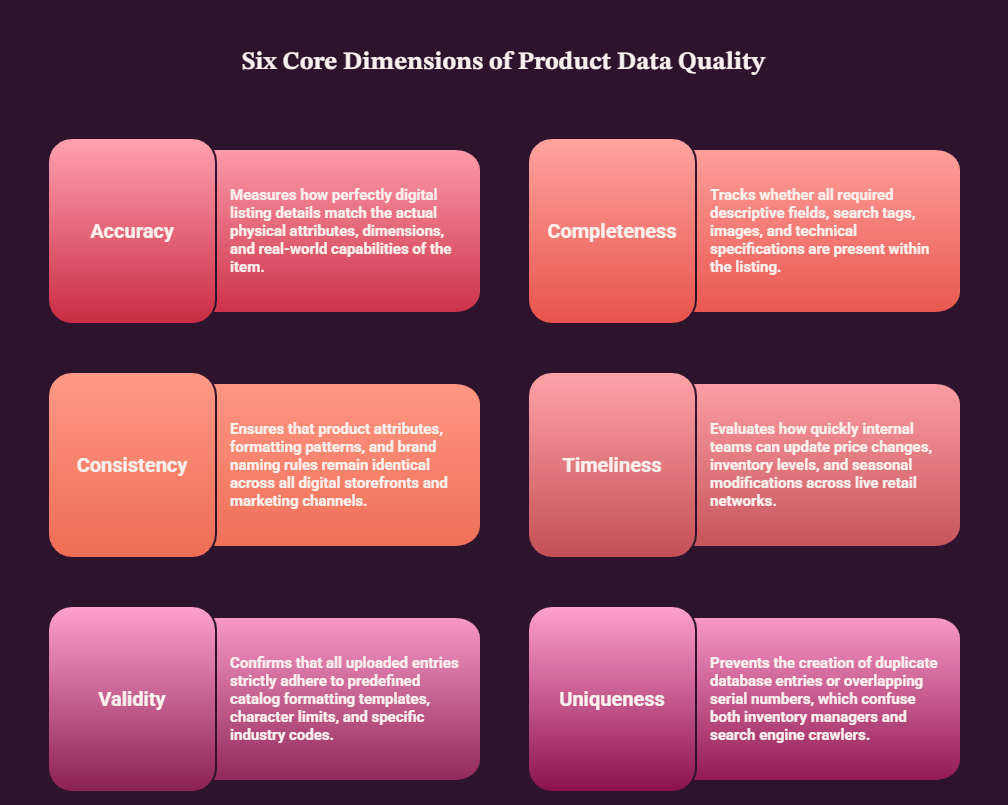
To measure the health of an enterprise catalog objectively, data architects analyze specific metric categories known as the core dimensions of data health. These distinct lenses help teams discover invisible structural defects within their internal databases before the flawed listings go live on consumer websites.
- Accuracy: This metric measures how perfectly digital listing details match the actual physical attributes, dimensions, and real-world capabilities of the item.
- Completeness: This dimension tracks whether all required descriptive fields, search tags, images, and technical specifications are present within the listing.
- Consistency: This standard ensures that product attributes, formatting patterns, and brand naming rules remain identical across all digital storefronts and marketing channels.
- Timeliness: This metric evaluates how quickly internal teams can update price changes, inventory levels, and seasonal modifications across live retail networks.
- Validity: This checkpoint confirms that all uploaded entries strictly adhere to predefined catalog formatting templates, character limits, and specific industry codes.
- Uniqueness: This safeguard prevents the creation of duplicate database entries or overlapping serial numbers, which confuse both inventory managers and search engine crawlers.
Organizations can leverage specialized e-commerce data management services to systematically grade their current inventories against these six core analytical pillars. This expert evaluation highlights hidden structural gaps and provides a clear path to optimizing your digital marketplace infrastructure.
 Common Product Data Quality Problems
 Common Product Data Quality Problems
Many growing retail brands suffer from silent catalog decay caused by inconsistent formatting practices and disjointed data pipelines. These structural issues often go unnoticed until angry consumers begin submitting bad reviews regarding inaccurate deliveries.
- Missing Attributes: Listings frequently lack critical size charts, electrical voltages, or color definitions, which immediately stalls consumer purchase momentum.
- Duplicate Records: Identical items are often entered multiple times under different names, creating major confusion for your logistics teams and search engine crawlers.
- Outdated Information: Stores accidentally display expired seasonal clearance prices, old packaging images, or discontinued manufacturing specifications to active buyers.
- Incorrect Specifications: Inaccurate weight metrics or mismatched compatibility tables lead to massive shipping errors and high order cancellation rates.
- Inconsistent Formatting: Mixing different units of measurement, like inches and centimeters, within the same collection ruins the user filtering experience.
- Supplier Data Issues: Raw, unorganized files provided by international manufacturing partners often contain broken text strings and missing field classifications.
Root Causes of Poor Product Data
Catalog errors are rarely isolated mistakes; they are almost always the direct result of broken foundational workflows within an organization. Identifying the structural source of these discrepancies allows companies to build permanent, automated solutions instead of relying on temporary manual fixes.
One of the most frequent causes of catalog fragmentation is relying on manual processes and error-prone spreadsheet entries across different internal business units. When individual departments isolate their data inside siloed systems, maintaining a unified source of operational truth becomes nearly impossible. This chaos is further complicated by managing multiple suppliers, missing governance rules, and trying to sync data across rigid legacy infrastructure. Partnering with a professional ecommerce product data entry services team helps brands eliminate these manual bottlenecks by establishing unified entry protocols.
Business Impact of Poor Product Data
The financial penalties of maintaining a messy digital catalog extend far beyond a few missed sales opportunities on your website. Informational errors trigger an expensive chain reaction that damages profit margins and strains relationships across your fulfillment network.
- Lost Sales: Confused shoppers leave your storefront immediately if they cannot find verified sizing or compatibility details for their desired items.
- Higher Return Rates: Delivering an item that looks completely different from its unoptimized online description leads to high return volumes and costly return shipping fees.
- Customer Dissatisfaction: Experiencing constant order cancellations due to inaccurate stock displays destroys brand loyalty and results in negative online reviews.
- Compliance Risks: Displaying inaccurate material warnings or incorrect weight details can result in severe financial penalties from international trade boards.
- Increased Operational Costs: Internal customer support teams waste valuable hours manually fixing order mistakes caused by incorrect product descriptions.
Product Data Quality Lifecycle
High-performing catalogs require continuous care throughout their entire corporate lifespan, from the initial draft phase to the final archive step. Sourcing support from specialized e-commerce data management services ensures that each phase of this information lifecycle remains highly efficient.
The lifecycle begins with data creation, where team members log foundational factory identifiers, baseline names, and raw manufacturing dimensions into the system. Next, enrichment marketing specialists add compelling descriptions, high-resolution lifestyle images, and search engine optimization keywords to the file. The record then passes through validation and formal approval checkmarks to confirm total alignment with corporate compliance rules before publication. Finally, continuous monitoring routines track how the information performs across live marketplaces, driving ongoing updates and continuous catalog optimizations.
Best Practices to Improve Product Data Quality
Elevating your digital catalog standards requires moving away from temporary manual fixes and embracing structured, long-term operational habits. Implementing these professional data standards allows your internal teams to scale up your inventory volumes without sacrificing descriptive accuracy.
- Standardize Attributes: Establish strict universal naming conventions, mandatory capitalization habits, and uniform units of measurement across your entire corporate database.
- Implement Validation Rules: Configure your software applications to block incomplete or incorrectly formatted entries automatically before they save to the system.
- Define Governance: Appoint dedicated catalog managers who possess clear ownership over data verification steps, category updates, and marketplace escalation paths.
- Automate Workflows: Connect your supplier data feeds directly into automated ingestion engines to eliminate manual copy-paste errors across departments.
- Conduct Regular Audits: Run scheduled database integrity scans to quickly discover hidden formatting errors, broken links, or missing fields.
How PIM, MDM, ERP, and PLM Support Product Data Quality
Enterprises rely on several specialized enterprise software systems to organize their technical specifications and manage global distribution assets. Sourcing leaders must understand the distinct functional role each application plays to ensure all platforms sync together seamlessly.
Product Lifecycle Management applications manage initial blueprints and design adjustments, while Enterprise Resource Planning systems handle transactional pricing, warehouse logistics, and physical stock volumes. Master Data Management platforms organize high-level corporate data, while Product Information Management systems serve as the ultimate editing tool for marketing teams. Utilizing professional ecommerce product data entry services ensures that your marketing descriptions, media assets, and SEO tags sync perfectly across all four technical systems.
Measuring Product Data Quality
An organization cannot optimize its catalog performance without establishing concrete, data-driven key performance indicators to track data accuracy over time. Moving away from subjective evaluations allows your management teams to address specific database weaknesses before they impact the customer journey.
- Completeness Percentage: This metric tracks the total volume of active catalog listings that possess 100% of their mandatory descriptive fields.
- Error Rate Variance: This indicator monitors the frequency of data corrections required after a listing has been published to live storefronts.
- Audit Scorecards: These regular reports grade specific product lines against your established formatting, compliance, and image resolution rules.
- Dashboard Alerts: Automated interfaces flag sudden anomalies, such as extreme price changes or duplicate listings, in real time for immediate correction.
AI and Automation in Product Data Quality
Modern artificial intelligence software enables growing brands to clean up massive databases at a fraction of the cost of legacy manual methods. Integrating these advanced digital tools allows your teams to accelerate their marketplace launch times while maintaining perfect text consistency.
Common Challenges and How to Overcome Them
Overcoming legacy data fragmentation requires a strategic combination of modern software platforms, clear internal governance rules, and expert external assistance. Many organizations struggle with low internal team alignment and lack the specialized personnel required to manage massive data migration projects.
To resolve these resource bottlenecks, smart brands partner with professional e-commerce data management services to handle their complex catalog structuring tasks. Outsourcing these repetitive formatting duties allows your internal teams to focus on strategic product innovation and core business expansion. Additionally, organizations must implement mandatory data onboarding training programs to ensure all internal departments stick to the same classification guidelines.
Product Data Quality Checklist
Executing a final verification scan across these critical parameters protects your brand from displaying embarrassing errors on public channels. Ensure your catalog operations team checks off every item on this list before pushing new listings live to production environments.
- Verify that all product names include key identifiers like brand, material, model number, and color.
- Confirm that high-resolution zoom images match the exact product color variations selected by the shopper.
- Check that all technical measurements are displayed in both imperial and metric units for international buyers.
- Review all pricing fields to confirm that global currencies and regional sales taxes are calculated accurately.
- Ensure that product schema codes are properly embedded to display live pricing details directly on Google search results.
- Test all search filters and navigation paths to ensure newly added items appear inside their correct categories.
Frequently Asked Questions
1. What is product data quality?
It represents the total accuracy, completeness, validity, and structural consistency of the informational files used to describe an enterprise’s physical inventory assets. Maintaining an exceptionally high standard ensures that your internal warehouse-tracking databases and external customer-facing websites remain perfectly synchronized.
2. How is product data quality measured?
It is measured by tracking specific operational data metrics, including listing completeness percentages, error variances, and automated database audit scores. Organizations can deploy professional ecommerce product data entry services to review their current catalogs against standard industry formatting rules.
3. What are the dimensions of product data quality?
The six core analytical dimensions are accuracy, completeness, consistency, timeliness, validity, and uniqueness. Tracking these independent metrics gives data architects a comprehensive view of overall database health and highlights hidden formatting errors.
4. How does PIM improve product data quality?
A Product Information Management application creates a single, centralized workspace where marketing teams can enrich, validate, and approve listings before publishing them. This software replaces error-prone spreadsheet processes with automated workflows, preventing inconsistent descriptions across different digital storefronts.
5. What KPIs should organizations track?
Companies must track catalog completeness rates, duplicate listing counts, data modification frequencies, product return rates caused by inaccurate descriptions, and internal support ticket volumes. Monitoring these metrics through specialized e-commerce data management services allows leadership teams to make data-driven decisions that maximize long-term profits.