

E-commerce Outsourcing Services: A Complete Guide to Scaling Operations and Maximizing ROI in 2026

Last updated on July 28th, 2026

Selling online is easier than ever, but scaling an ecommerce business has become increasingly complex. Brands must manage multiple sales channels, product catalogs, customer support, fulfillment, and real-time analytics, which can quickly overwhelm internal teams.
This complexity is driving demand for ecommerce outsourcing services, where businesses partner with specialized providers to handle key operational tasks more efficiently and at scale.
In 2026, outsourcing is no longer just a cost-saving tactic. It is a growth strategy that enables ecommerce companies to access expertise, improve efficiency, expand into new markets, and enhance customer experience.
This article covers the key aspects of ecommerce outsourcing, including frameworks, implementation roadmaps, ROI measurement, AI-driven trends, and partner selection.
Table of Contents
What Are Ecommerce Outsourcing Services?
Why More Brands Are Outsourcing in 2026
Priority-Based Ecommerce Outsourcing Framework
What Ecommerce Outsourcing Companies Typically Handle
Outsourcing vs In-House Ecommerce Operations
Offshore vs Nearshore vs Onshore Outsourcing
Step-by-Step Ecommerce Outsourcing Roadmap
The Future of Ecommerce Outsourcing with AI
What Are E-commerce Outsourcing Services?
Ecommerce outsourcing services involve delegating specific ecommerce functions to external specialists who manage operational tasks on behalf of an online business.
Outsourcing business functions can help companies improve efficiency, reduce operational burdens, and access specialized expertise that may not be available internally. Businesses increasingly use outsourcing strategies to remain competitive while focusing resources on core growth initiatives. As noted by Entrepreneur, shifting complex, daily e-commerce operations to external experts allows growing online brands to protect their margins, scale rapidly, and avoid the friction of expanding fixed in-house overhead.
Modern ecommerce outsourcing solutions provide access to trained professionals, technology platforms, and established workflows that would otherwise require significant internal investment.
Future-proof your digital storefront and maximize multi-channel ROI using our AI-driven e-commerce outsourcing framework.

Why More Brands Are Outsourcing in 2026
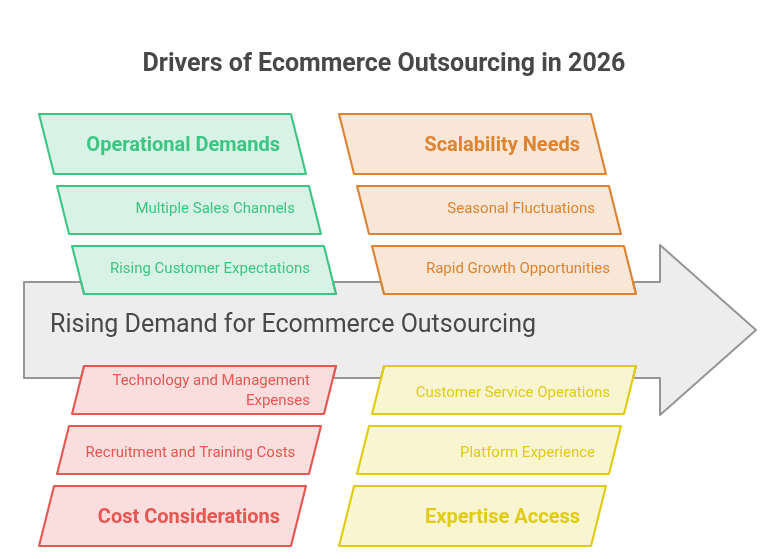
The ecommerce industry is evolving at a pace that few businesses can manage alone. What was once a straightforward online store operation now involves coordinating multiple marketplaces, maintaining consistent customer experiences across channels, managing fulfillment expectations, and leveraging data to stay competitive.
Today’s ecommerce brands are expected to handle:
- Multiple sales channels such as Shopify, Amazon, Walmart, and eBay
- Rising customer expectations for fast and accurate support
- Shorter delivery windows and fulfillment demands
- Complex inventory and supply chain management
- Cross-border selling and international marketplace expansion
- AI-driven personalization and customer engagement strategies
As operational demands increase, many businesses discover that building internal teams for every function is expensive and difficult to scale. Recruiting, training, and managing specialized staff can consume time and resources that could be invested in growth initiatives.
This is one reason the demand for ecommerce outsourcing services continues to rise. Outsourcing allows businesses to access experienced professionals without the costs of expanding in-house teams.
By working with established ecommerce outsourcing companies, brands can improve efficiency, scale operations more quickly, and focus internal resources on customer acquisition, product development, and long-term growth strategies.
Reduced Operating Costs
Building and maintaining an in-house ecommerce operations team requires significant investment in recruitment, training, salaries, technology, and management. Outsourcing helps reduce these overhead costs while providing access to experienced professionals who can support day-to-day operations.
Faster Scalability
Ecommerce demand can fluctuate throughout the year, especially during major sales events and holiday seasons. Outsourcing allows businesses to quickly scale support, catalog management, and operational resources without the delays associated with hiring and onboarding new employees.
Access to Specialized Expertise
Established outsourcing providers bring experience across ecommerce platforms, online marketplaces, customer service operations, and backend processes. Their expertise can help businesses improve efficiency, reduce errors, and implement industry best practices more quickly.
Greater Focus on Growth
When repetitive operational tasks are handled externally, internal teams can dedicate more time to activities that directly contribute to business growth. This includes strategic planning, marketing initiatives, product development, customer acquisition, and expanding into new markets.
Priority-Based Ecommerce Outsourcing Framework
One of the most common outsourcing mistakes is trying to delegate too many functions at once. Not every business has the same operational needs, and outsourcing priorities often change as a company grows.
A more effective approach is to outsource strategically based on your stage of growth. This allows businesses to address their biggest operational challenges first while maintaining control over critical processes.
| Business Stage | Recommended Priority Outsourcing Areas |
| Startup | Customer support, data entry, and catalog management |
| Growing Brand | Marketplace operations, inventory monitoring, and order management |
| Mid-Market | Analytics, customer experience optimization, omnichannel support |
| Enterprise | Global marketplace management, AI operations, and advanced reporting |
For startups, outsourcing repetitive administrative tasks can free up valuable time for product development and customer acquisition. Growing brands often benefit from delegating marketplace and order management functions as sales volume increases. Larger organizations typically focus on outsourcing specialized areas such as analytics, global operations, and AI-enhanced processes.
By following a phased approach, businesses can implement e-commerce outsourcing services more effectively, reduce operational risk, and create a scalable foundation for long-term growth.
What E-commerce Outsourcing Companies Typically Handle
The scope of modern e-commerce outsourcing services extends far beyond basic customer support. Today’s providers help businesses manage critical operational functions that directly impact efficiency, customer satisfaction, and revenue growth.
While service offerings vary, most e-commerce outsourcing companies support the following key areas:
Customer Support
Customer experience plays a major role in ecommerce success. Outsourced teams handle inquiries through email, chat, social media, and phone channels, assisting customers with order tracking, returns, refunds, product questions, and account-related concerns.
Product Catalog Management
Accurate product information is essential for maintaining customer trust and marketplace compliance. Outsourcing providers can create and update product listings, optimize descriptions, upload images, manage product attributes, and ensure catalog consistency across multiple channels.
Marketplace Operations
Managing multiple marketplaces requires ongoing attention and expertise. Outsourced specialists help maintain listings, monitor performance metrics, manage promotions, resolve account issues, and ensure compliance with platform requirements across Amazon, Walmart, eBay, Shopify, and other sales channels.
Order Processing and Fulfillment Coordination
Efficient order management helps prevent delays and improve customer satisfaction. Providers often assist with order verification, fulfillment coordination, shipment tracking, inventory updates, and issue resolution to keep operations running smoothly.
Reporting and Analytics
Data-driven decision-making is increasingly important in e-commerce. Outsourcing teams can generate reports, track key performance indicators, identify operational trends, and provide insights that support inventory planning, marketing optimization, and revenue growth strategies.
Rather than outsourcing a single function, many businesses adopt comprehensive e-commerce outsourcing solutions that combine several of these services into a streamlined operational framework. This approach improves efficiency while creating a more scalable foundation for long-term growth.
Outsourcing vs In-House Ecommerce Operations
One of the most important decisions ecommerce businesses face is whether to manage operations internally or partner with an external provider. Both approaches have advantages, but the right choice depends on factors such as budget, growth stage, operational complexity, and scalability requirements.
The comparison below highlights the key differences between outsourcing and maintaining a fully in-house ecommerce operations team.
| Factor | Outsourcing | In-House |
| Cost | Lower operational costs | Higher staffing costs |
| Scalability | Highly flexible | Slower expansion |
| Expertise | Immediate access | Requires hiring |
| Technology Access | Included in many contracts | Requires investment |
| Management Control | Shared oversight | Full control |
| Speed of Deployment | Fast | Slower |
For businesses experiencing rapid growth, ecommerce outsourcing services offer the flexibility to scale operations without compromising service quality. By leveraging specialized expertise and adaptable support resources, companies can respond more effectively to increasing order volumes, expanding sales channels, and evolving customer expectations while maintaining operational efficiency.
Offshore vs Nearshore vs Onshore Outsourcing
Businesses exploring ecommerce outsourcing services often choose between offshore, nearshore, and onshore models depending on their budget, communication needs, and operational priorities. Each approach offers distinct advantages and trade-offs that can significantly impact performance, collaboration, and overall cost efficiency.
| Model | Advantages | Considerations |
| Offshore | Lowest costs, large talent pools | Time zone differences |
| Nearshore | Similar working hours, cultural alignment | Moderate costs |
| Onshore | Maximum control and communication | Highest costs |
Many international brands choose e-commerce outsourcing providers from the Philippines because they combine cost efficiency, strong English proficiency, and extensive e-commerce experience.
Step-by-Step Ecommerce Outsourcing Roadmap
A successful outsourcing strategy is not executed overnight. It requires a structured, phased approach that ensures operational stability while gradually shifting responsibilities to external partners.
Step 1: Assess Current Operations
Begin by reviewing your existing workflows to identify bottlenecks, repetitive tasks, and areas that consume excessive time or resources. This provides clarity on what should be outsourced first.
Step 2: Define Clear Objectives
Set measurable goals that outsourcing should achieve. These may include improving response times, increasing order processing efficiency, reducing operational costs, or enhancing customer satisfaction.
Step 3: Select the Right Vendor
Evaluate potential partners based on experience, industry expertise, scalability, communication standards, and proven case studies. The right provider should align with your business goals and operational requirements.
Step 4: Transfer Knowledge
Document all key processes, including workflows, standard operating procedures (SOPs), and system access guidelines. Proper knowledge transfer ensures consistency and reduces onboarding errors.
Step 5: Launch a Pilot Program
Start small by outsourcing a limited scope of work. This allows you to test performance, identify gaps, and refine processes before full-scale implementation.
Step 6: Establish Key Performance Indicators (KPIs)
Track performance using clear metrics such as response times, order accuracy, customer satisfaction scores, processing efficiency, and revenue impact. These KPIs help measure effectiveness and accountability.
Step 7: Scale Gradually
Once the pilot phase demonstrates consistent results, expand responsibilities step by step. Gradual scaling ensures stability while maximizing the benefits of ecommerce outsourcing services.
The Future of Ecommerce Outsourcing with AI
A major gap in many existing industry discussions is the limited focus on artificial intelligence and its impact on outsourcing. In 2026, AI is no longer an emerging tool. It is actively reshaping how ecommerce outsourcing companies deliver services, improve efficiency, and support business growth.
AI is influencing outsourcing in several key areas:
- AI-Assisted Customer Support: Support teams now use AI tools to generate faster responses, summarize customer issues, and improve accuracy in handling inquiries across multiple channels.
- Intelligent Catalog Management: AI systems help detect listing errors, eliminate duplicate content, optimize product descriptions, and improve overall catalog quality at scale.
- Predictive Inventory Monitoring: Machine learning models analyze sales patterns and forecast demand more accurately, helping businesses reduce stockouts and overstocking issues.
- Automated Analytics and Reporting: Instead of manually compiling data, AI-powered systems generate real-time reports that highlight trends, performance gaps, and actionable insights.
The future of ecommerce outsourcing services will be defined by providers that successfully combine human expertise with AI-driven systems. This hybrid model allows businesses to achieve higher efficiency, better decision-making, and more scalable operations.
As a result, many ecommerce outsourcing solutions providers are already investing heavily in AI-enabled workflows to remain competitive and deliver greater value to clients.
Ecommerce Outsourcing ROI Framework
Effective ecommerce outsourcing services should deliver clear, measurable improvements in both operational efficiency and business performance. To evaluate success, companies must track key performance indicators that reflect cost efficiency, productivity, and customer experience.
Key Performance Indicators (KPIs)
| KPI | Measurement |
| Cost Savings | Percentage reduction in overall operational costs |
| Order Efficiency | Number of orders processed per employee or per team |
| Response Time | Average time taken to respond to customer inquiries |
| Catalog Accuracy | Reduction in listing errors and data inconsistencies |
| Conversion Rate | Improvement in revenue performance after optimization |
| Customer Satisfaction | CSAT and NPS score improvements |
Sample ROI Calculation
To understand the financial impact of outsourcing, consider a simple comparison:
- Annual internal operations cost: $120,000
- Annual outsourced operations cost: $80,000
Annual savings:
$120,000 – $80,000 = $40,000
ROI Calculation:
($40,000 ÷ $80,000) × 100 = 50% ROI
This means the business saves half of its outsourcing investment in direct operational cost reductions alone, not including gains from improved efficiency or revenue growth.
By applying this framework, companies can more accurately assess the real impact of ecommerce outsourcing services and ensure their investment delivers both financial and operational value.
Conclusion
Ecommerce growth in 2026 requires more than great products and effective marketing. Sustainable success depends on efficient operations that can scale alongside customer demand.
The right ecommerce outsourcing services partner can help businesses reduce costs, improve efficiency, accelerate growth, and gain access to specialized expertise. Whether through customer support, marketplace management, analytics, or AI-enabled operations, outsourcing has evolved into a strategic advantage rather than a simple cost-saving measure.
Companies that combine a clear outsourcing roadmap, measurable ROI framework, and future-focused operational strategy will be best positioned to compete in the increasingly complex ecommerce landscape.
Frequently Asked Questions
1. How long does it take to implement ecommerce outsourcing?
Implementation timelines vary based on process complexity. Smaller projects can launch within two to four weeks, while larger operational transitions may require several months for training, workflow documentation, testing, and performance validation before reaching full productivity.
2. Can outsourced ecommerce teams support multiple marketplaces simultaneously?
Yes. Many providers manage operations across Amazon, Walmart, eBay, Shopify, and other channels. Dedicated teams often use centralized systems to maintain consistency, monitor performance, update listings, and coordinate order processing across multiple marketplaces.
3. What security measures should businesses require from outsourcing providers?
Businesses should verify access controls, data protection policies, confidentiality agreements, employee training procedures, and compliance standards. Regular audits, secure communication channels, and documented incident response plans help reduce operational and cybersecurity risks.
4. Can small ecommerce businesses benefit from outsourcing?
Absolutely. Small businesses often gain the greatest advantage because outsourcing provides access to experienced specialists without the cost of building large internal teams. This allows founders to focus on growth, marketing, and customer acquisition activities.