


A Complete Guide to Ecommerce Product Data Management

Last updated on July 28th, 2026

Managing product information sounds simple until your catalog grows from hundreds to thousands of products. Suddenly, product descriptions are inconsistent, images are missing, supplier updates arrive daily, and different sales channels display conflicting information.
This is where ecommerce product data management services become essential. Effective product data management is not just about maintaining product listings. It is about creating a structured system that ensures every product attribute, image, specification, and price remains accurate across all customer touchpoints.
What Is Ecommerce Product Data Management?
Ecommerce product data management refers to the process of collecting, organizing, enriching, validating, maintaining, and distributing product information across ecommerce systems and sales channels.
Product data typically includes:
- Product titles
- Descriptions
- Specifications
- SKUs
- Categories
- Images and videos
- Pricing information
- Inventory data
- SEO metadata
- Product attributes
The goal is to establish a single source of truth that keeps product information accurate and consistent regardless of where customers interact with your products.
Accelerate your product launch speed and scale your inventory effortlessly with automated ecommerce product data entry services.
Many businesses rely on ecommerce product data management services to manage growing catalogs while maintaining quality and consistency across platforms.
Understanding the Product Data Lifecycle
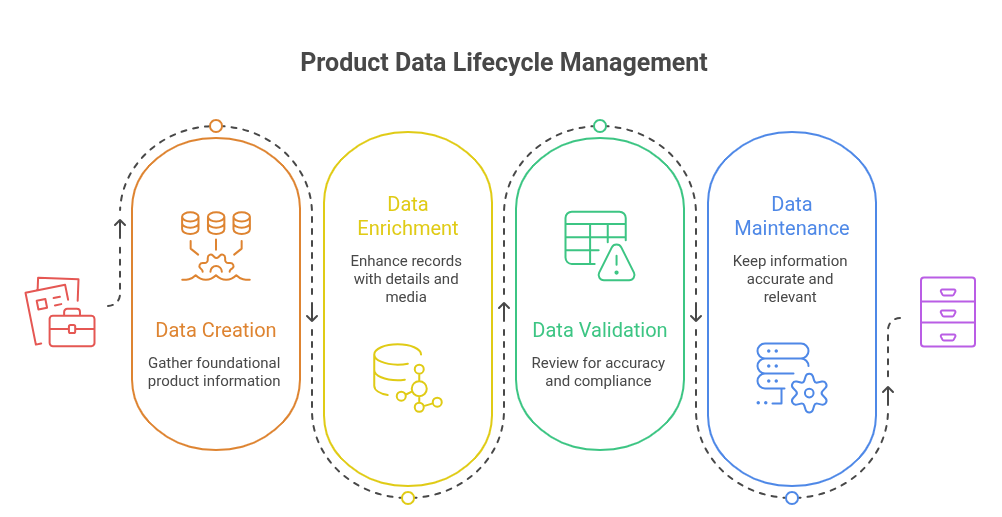
Many articles explain what product data management is, but few explore what happens to product information after it enters an organization. In reality, successful ecommerce product data management depends on a structured lifecycle that governs how product information is created, refined, maintained, and shared across every sales channel.
Without a clearly defined process, product data can quickly become outdated, inconsistent, or incomplete. This often leads to listing errors, poor customer experiences, and operational inefficiencies. High-performing ecommerce businesses avoid these issues by managing product data through five critical stages.
1. Data Creation
The lifecycle begins when product information is collected from various sources. These may include manufacturers, suppliers, distributors, ERP systems, spreadsheets, product catalogs, and internal merchandising teams.
At this stage, the goal is to gather accurate foundational information such as product names, SKUs, specifications, dimensions, pricing, and inventory details. Establishing data standards early helps prevent inconsistencies from spreading throughout the catalog.
2. Data Enrichment
Raw product data rarely provides enough information to support strong customer experiences or marketplace requirements. During the enrichment stage, businesses enhance product records with detailed descriptions, feature highlights, technical specifications, SEO metadata, images, videos, and category-specific attributes.
This process transforms basic product information into compelling, search-friendly content that helps customers make informed purchasing decisions while improving product discoverability.
3. Data Validation
Even small inaccuracies can create significant problems when managing large product catalogs. Validation ensures that product information meets established quality standards before publication.
Teams typically review records for missing attributes, duplicate SKUs, inconsistent naming conventions, incorrect specifications, formatting errors, and channel compliance requirements. Strong validation processes reduce costly mistakes and help maintain catalog integrity across platforms.
4. Data Maintenance
Product data is never static. Suppliers update specifications, prices change, inventory levels fluctuate, and new compliance requirements emerge. Ongoing maintenance ensures product information remains accurate and relevant over time.
Regular audits, automated update workflows, and continuous monitoring help businesses keep catalogs synchronized and prevent outdated information from reaching customers.
5. Data Distribution
Once product information has been enriched and validated, it must be distributed consistently across all sales channels. This includes ecommerce websites, online marketplaces, mobile applications, distributor portals, social commerce platforms, and B2B ecommerce systems.
A centralized approach ensures that every channel receives accurate and up-to-date product information while reducing manual updates and minimizing inconsistencies.
Why Product Data Quality Matters
Poor product data affects every aspect of ecommerce performance.
Common data quality issues include:
- Duplicate product listings
- Missing specifications
- Inconsistent naming conventions
- Incorrect dimensions
- Outdated inventory information
- Poor categorization
These problems create customer confusion, increase return rates, and reduce conversion rates.
Strong governance policies help prevent these issues. Organizations often establish data standards, approval workflows, ownership responsibilities, and validation procedures to ensure long-term accuracy.
Businesses investing in ecommerce product data entry services often see improvements in catalog consistency because dedicated teams focus on maintaining data quality standards.
Multi-Channel Product Data Management Challenges
As ecommerce businesses expand, managing product information across multiple sales channels becomes increasingly complex. A product may need to be listed on a website, marketplaces, social commerce platforms, and B2B portals, each with different data requirements and formatting standards. Without a centralized strategy, maintaining accurate and consistent product information across every channel can quickly become a major operational challenge.
A growing retailer may sell through:
- Shopify
- Amazon
- Walmart Marketplace
- eBay
- B2B portals
- Mobile applications
- Social commerce channels
Each platform has unique requirements for product attributes, categories, image specifications, and product feed formats. Managing this complexity manually becomes increasingly challenging as product catalogs expand and sales channels multiply. A product that contains 20 attributes on a website may require 40 or more attributes on a marketplace to meet listing standards and improve discoverability. Missing or inaccurate information can reduce visibility, negatively impact search rankings, or even prevent products from being published altogether. This is why many organizations invest in ecommerce product data management services that centralize product information, maintain consistency across channels, and automate platform-specific publishing requirements.
The Growing Role of AI and Automation
Artificial intelligence is rapidly transforming how ecommerce businesses manage product data. As product catalogs become larger and more complex, relying solely on manual processes can slow operations, increase costs, and create opportunities for errors. AI-powered tools help businesses streamline repetitive tasks, improve data quality, and manage product information at scale with greater efficiency.
Automated Product Classification
AI can automatically categorize products based on descriptions, attributes, images, and historical catalog data, reducing the time required for manual classification while improving consistency across large inventories.
Attribute Extraction
Advanced systems can identify and extract important product details such as dimensions, materials, colors, specifications, and technical features directly from supplier documents, catalogs, and data sheets.
Duplicate Detection
Machine learning algorithms can detect duplicate SKUs, similar product listings, and conflicting records that may otherwise go unnoticed, helping maintain a cleaner and more accurate catalog.
Content Generation
AI assists with creating product descriptions, feature highlights, SEO metadata, and other content elements, enabling businesses to enrich product listings more efficiently while maintaining consistency.
Workflow Automation
Routine processes such as data validation, approval workflows, supplier updates, and catalog publishing can be automated, allowing teams to focus on higher-value activities rather than repetitive administrative tasks.
By combining automation with human oversight, businesses can improve catalog accuracy, accelerate product onboarding, and manage growing inventories more effectively. These advancements are also enabling ecommerce data entry services to handle larger product catalogs with greater speed, consistency, and scalability.
Scaling Product Data Operations
As ecommerce businesses grow, the complexity of managing product data increases dramatically. Processes that work efficiently for a catalog of a few hundred products often become difficult to sustain when product counts reach tens of thousands. Without scalable systems, standardized workflows, and strong data governance, maintaining accuracy, consistency, and speed across a growing catalog can quickly become a significant operational challenge.
As businesses scale, they often face:
- Increasing supplier feeds
- Larger product assortments
- Faster update cycles
- Additional sales channels
- Global expansion requirements
Scaling successfully requires investment in:
- Product Information Management (PIM) platforms
- Data governance frameworks
- Automation tools
- Standardized workflows
- Dedicated catalog management teams
Without these systems, product information becomes difficult to maintain, leading to operational bottlenecks.
When to Consider Outsourcing
When product catalogs expand, sales channels multiply. Managing product data can become increasingly difficult for in-house teams. What starts as a manageable task can quickly evolve into a resource-intensive operation that requires dedicated expertise, ongoing maintenance, and strict quality control. When product data management begins consuming excessive time and resources, outsourcing may become a practical and cost-effective solution.
Common signs include:
- Frequent listing errors
- Delayed product launches
- Incomplete product information
- Resource constraints
- Growing marketplace requirements
At this stage, ecommerce product data entry services can provide specialized support.
Outsourcing often includes:
- Product catalog creation
- Data enrichment
- Attribute management
- Marketplace listing management
- Product content updates
- Supplier data processing
Professional ecommerce product data entry teams help maintain consistency while allowing internal teams to focus on strategy and growth initiatives.
Conclusion
Product data is no longer a back-office function. It is a strategic asset that directly influences discoverability, conversions, customer satisfaction, and operational efficiency.
Businesses that understand the full product data lifecycle, implement strong governance, manage multi-channel complexity, leverage AI, and build scalable processes gain a significant competitive advantage.
As catalogs expand and sales channels multiply, investing in ecommerce product data management services, ecommerce product data entry services, and ecommerce data entry services becomes increasingly valuable. The organizations that treat product information as a growth engine rather than an administrative task are the ones best positioned to scale successfully in today’s competitive ecommerce landscape.
Frequently Asked Questions
1. How often should ecommerce product catalogs be audited?
Most businesses benefit from quarterly catalog audits. High-volume retailers and marketplace sellers may require monthly reviews to identify missing attributes, pricing inconsistencies, duplicate products, and outdated specifications before they impact customer experience or sales performance.
2. What is the difference between PIM and product data management?
Product data management refers to the overall process of maintaining product information, while a Product Information Management (PIM) system is the software platform used to centralize, organize, enrich, and distribute that information across multiple channels and teams.
3. Can product data management improve marketplace rankings?
Yes. Complete and accurate product information improves listing quality, search relevance, filtering accuracy, and customer engagement. Many marketplaces reward well-structured product data with better visibility and improved discoverability within search results and category pages.
4. What metrics should businesses track for product data performance?
Important metrics include attribute completeness, duplicate record rates, listing approval rates, product launch speed, data accuracy scores, marketplace compliance rates, return rates related to inaccurate information, and catalog update turnaround times.