

Accounts Receivable for Manufacturing: Best Practices, Automation, and Strategies to Improve Cash Flow

Last updated on September 1st, 2026

Managing order-to-cash cycles across complex industrial production models requires strict financial discipline and structural operational controls. Executive leaders routinely balance raw material procurement costs against extended credit terms extended to commercial buyers. Implementing specialized accounts receivable services for manufacturing companies enables finance leaders to unlock trapped working capital and maintain cash flow stability.
The Association for Financial Professionals notes that companies generally should aim for a Days Sales Outstanding (DSO) below 45 days, as lower DSO supports steadier cash flow and greater access to working capital. For manufacturers, automating collections, payment matching, reconciliation, and receivables workflows can help reduce manual bottlenecks, accelerate cash conversion, and improve visibility into outstanding invoices. By combining clear credit policies, proactive collections, accurate invoicing, and technology-enabled AR processes, manufacturers can strengthen liquidity, reduce working-capital pressure, and support sustainable growth.

vservesolution
Why Accounts Receivable Is More Complex for Manufacturers
Managing revenue streams in industrial sectors involves far more administrative friction than standard retail or service billing models. Complex supply chains, multi-tiered commercial agreements, and custom production runs create distinct financial intricacies that demand specialized handling.
High-Volume Invoicing
Industrial facilities generate thousands of line-item receipts, freight addendums, and material surcharges across daily shipments. Processing these transactions manually creates administrative bottlenecks that delay invoice dispatch and increase error rates. Automated data capture tools prevent billing backlogs from stalling incoming revenue.
Partial Shipments and Split Billing
Backorders and phased production cycles frequently force plant managers to dispatch partial orders to maintain client assembly timelines. Generating distinct bills for each partial delivery complicates matching against original purchase orders for client accounts payable teams. Precise reconciliation workflows ensure every split shipment receives rapid validation and payment.
Distributor and Dealer Networks
Manufacturers sell through multi-tier distribution networks governed by varied rebate schemes, volume discounts, and co-op advertising allowances. Tracking separate credit limits and contract terms across hundreds of independent dealers demands continuous oversight. Centralized ledger monitoring prevents unauthorized credit extensions across high-risk dealer channels.
Customer Deductions and Chargebacks
Commercial buyers frequently withhold payments for short shipments, damaged goods, or perceived compliance infractions. Resolving these disputed balances requires cross-referencing bills of lading, quality assurance logs, and receiving reports across departments. Prompt deduction management recovers revenue that would otherwise linger in unresolved balance buckets.
Long Payment Cycles
Industrial supply agreements routinely mandate Net 60, Net 90, or extended milestone-based payment windows. These prolonged credit terms force producers to fund ongoing working capital and raw material procurement out of pocket. Streamlining invoice validation helps manufacturers collect precisely on due dates without compounding credit delays.
Multi-Location and Global Operations
Operating multiple plants and international subsidiaries introduces multi-currency conversions, regional tax compliance, and cross-border banking rules. Consolidating ledger data across distinct production sites requires robust centralized accounting governance. Seamless operational alignment ensures enterprise-wide liquidity visibility across all global divisions.
Implement specialized accounts receivable strategies for manufacturing to accelerate collections, reduce DSO, and protect your cash flow.
Common Accounts Receivable Challenges in Manufacturing
Manufacturing finance departments face structural operational hurdles that hinder timely collections and accurate ledger reconciliation. Identifying these friction points enables operations leaders to modernize billing workflows effectively.
- Manual invoicing: Relying on manual data entry from paper bills of lading creates billing errors and delays invoice delivery to commercial clients.
- Payment delays: Extended payment terms combined with customer approval friction cause working capital shortages and strain supply chain liquidity.
- Cash application issues: Unapplied remittances and missing remittance advice leave open balances unmatched in central accounting systems.
- Invoice disputes: Unresolved customer chargebacks and short payments stall collections while finance teams manually trace order discrepancies.
- Credit risk management: Inadequate buyer credit evaluations expose the enterprise to high bad debt write-offs during economic downturns.
- Limited payment visibility: Fragmented reporting across disconnected plant locations prevents executive leaders from accurately forecasting short-term cash flow.
Outsourcing accounts receivable gives manufacturers access to specialized expertise, streamlined processes, and better payment visibility without adding pressure to internal finance teams. By improving collections, cash application, dispute resolution, and credit management, an experienced AR partner can help accelerate cash flow, reduce risk, and make outsourcing a worthwhile investment.
Manufacturing Accounts Receivable Process (Step-by-Step)
A structured receivables lifecycle transforms raw fulfillment data into predictable cash flow. Standardizing each operational phase reduces administrative overhead and eliminates settlement friction.
Order Fulfillment
The receivables process begins when production teams complete assembly and dispatch finished goods to commercial clients. Shipping documentation, including signed proof-of-delivery receipts and bills of lading, must be logged immediately into central record systems. Timely fulfillment logging forms the legal foundation for all subsequent billing actions.
Invoice Generation
Once shipment confirmation is secured, finance systems pull accurate pricing, tier discounts, and tax liabilities to generate detailed invoices. Aligning line items precisely with buyer purchase orders prevents preliminary processing delays. Automated invoice creation eliminates manual transcription errors across complex bill-of-material lines.
Invoice Delivery
Delivering billing files through preferred electronic channels accelerates buyer receipt and authorization timelines. Many enterprise buyers require electronic data interchange (EDI) transmission or direct portal uploads for invoice ingestion. Rapid delivery reduces billing lag, giving buyers immediate access to schedule prompt payments.
Payment Collection
Proactive collection workflows track maturing invoices and send automated reminders as due dates approach. When accounts become past due, structured escalation protocols direct collection teams to contact buyer accounts payable personnel. Maintaining courteous, systematic communication preserves buyer relationships while prioritizing prompt settlement.
Cash Application
Receiving funds requires immediate matching of incoming electronic bank transfers or checks against open customer ledger balances. Advanced cash application solutions extract remittance data to settle corresponding line items automatically. Prompt application provides real-time credit visibility and keeps buyer accounts in good standing.
Reconciliation
Periodically auditing ledger balances against bank statements ensures total financial accuracy and identifies phantom discrepancies early. Reconciliation specialists verify short payments, bank fees, and currency adjustment entries across global manufacturing accounts. Regular ledger audits maintain accounting integrity and prepare the organization for external financial reviews.
Reporting and Analytics
Comprehensive financial analytics turn raw transactional histories into actionable strategic insights for executive decision-makers. Dashboard tools highlight high-risk collection trends, buyer payment patterns, and working capital performance. Leaders utilize these operational metrics to refine commercial credit terms and operational forecasts.
Benefits of Modernizing Manufacturing Accounts Receivable
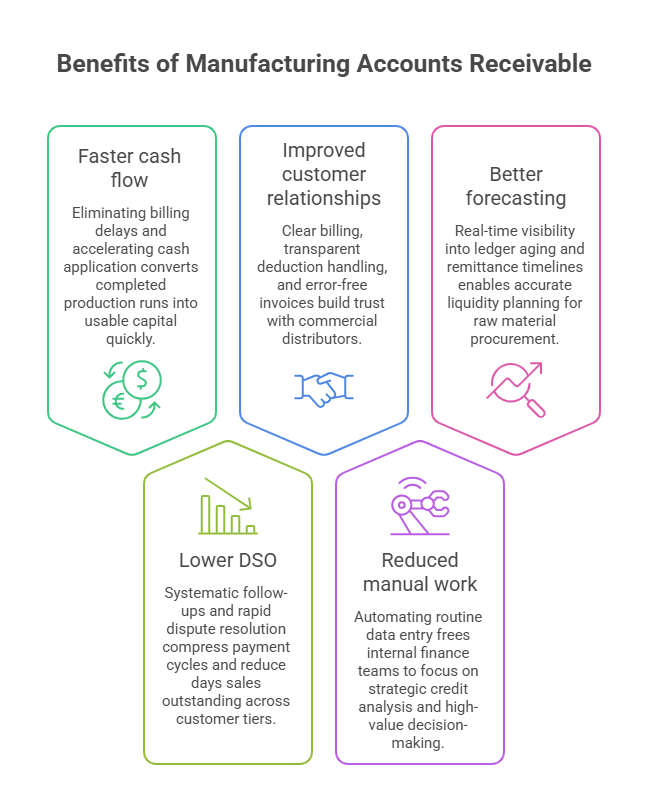
Upgrading legacy accounting workflows delivers tangible financial and operational advantages across industrial manufacturing enterprises. Embracing modern tools and structured external support drives sustainable working capital performance.
- Faster cash flow: Eliminating billing delays and accelerating cash application converts completed production runs into usable capital quickly.
- Lower DSO: Systematic follow-ups and rapid dispute resolution compress payment cycles and reduce days sales outstanding across customer tiers.
- Improved customer relationships: Clear billing, transparent deduction handling, and error-free invoices build trust with commercial distributors.
- Reduced manual work: Automating routine data entry frees internal finance teams to focus on strategic credit analysis and high-value decision-making.
- Better forecasting: Real-time visibility into ledger aging and remittance timelines enables accurate liquidity planning for raw material procurement.
Key Accounts Receivable KPIs Every Manufacturer Should Track
Monitoring specialized operational metrics allows finance leaders to diagnose collection friction and evaluate receivables productivity. Establishing precise benchmarks ensures continuous alignment with cash flow goals.
Days Sales Outstanding (DSO)
DSO calculates the average number of days required to collect revenue following a credit sale. Tracking this metric reveals overall collection efficiency and highlights emerging liquidity friction across production lines. Sustained DSO reductions directly increase cash reserves available for operational expansion.
Collection Effectiveness Index (CEI)
CEI measures the percentage of total available funds collected during a specific operational period. Unlike DSO, this metric focuses strictly on current receivables performance without skewing from sudden sales spikes. High CEI percentages reflect an aggressive, highly efficient collections team.
Average Collection Period
This indicator tracks the exact elapsed time between invoice issuance and final bank deposit clearance. Comparing this average against agreed commercial credit terms highlights non-compliant customer segments. Closing this gap prevents working capital erosion caused by habitual late payers.
Aging Reports
AR aging schedules categorize outstanding customer balances into 30, 60, 90, and 120-day overdue buckets. Analyzing aging patterns helps credit managers spot deteriorating accounts before debt becomes uncollectible. Finance teams leverage these reports to prioritize daily collection outreach efforts.
Bad Debt Percentage
Bad debt percentage calculates uncollectible account write-offs relative to total gross credit sales over a given period. Keeping write-offs low protects gross profit margins from customer insolvency events. When evaluating operational strategies, many enterprises elect to outsource accounts receivable services for manufacturing to enforce stricter credit control protocols.
Invoice Accuracy Rate
This metric measures the proportion of invoices generated without billing errors, line-item pricing discrepancies, or missing documentation. Achieving high invoice accuracy eliminates buyer dispute stalls that freeze payment processing. Error-free billing accelerates payment authorization across automated accounts payable systems.
Cash Application Rate
Cash application rate tracks how rapidly incoming payments are matched and posted to customer ledgers. High straight-through processing rates ensure buyer credit limits refresh instantly upon payment receipt. Rapid posting provides real-time liquidity visibility for executive planning teams.
Personas and Decision Makers in Manufacturing Accounts Receivable Automation
Implementing modern receivables technology requires cross-functional buy-in across enterprise leadership teams. Understanding the distinct priorities of internal decision-makers ensures smooth software rollout and operational alignment.
Chief Financial Officers focus primarily on working capital optimization, working capital forecasting, and DSO reduction. Operations leaders prioritize seamless integration between shop-floor ERP dispatch logs and billing systems to eliminate fulfillment bottlenecks. IT managers evaluate system security, native database compatibility, and technical scalability across enterprise resource planning environments. Procurement managers require real-time buyer credit standing visibility to regulate ongoing raw material allocations effectively.
Aligning these diverse executive personas around standardized receivables workflows accelerates organizational transformation. Decision-makers often decide to outsource accounts receivable services for manufacturing to relieve internal technology loads while achieving rapid process standardization. Establishing collaborative governance ensures technology implementations deliver measurable financial ROI.
Best Practices for Managing Manufacturing Accounts Receivable
Adopting proven operational strategies transforms receivables management from a reactive administrative chore into a proactive liquidity engine. Finance leaders rely on structured frameworks to maintain steady cash velocity.
- Standardize invoicing: Establish uniform billing formats, clear line descriptions, and immediate dispatch protocols upon order shipment.
- Set clear credit policies: Conduct rigorous credit evaluations and set enforceable payment limits before extending commercial credit to new buyers.
- Automate follow-ups: Deploy automated communication tools to send courteous payment reminders before invoice due dates.
- Monitor KPIs regularly: Review DSO, aging buckets, and cash application speeds weekly to spot operational friction early.
- Streamline dispute resolution: Assign dedicated personnel to investigate short payments and resolve customer chargebacks promptly.
- Integrate AR with ERP systems: Link billing platforms directly with core inventory and manufacturing modules to ensure data synchronization.
- Leverage external expertise: Choose to outsource accounts receivable services for manufacturing when internal teams lack capacity to manage complex global billing accounts.
Frequently Asked Questions
What makes accounts receivable different in manufacturing?
Manufacturing receivables involve complex line items, partial shipments, distributor rebate allowances, and frequent deduction chargebacks. Unlike simple service models, billing must mirror physical shipping records across multi-location facilities.
How can manufacturers reduce DSO?
Manufacturers reduce DSO by automating invoice delivery, shortening dispute resolution turnaround, enforcing strict credit limits, and using automated follow-ups. Deciding to outsource accounts receivable services for manufacturing also provides dedicated staff to clear backlogged balances rapidly.
Should manufacturers outsource AR or automate it?
Many enterprise organizations combine both strategies by deploying software automation while using specialized third-party experts to handle manual collections and complex disputes. Partnering with top providers for accounts receivable services for manufacturing companies delivers immediate scalable expertise without heavy internal overhead.
Which KPIs matter most for manufacturing AR?
Days Sales Outstanding (DSO), Collection Effectiveness Index (CEI), AR aging buckets, and invoice accuracy rates offer the clearest picture of health. Tracking these metrics consistently helps finance leaders identify bottlenecks before they impact cash flow.
How does ERP integration improve accounts receivable?
Integrating AR software with central ERP systems synchronizes sales orders, shipment receipts, and accounting ledgers in real time. This connection eliminates duplicate data entry, reduces billing errors, and accelerates cash application.
What role does AI play in manufacturing accounts receivable?
Artificial intelligence automates complex remittance matching, predicts customer payment defaults, and flags invalid deduction chargebacks automatically. Utilizing machine learning speeds up reconciliation while freeing staff for high-level credit governance.