

Do You Need Accounts Payable Services? Signs, Benefits, and Best Practices

Last updated on June 19th, 2026

Accounts payable has evolved far beyond simple invoice tracking. Today, businesses rely on structured financial workflows, automation, and outsourced expertise to maintain efficiency and control costs. As organizations scale, managing vendor payments, invoice approvals, and compliance becomes increasingly complex. This is where accounts payable services come in.

Accounts payable represent a company’s short-term liabilities arising from goods or services received but not yet paid for, making it an essential part of managing working capital and overall financial stability. This is why many companies are now exploring modern accounts payable services to streamline operations and reduce financial risk.
In this guide, we will break down when businesses need AP support, how different service models compare, and how to implement them effectively.
Table of Contents
Understanding the Role of Accounts Payable Services
Key Signs Your Business Needs AP Support
Decision-Making Framework for AP Adoption
Step-by-Step Implementation Guide
Operational Best Practices for AP Management
Common AP Challenges and Solutions
Understanding the Role of Accounts Payable Services
Modern accounts payable services are designed to manage the entire invoice-to-payment lifecycle. This includes invoice capture, validation, approval routing, and payment execution. Businesses today often combine internal teams with external support to improve accuracy and speed.
For growing companies, especially in fast-moving sectors, accounts payable outsourcing for the e-commerce industry has become a strategic solution to handle seasonal spikes in transactions and supplier complexity.
Key Signs Your Business Needs AP Support
There are clear warning signs that indicate a need for structured accounts payable services:
- Frequent late payments causing vendor dissatisfaction
- Increasing invoice backlog with no clear resolution timeline
- Rising processing costs due to manual handling
- Limited visibility into financial obligations
When these issues persist, businesses often turn to accounts payable processing services to restore control and efficiency.
Companies experiencing rapid growth also adopt 24/7 accounts payable processing to prevent delays caused by time zone differences or workload bottlenecks. Similarly, businesses in high-volume retail often require accounts payable outsourcing for the ecommerce industry to keep up with fluctuating order cycles.
Scale accounts payable operations efficiently through outsourced support and improved vendor management
Decision-Making Framework for AP Adoption
Before implementing accounts payable services, businesses should evaluate five key factors:
- Invoice volume per month
- Number of active suppliers
- Internal AP staffing capacity
- Payment complexity and compliance requirements
- Growth trajectory over the next 12 to 24 months
If invoice volumes exceed internal processing capacity or approval delays become frequent, it is a strong indicator that accounts payable processing services are needed.
Businesses scaling quickly often find that 24/7 accounts payable processing is essential to maintain uninterrupted financial operations. Meanwhile, accounts payable outsourcing for the e-commerce industry is especially beneficial for companies dealing with thousands of daily transactions.
Step-by-Step Guide to Implementing Accounts Payable Services
Implementing accounts payable services successfully requires more than simply outsourcing invoice processing. Organizations must follow a structured approach that aligns people, processes, and technology to ensure a smooth transition and long-term operational efficiency. By carefully planning each phase, businesses can improve accuracy, strengthen compliance, reduce processing costs, and maximize the value of their AP services investment.
1. Assess Your Current AP Process
Conduct a comprehensive review of your existing accounts payable workflow to identify inefficiencies, bottlenecks, manual tasks, and areas for improvement.
2. Document Existing Workflows
Map out all AP processes, including invoice approvals, exception handling procedures, payment cycles, and reporting requirements.
3. Select the Right Service Provider
Choose an accounts payable processing provider that aligns with your business needs and offers scalability, technology integration, and industry expertise.
4. Facilitate Knowledge Transfer
Ensure a smooth transition by sharing process documentation, operational requirements, and business-specific procedures with the external AP team.
5. Establish Governance and Compliance Standards
Define approval hierarchies, compliance requirements, security protocols, key performance indicators (KPIs), and service-level agreements (SLAs).
6. Integrate Systems and Automate Processes
Connect AP services with your existing ERP, accounting, procurement, and financial systems to enable seamless data flow and automation.
7. Launch and Monitor Performance
Go live with the new AP solution and closely monitor performance metrics such as invoice processing time, payment accuracy, and exception rates.
8. Optimize for Continuous Improvement
Leverage analytics, automation, and process reviews to improve efficiency over time. Many organizations implement 24/7 accounts payable processing to reduce delays, accelerate invoice approvals, and maintain uninterrupted operations.
9. Enable Industry-Specific Integrations
For ecommerce businesses, integrate accounts payable outsourcing services with inventory management, order processing, and supply chain systems to improve visibility and operational efficiency.
Operational Best Practices for Efficient AP Management
Effective accounts payable services require consistent processes, strong internal controls, and ongoing optimization. Following established best practices helps organizations improve efficiency, reduce errors, strengthen compliance, and maintain healthy supplier relationships. Whether managed in-house or through accounts payable processing services, these strategies can help businesses maximize operational performance and achieve long-term financial stability.
- Standardizing invoice submission formats
- Automating approval workflows
- Scheduling payments strategically to optimize cash flow
- Maintaining accurate vendor master data
Organizations using accounts payable processing services also enforce segregation of duties to reduce fraud risk. Continuous monitoring improves efficiency and ensures compliance.
Companies adopting 24/7 accounts payable processing benefit from faster turnaround times, and it improves scalability during peak sales seasons.
Common Accounts Payable Challenges and Solutions
Businesses often struggle with:
- Invoice duplication
- Approval bottlenecks
- Late payments
- Vendor disputes
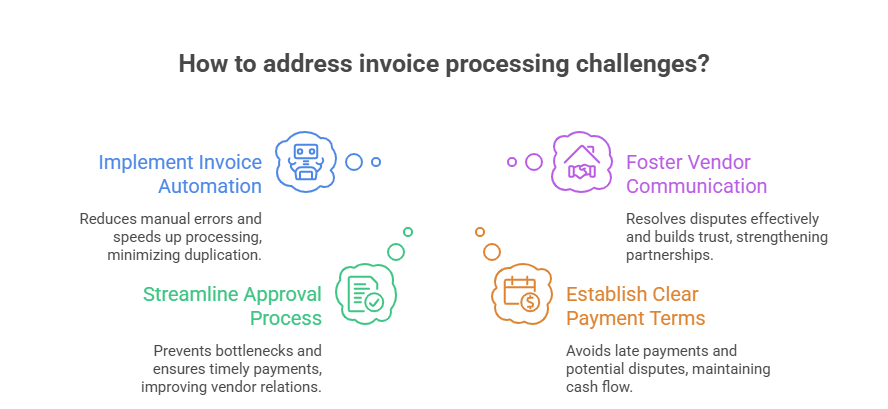
These issues usually stem from manual workflows and a lack of system integration. Implementing accounts payable services helps automate invoice tracking and approval routing.
Advanced accounts payable processing services reduce errors through validation rules and digital workflows. Meanwhile, the service helps eliminate delays caused by time constraints. For online retailers, outsourcing your accounts payable processes resolves scaling challenges during high-demand periods.
Real-World Example
A real-world example of large-scale accounts payable challenges and transformation can be seen in Deloitte’s case study on back-office finance operations, where a global organization struggled with massive invoice backlogs, delayed supplier payments, and limited process visibility due to inefficient accounts payable workflows.
In this scenario, thousands of supplier invoices accumulated because manual processes and weak workflow controls could not keep up with business growth. The result was delayed payments, strained vendor relationships, and operational disruption.
Large enterprises also adopt 24/7 accounts payable processing to ensure continuous invoice handling across time zones, while accounts payable outsourcing for the ecommerce industry helps high-volume businesses manage seasonal spikes and supplier complexity more efficiently.
Conclusion
As businesses scale, managing invoices and payments becomes more complex and time-sensitive. Adopting structured accounts payable services can significantly improve accuracy, efficiency, and financial visibility.
Through accounts payable processing services, organizations can reduce operational friction and improve vendor relationships.
Ultimately, choosing the right AP model ensures long-term financial stability and operational efficiency.
Frequently Asked Questions
1. How do accounts payable services improve cash flow management?
They help businesses track liabilities accurately, schedule payments strategically, and avoid unnecessary penalties. This improves liquidity planning and ensures better control over outgoing cash, especially when using structured AP systems.
2. Can small businesses benefit from AP outsourcing?
Yes, small businesses often gain efficiency by outsourcing invoice handling and payment processing. It reduces manual workload, improves accuracy, and allows owners to focus on growth rather than administrative tasks.
3. What technologies are used in modern AP systems?
Modern systems use automation tools, AI-based invoice recognition, cloud platforms, and ERP integrations. These technologies streamline workflows and reduce manual intervention across financial operations.
4. How do companies ensure data security in AP outsourcing?
They use encrypted systems, restricted access controls, and compliance frameworks such as SOC audits. Vendors are also evaluated based on their security certifications and internal control standards.