

KPIs in Supply Chain Outsourcing: The Essential Metrics to Measure Outsourcing Success


Last updated on September 16th, 2026

Scaling global fulfillment and procurement operations requires rigorous operational oversight across every node of your extended partner network. Enterprise leaders face intense pressure to balance working capital, mitigate disruption risks, and maintain strict service quality without expanding fixed corporate overhead. Delegating execution to specialized partners requires transitioning from passive service monitoring to proactive governance driven by supply chain outsourcing services.
According to operational benchmark research published by Buske Logistics, top-performing organizations cap total supply chain operating costs between 5% and 8% of net revenue. Establishing clear key performance indicators converts subjective vendor assessments into objective, data-driven management frameworks. This guide outlines the core metric structures, risk controls, and analytical tools enterprise decision-makers need to evaluate external partners and ensure long-term program performance.

Admin2
Why Measuring Outsourcing Performance Is Critical
Delegating operational control to third-party partners introduces structural dependencies that impact your balance sheet and customer satisfaction scores. Without clear baseline benchmarks and continuous audit cadences, organizations risk margin erosion caused by uncaptured process inefficiencies. Establishing an enterprise-level performance scorecard ensures that external service providers maintain strict alignment with your broader corporate objectives.
Measuring partner performance provides the visibility required to protect unit economics and maintain brand reputation across all customer touchpoints:
- Cost Control: Tracks invoice line items, prevents scope creep, and ensures partners meet contractual efficiency targets without hidden transaction surcharges.
- Service Quality: Enforces strict adherence to order accuracy, packaging standards, and transit timelines to safeguard the end-customer experience.
- Accountability: Establishes objective, audit-ready operational benchmarks that tie vendor compensation directly to contractual service level agreements.
- Continuous Improvement: Identifies operational bottlenecks, encouraging partners to optimize workflows, adopt automation, and eliminate waste over time.
- Risk Mitigation: Monitors operational anomalies early, enabling proactive interventions before minor supplier delays escalate into catastrophic inventory stockouts.
Turn Supply Chain Data Into Operational Control
The Four KPI Categories Every Outsourcing Program Should Track
An effective vendor management framework balances financial discipline with operational speed and systemic resilience. Enterprise decision-makers leverage supply chain outsourcing services to establish standard measurement protocols across four core functional operational pillars.
Financial Performance
Financial metrics evaluate whether an outsourcing engagement delivers expected cost efficiencies and working capital improvements. Enterprise teams measure direct process expenses alongside inventory holding costs to verify that external management improves overall operating margins.
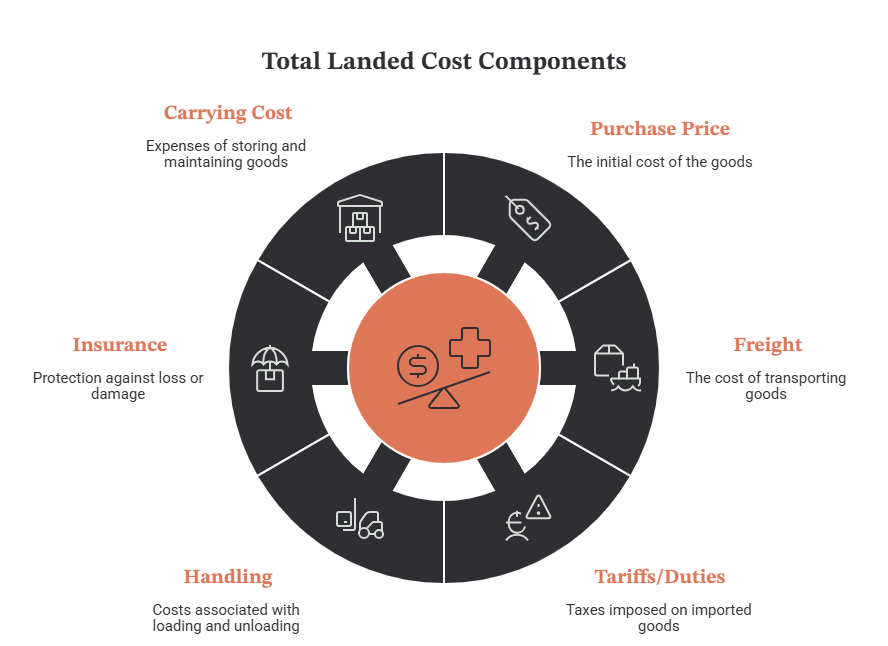
Monitoring total landed cost prevents hidden transportation and storage fees from eroding gross product margins:
- Cost Per Transaction: Measures the fully burdened operational expense incurred to process a single purchase order, warehouse pick, or shipping document.
- Working Capital Improvement: Tracks cash-to-cash cycle time reductions achieved by optimizing payment terms, safety stock levels, and receivables velocity.
- Inventory Carrying Costs: Calculates total holding expenses, including capital costs, warehouse space, insurance, taxation, and physical obsolescence.
- Total Landed Cost: Aggregates all direct and indirect expenditures required to move materials from raw suppliers to end-customer destinations.
Operational Efficiency
Operational metrics measure the speed, precision, and consistency of day-to-day fulfillment workflows. Operations executives utilize these indicators to streamline throughput, minimize lead times, and eliminate process friction across fulfillment centers.
Targeting a perfect order rate above 95% ensures that high operational speed does not compromise fulfillment accuracy:
- Order Cycle Time: Tracks elapsed time from initial buyer order placement through final warehouse dispatch and carrier departure.
- Inventory Turnover: Evaluates how many times an organization sells and replaces its average inventory balance over a specified annual period.
- Forecast Accuracy: Measures variance between projected customer demand and actual order volumes to optimize safety stock parameters.
- Perfect Order Rate: Quantifies the percentage of orders processed on time, complete, undamaged, and accompanied by correct invoice documentation.
Supplier and Logistics Performance
Supplier and carrier metrics assess how effectively external partners execute physical transportation and procurement workflows. Supply chain directors evaluate vendor reliability to stabilize upstream production schedules and protect downstream delivery windows.
Maintaining high unit fill rates prevents order backlogs and reduces expensive partial-shipment expediting charges:
- On-Time Delivery: Measures the percentage of shipments arriving at customer locations or distribution centers within designated delivery windows.
- Fill Rate: Tracks the proportion of customer order quantities fulfilled immediately from available on-hand stock without backordering.
- Lead Time Variability: Calculates standard deviation in transit and processing times to evaluate carrier and vendor consistency.
- Supplier Compliance: Audits vendor adherence to routing guides, advanced shipping notice requirements, barcoding standards, and pallet configurations.
Risk and Resilience
Risk metrics quantify an extended supply network's vulnerability to external shocks, demand spikes, and operational interruptions. Procurement leaders monitor these metrics to verify that partners maintain robust business continuity plans and redundant capacity safeguards.
Tracking disruption response time ensures partners initiate contingency plans before material shortages cripple production:
- Disruption Response Time: Measures the exact time required for an external partner to identify, report, and execute containment strategies for operational delays.
- Vendor Dependency: Evaluates concentration risk by tracking the percentage of total volume or revenue assigned to a single external provider.
- Exception Management: Tracks the frequency, root cause, and resolution velocity of shipping delays, damaged goods, or billing discrepancies.
- Compliance Performance: Monitors partner adherence to international trade regulations, labor standards, environmental codes, and industry security certifications.
Leading Indicators Versus Lagging Indicators
Relying exclusively on cost savings and quarterly margin reports creates a backward-looking management culture that leaves operations vulnerable to sudden market disruptions. Financial statements show where capital was lost, but they cannot prevent upcoming stockouts or carrier capacity crunches. High-performing organizations combine prospective leading indicators with retrospective lagging metrics to build proactive operational governance frameworks.
Leading indicators provide real-time operational signals that allow managers to adjust capacity and inventory buffers before service failures occur:
- Supplier Responsiveness: Tracks partner communication speed and acknowledgement rates for purchase order changes, RFQs, and operational inquiries.
- Forecast Accuracy: Identifies demand shift trends early, enabling procurement teams to adjust raw material orders before supply shortages materialize.
- Capacity Utilization: Monitors facility, labor, and transport equipment utilization rates to spot potential throughput bottlenecks weeks in advance.
- Exception Resolution Time: Measures how quickly operational teams resolve minor inventory variances or shipping holds before they impact delivery schedules.
Lagging indicators evaluate historical outcomes over fixed timeframes to validate macro strategic alignment and contract performance:
- Revenue Impact: Measures total top-line growth enabled by expanding market reach, improving product availability, and eliminating stockouts.
- Inventory Levels: Audits total dollar value tied up in safety stock, work-in-progress, and finished goods at the end of each accounting period.
- Customer Satisfaction: Evaluates post-delivery buyer feedback, net promoter scores, and order retention metrics across commercial segments.
- Operating Margins: Calculates net profitability improvements achieved through optimized logistics, lower labor costs, and reduced scrap rates.
Transitioning operational management toward forward-looking metrics changes the dynamic between buyers and service providers. Organizations that decide to outsource supply chain services establish shared analytics platforms to track these dual indicator sets simultaneously.
Conclusion
Building a resilient, cost-effective extended network requires moving beyond passive vendor oversight to establish rigorous, data-driven KPI frameworks. Tracking balanced metrics across financial, operational, logistics, and risk categories provides enterprise leaders with complete visibility into partner performance.
Organizations that partner with top-tier supply chain outsourcing companies combine real-time leading indicators with historical lagging benchmarks to protect operating margins. Establishing transparent governance protocols ensures your external partnerships drive continuous innovation, optimize working capital, and deliver predictable customer experiences.
Frequently Asked Questions
1. What are the most important KPIs in supply chain outsourcing?
The most critical metrics combine total landed cost, perfect order rate, on-time in-full delivery, and forecast accuracy. Balancing financial efficiency with service quality ensures partners deliver sustainable cost reductions without sacrificing customer satisfaction.
2. How often should outsourcing KPIs be reviewed?
Operational metrics like cycle times and daily order accuracy require real-time dashboard monitoring and weekly operational reviews. Strategic metrics, including landed cost trends, working capital impacts, and vendor compliance, are typically evaluated during formal quarterly business reviews.
3. What is the difference between operational and strategic KPIs?
Operational KPIs measure daily execution speed, order precision, and facility throughput across specific tactical workflows. Strategic KPIs evaluate macro financial returns, network resilience, long-term working capital gains, and overall partner relationship value.
4. Which KPIs matter most when evaluating a 3PL?
When auditing a 3PL outsourcing partner, focus on warehouse order picking accuracy, inventory record accuracy, carrier on-time delivery percentages, and dock-to-stock turnaround times. Evaluating these core metrics verifies whether a provider can handle volume spikes without operational degradation.
5. How can AI improve supply chain KPI tracking?
Artificial intelligence automates data ingestion across disparate ERPs, parses unstructured shipping notices, and provides real-time anomaly detection across partner networks. Modern supply chain solutions companies deploy predictive analytics models to forecast vendor delays and automate corrective routing decisions instantly.