

E-Procurement Catalog Challenges: Common Problems, Causes & Solutions

Last updated on August 26th, 2026

An e-procurement catalog is a structured digital collection of products and services that employees can search, compare, and purchase through an organization’s procurement platform. It typically contains product names, descriptions, specifications, supplier details, prices, part numbers, units of measure, categories, contract information, and availability.
A well-managed catalog makes purchasing faster and more controlled. Catalog quality therefore directly affects purchasing efficiency, procurement compliance, spend visibility, and user adoption.
Simply loading supplier products into an e-procurement platform, however, does not guarantee that the resulting catalog will be accurate, searchable, current, or aligned with contracts. Procurement catalog management solutions must address data quality, pricing, UOM, taxonomy, search, integration, supplier onboarding, maintenance, and compliance challenges throughout the catalog lifecycle.
A structured catalog content management approach can help organizations establish the processes needed to keep catalog information accurate and usable.

vservesolution
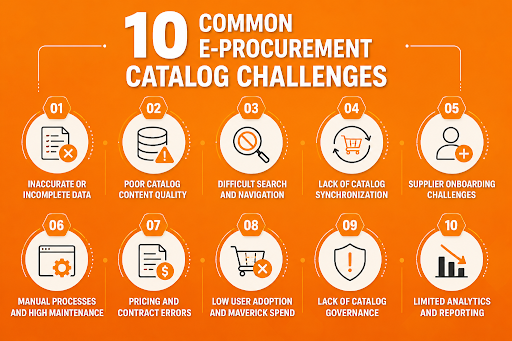
10 Common E-Procurement Catalog Challenges
E-procurement catalogs sit between suppliers, procurement teams, employees, finance, and underlying business systems. As a result, a problem in one area can affect the entire purchasing process. The following are ten of the most common challenges and their procurement catalog management solutions.
1. Incomplete or Inaccurate Product Data
Supplier information is often incomplete or inconsistent. Records may contain missing product descriptions, attributes, specifications, identifiers, or supplier information. A supplier might provide a part number but omit other technical specifications. In other cases, identifiers may contain formatting errors or differ from the identifiers used in the buyer's ERP or procurement platform. Poor data quality creates practical problems for both buyers and procurement teams.
For example, a supplier may submit a record for "Industrial Safety Gloves" with only the product name and price. If the catalog does not specify glove size, material, protection rating, or manufacturer part number, a buyer may select the wrong product even though the item appears valid in the catalog.
2. Stale Pricing and Availability Information
Catalog prices and availability can change frequently, particularly for products affected by market conditions, supplier agreements, promotions, inventory fluctuations, or contract renewals. If supplier updates are not reflected promptly, buyers may see outdated prices or products that are no longer available. This can create discrepancies between the catalog, purchase order, supplier invoice, and contracted pricing.
For example, a catalog may display a negotiated unit price of $48 while the supplier's current contract price is $52. The resulting purchase order and invoice may require manual intervention to resolve the difference.
3. Inconsistent Units of Measure and Pack Sizes
Units of measure (UOM) determine how products are ordered, priced, received, and invoiced. Common problems include confusion between case, box, and carton, or different weight and volume conventions. Suppliers may also use their own UOM terminology, making standardization more difficult.
Consider a product listed at $25 per unit. If one supplier means one item while another means one box of 10 items, comparing the two prices without understanding the UOM can produce a misleading result. A buyer may also unintentionally order 10 cases when they intended to order 10 individual items.
4. Duplicate Products and SKUs
Duplicate records can enter an e-procurement catalog when different suppliers provide the same product, when manufacturer part numbers differ from internal part numbers, or when suppliers submit slightly different descriptions for an identical item. The same product may therefore appear several times under different SKUs or supplier records.
For example, "HP LaserJet Toner 410A Black," "HP 410A Black Toner," and a supplier-specific description may refer to the same manufacturer product. Without appropriate product matching and identifier management, these records can remain separate even though they represent the same item.
5. Poor Product Categorization and Taxonomy
A catalog taxonomy determines how products are organized and how users navigate the catalog. Problems arise when suppliers use different classification structures or when products are assigned to incorrect categories. A supplier might classify an item according to its manufacturing function while the buyer organizes products according to purchasing categories. Organizations may use standards such as UNSPSC or develop internal category structures, but the classification approach must be applied consistently.
A well-designed hierarchy should allow users to move from broad categories to increasingly specific product groups without creating unnecessary complexity. Poor taxonomy can reduce search effectiveness, distort spend reporting, complicate category management, and make it harder to identify opportunities for supplier consolidation. For procurement catalog management solutions to understand the broader role of catalog content, one can also refer to the catalog content management approach for e-procurement.
6. Poor Catalog Search and Product Discoverability
Search problems commonly arise from keyword mismatches, missing synonyms, abbreviations, manufacturer part numbers, inadequate filters, and insufficient product attributes. Filters and facets can improve discoverability by allowing buyers to narrow results based on attributes. Monitoring zero-result searches is particularly useful. Repeated failed searches can reveal missing keywords, attributes, synonyms, or products.
For example, a supplier might describe a product as "ballpoint pen," while a buyer searches for "ink pen." If the catalog does not recognize synonyms, the search may return no results even though the appropriate product is available. Similarly, a supplier may use "SS304 fastener" while a buyer searches for "stainless steel 304 bolt."
7. Catalog Synchronization and Integration Problems
E-procurement catalogs often depend on information flowing between multiple systems, including ERP platforms, procurement applications, supplier eCommerce systems, integration platforms, and master-data systems. APIs, cXML, OCI, flat files, and other integration methods may be used to exchange catalog information.
The challenge is ensuring that data mapping and synchronization work consistently across these systems. Synchronization failures can therefore create data drift between the source system and the catalog. Organizations need monitoring, error handling, reconciliation, and defined synchronization schedules to detect and correct these issues.
8. Supplier Onboarding and Catalog Submission Issues
Supplier catalog onboarding can become complicated when different buyers have different data requirements or suppliers have varying technical capabilities. Large suppliers may support structured electronic catalog formats, while smaller suppliers may rely on spreadsheets or manually prepared templates.
Without standardized requirements, procurement teams may receive catalogs in multiple formats with inconsistent fields, naming conventions, UOMs, and product identifiers. A structured onboarding process should establish requirements, provide clear templates, communicate validation rules, and allow suppliers to test their submissions before publication.
Organizations managing large supplier networks can also consider broader retail procurement services practices when designing supplier-facing processes.
9. Catalog Maintenance and Version Control
Catalog management in procurement does not end when a catalog is published. Products are added, removed, replaced, discontinued, repriced, and affected by contract renewals throughout their lifecycle. Organizations need processes for adding new products, removing obsolete products, updating prices, identifying discontinued items, and maintaining catalog versions.
Update schedules should reflect supplier agreements and product characteristics, while significant changes may require approval before publishing. Version control also provides an audit trail showing what changed, when it changed, and who approved the update. Treating catalog management in procurement as an ongoing operational process rather than a one-time implementation helps maintain catalog accuracy over time.
10. Contract and Compliance Misalignment
Catalog content must reflect procurement contracts and organizational purchasing policies. A product may be technically available in the catalog but still be inappropriate if its price does not match the negotiated contract, the supplier is not approved for the buyer, or the product is restricted to a particular business unit.
If a contract ends but the associated catalog remains active, employees may continue ordering against outdated commercial terms. When catalog and contract information become misaligned, users may bypass approved channels or purchase products at non-negotiated prices. This can contribute to maverick spend, reduce purchasing leverage, and weaken compliance.
APQC's benchmarking data reports a median of 1.6% for unmanaged or maverick spend across its sample, illustrating why organizations should track this measure as part of procurement process performance. APQC also reports a median of 48% of purchase-order line items being transacted through e-procurement-enabled catalog suppliers in its benchmark dataset, making catalog usage an important metric for assessing adoption and purchasing-channel performance.
Get accurate books, timely reports, and scalable financial support from experienced professionals who understand recurring SaaS revenue models and workflows.
How to Overcome E-Procurement Catalog Challenges
The most effective approach is to treat catalog management in procurement as a controlled lifecycle rather than a data-upload exercise. They must create a feedback loop in which catalog problems are identified, corrected, and prevented from recurring.
Establish Catalog Data Standards
Organizations should define a common data model for all supplier catalogs. Standards should cover product names, descriptions, attributes, identifiers, units of measure, pricing, supplier information, and category structures.
Required fields should be clearly defined, while naming conventions and formatting rules should be applied consistently. Standardization supports better product matching and spend analysis. A structured product data management process can help organizations maintain consistency across large product datasets.
Create a Catalog Validation Process
Every catalog should pass defined validation checks before it is published. Catalog management in procurement should identify missing required fields, duplicate records, unusual prices, incorrect UOMs, invalid categories, incorrect product identifiers, and mismatches with contracts.
Validation can combine automated rules with human review. For example, a system can automatically flag a 500% price increase while a category manager reviews whether the change reflects a legitimate supplier update. This approach helps prevent poor-quality data from reaching end users.
Automate Supplier Catalog Updates
Manual catalog management in procurement becomes increasingly difficult as product counts and supplier relationships grow. APIs, integration platforms, and PunchOut connections can reduce the amount of manual intervention required.
Automated updates can synchronize prices, product information, availability, and other fields from supplier systems. PunchOut catalogs are particularly useful when suppliers maintain extensive or frequently changing product ranges because buyers can access current supplier content while still initiating the transaction through the procurement environment.
Build a Supplier Catalog Onboarding Workflow
A standardized supplier onboarding workflow ensures consistency from the start. It typically covers supplier intake, data requirements, catalog submission, field mapping, validation, testing, and buyer approval.
Once approved, the catalog can be published and continuously monitored for errors or changes. This repeatable process reduces delays, minimizes rework, and gives suppliers clear expectations for submitting accurate catalog data.
Implement Catalog Governance
Catalog management in procurement requires clear ownership across procurement, IT, suppliers, finance, category managers, and master-data teams. Procurement may own commercial requirements, while IT manages integrations and master-data teams manage data standards and quality rules.
Category managers can oversee product and contract alignment, suppliers remain responsible for accurate source information, and finance can help identify pricing or invoice discrepancies. Clear ownership in catalog management in procurement teams prevents catalog problems from becoming "everyone's responsibility but nobody's task."
Monitor Catalog Performance Continuously
Catalog performance should be measured using operational and user-behavior metrics. Organizations can track catalog error rate, search success rate, zero-result searches, catalog freshness, product completeness, price accuracy, catalog usage, off-catalog purchases, and supplier onboarding time.
These metrics provide an early-warning system. For example, a rising zero-result search rate may indicate missing product attributes or synonyms, while an increase in off-catalog purchases may indicate poor availability, pricing, or product discoverability.
Best Practices for Managing E-Procurement Catalogs
Effective catalog management in procurement operations combines data discipline with continuous operational monitoring. The following practices can help organizations keep catalogs accurate, usable, and aligned with procurement objectives.
- Treat catalog data as master data. Manage product information with the same discipline applied to other critical enterprise data, including defined standards, ownership, quality checks, and change controls.
- Define ownership. Assign clear responsibilities to procurement, IT, suppliers, finance, category managers, and master-data teams so issues can be resolved quickly.
- Standardize supplier requirements. Use consistent templates, mandatory fields, identifiers, UOMs, taxonomy rules, and submission formats across suppliers.
- Automate validation. Use automated checks to detect missing information, duplicates, invalid identifiers, pricing anomalies, and other catalog errors before publication.
- Automate updates wherever possible. Use APIs, integration platforms, PunchOut, and other electronic connections to reduce repetitive manual maintenance.
- Test catalogs before publishing. Verify search, pricing, UOM, ordering, product availability, contract terms, and integration behavior before users access the catalog.
- Monitor search behavior. Analyze unsuccessful searches, frequently used terms, synonyms, and zero-result queries to improve product discoverability.
- Review catalog performance regularly. Establish periodic reviews covering data quality, usage, pricing, supplier performance, and compliance.
- Link catalog content to contracts. Ensure products, suppliers, prices, and purchasing restrictions reflect current contractual agreements.
- Remove obsolete products promptly. Discontinued or inactive products should be removed or clearly marked to prevent accidental purchases.
- Create clear supplier SLAs. Define requirements for catalog submissions, update frequency, data accuracy, response times, and issue resolution.
Conclusion
Catalog quality is foundational to e-procurement success because every stage of the purchasing process depends on reliable product, supplier, pricing, and contract information. A catalog that is difficult to search, poorly categorized, outdated, or disconnected from contracts can reduce user adoption and increase purchasing errors and off-catalog buying.
By contrast, accurate and discoverable catalog content gives employees a clearer path to approved products while giving procurement teams greater control and visibility.The strongest approach to catalog management in procurement is to manage the catalog as a continuous lifecycle.
Organizations should treat catalog management in procurement as an ongoing governance process rather than a one-time implementation task. Regular validation, supplier collaboration, system synchronization, performance monitoring, and structured e-procurement catalog management help ensure that catalog content remains accurate, compliant, and useful as products, suppliers, prices, and contracts change.
Frequently Asked Questions
What are the most common e-procurement catalog challenges?
The most common challenges include poor product data quality, stale pricing and availability, inconsistent units of measure, duplicate products, weak taxonomy, poor search, integration problems, supplier onboarding difficulties, inadequate catalog maintenance, and contract or compliance misalignment.
Why is catalog data quality important in e-procurement?
Catalog data quality directly affects purchasing accuracy because users rely on catalog information to select the correct product, supplier, price, and quantity. Poor data can also reduce compliance and user adoption because employees may avoid a catalog they cannot trust.
What causes e-procurement catalogs to become outdated?
Catalogs commonly become outdated because of manual update processes, disconnected supplier and buyer systems, supplier product or price changes, failed integrations, infrequent synchronization, and weak governance. A catalog can also become stale when ownership is unclear and no team is responsible for monitoring changes after implementation.
How can organizations improve e-procurement catalog accuracy?
Catalog management in procurement can get improved accuracy by standardizing supplier data requirements, validating catalog submissions, matching products and identifiers, synchronizing information with source systems, linking catalog content to contracts, and establishing ongoing governance.
What is the difference between hosted and PunchOut catalogs?
A hosted catalog stores supplier product information directly within the buyer's e-procurement platform. Buyers search the platform's catalog and select products from the stored data. A PunchOut catalog connects the buyer's procurement system to the supplier's online store. The user shops through the supplier's interface, while the selected products and transaction information are returned to the procurement system.
How often should e-procurement catalogs be updated?
There is no universal update frequency in catalog management in procurement. It should depend on product type, pricing volatility, inventory changes, supplier agreements, and the frequency of supplier updates. Highly volatile categories may require frequent or near-real-time synchronization, while stable products may only require periodic updates.
How do poor catalogs increase maverick spend?
Poor catalogs can increase maverick spend when employees cannot find the products they need, see inaccurate prices, encounter unavailable products, or have difficulty navigating the approved purchasing process. They may then purchase directly from suppliers or use alternative channels.
How does catalog quality affect procurement compliance?
Accurate and contract-aligned catalog management in procurement makes it easier for employees to select approved suppliers, products, and negotiated prices. When catalogs are incomplete, outdated, or difficult to search, users may bypass the procurement system, increasing the risk of non-compliant and off-contract purchases.
How can organizations measure e-procurement catalog performance?
Organizations can track metrics such as catalog accuracy, product completeness, search success rate, zero-result searches, price accuracy, catalog usage, supplier onboarding time, and off-catalog purchases. Reviewing these metrics regularly helps identify gaps and prioritize improvements.
What role do suppliers play in catalog management?
Suppliers are responsible for providing accurate, complete, and timely product information and communicating changes to prices, availability, specifications, and discontinued products. Clear submission standards and supplier SLAs help ensure that catalog data remains reliable.