

5 Category Management Mistakes That Cost Procurement Teams Time, Money, and Supplier Performance

Last updated on September 8th, 2026

Category management is one of the most effective ways for procurement teams to align purchasing decisions with business objectives, supplier capabilities, and market conditions. However, even well-designed category strategies can lose effectiveness when execution gaps prevent procurement teams from adapting to changing requirements. Understanding the most common mistakes in category management helps procurement leaders protect margins, improve supplier performance, and maintain strategic alignment.
Effective category management in procurement extends beyond negotiating favorable supplier prices. It requires continuous analysis of demand, supplier markets, cost drivers, stakeholder requirements, and business priorities. According to ScienceDirect, category management in operational resource purchasing can increase net profit in large industrial companies by 4 to 5%, while improving logistics service levels and procurement decision-making. Organizations that need additional expertise can also work with specialized procurement outsourcing service providers to strengthen category strategy and execution without placing the entire workload on internal teams.

vservesolution
Why Category Management Fails
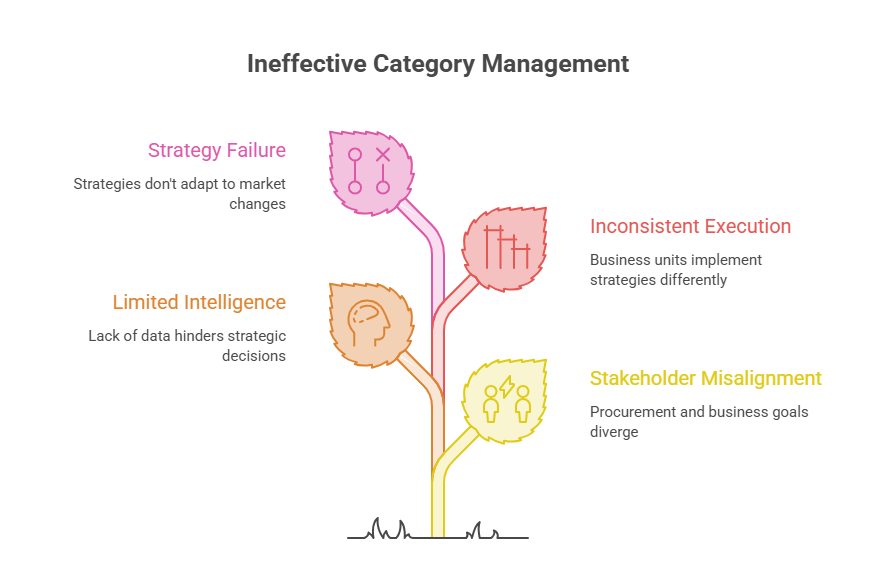
Category management fails when procurement strategies are developed as static plans instead of continuously managed business programs. Market conditions, supplier capabilities, demand patterns, and organizational priorities can change significantly after a sourcing strategy has been implemented. As a result, category management in procurement requires an operating model that allows category strategies to evolve while maintaining consistent governance.
Misalignment Between Procurement and Business Stakeholders
Organizational misalignment remains one of the most common mistakes in category management. Procurement teams may prioritize cost reduction while operations, finance, engineering, or business-unit leaders are focused on different requirements.
For example, a procurement team may negotiate lower unit prices while operational teams require greater flexibility, faster delivery, or specific technical specifications. Establishing cross-functional governance ensures category strategies reflect the broader business objectives rather than procurement metrics alone.
Limited Category Intelligence
Historical spend data provides an important foundation for category planning, but it does not explain everything happening in the supplier market. Category managers also need visibility into commodity movements, supplier capacity, demand changes, competitive conditions, lead times, and emerging risks.
When category teams rely primarily on historical purchasing records, they may continue following strategies that no longer reflect current market conditions. Combining internal spend information with external market intelligence enables more informed sourcing decisions and stronger supplier negotiations.
Inconsistent Execution Across Business Units
Large organizations frequently experience variations in purchasing behavior between business units, locations, or operational teams. Without standardized category policies, different groups may negotiate separate terms, select overlapping suppliers, or follow inconsistent procurement procedures.
This fragmentation reduces the organization's ability to leverage aggregate purchasing volumes. Standardized category playbooks, supplier frameworks, and clearly defined decision rights create consistency while still allowing appropriate flexibility for individual business requirements.
Weak Supplier Performance Governance
Negotiating a favorable agreement is only one part of effective category management. Procurement teams must continue monitoring delivery performance, quality, pricing accuracy, responsiveness, innovation, and compliance after contracts are awarded.
Without structured supplier reviews, negotiated improvements can gradually deteriorate. Supplier scorecards and recurring business reviews give category managers a systematic way to identify performance problems and address them before they affect business operations.
Failure to Adapt Category Strategies
Categories rarely remain static. New competitors, supplier consolidation, inflation, technological developments, demand changes, and evolving business priorities can all affect category economics.
A strategy that was effective when originally developed may become less competitive over time. Regular category reviews allow procurement leaders to identify emerging opportunities and adjust sourcing strategies before performance deteriorates.
Eliminate common category management mistakes with the expert team.
5 Common Category Management Mistakes
Effective category management requires continuous coordination between market intelligence, supplier capabilities, internal stakeholders, and commercial objectives. Recognizing these mistakes in category management allows procurement teams to correct structural weaknesses before they become significant financial or operational problems.
1. Treating Category Management as a One-Time Sourcing Event
Some procurement teams treat category management as a process that begins with an RFP and ends when a supplier contract is signed. However, sourcing represents only one stage of the category lifecycle.
A successful category strategy requires continuous monitoring of demand, supplier performance, cost drivers, market conditions, and business requirements. Treating the strategy as complete after contract award can cause value erosion when market conditions change.
2. Relying on Historical Spend Data Without Market Intelligence
Historical data can show what an organization purchased, from whom, and at what price. It does not necessarily explain what the organization should purchase in the future or how external conditions could affect costs.
Effective category managers combine internal purchasing records with commodity trends, supplier capacity information, market pricing, economic indicators, and other external intelligence. This broader perspective allows procurement teams to identify emerging risks and opportunities before they become urgent sourcing issues.
3. Siloed Stakeholder Engagement
Developing strategies without meaningful input from finance, operations, engineering, sales, or business-unit stakeholders can create implementation problems. Procurement may negotiate commercially attractive agreements that fail to satisfy operational requirements.
Cross-functional category teams create stronger alignment by incorporating different perspectives into the planning process. Shared objectives also make it easier to balance purchase price, quality, risk, service levels, and total cost of ownership.
4. Neglecting Post-Contract Supplier Performance
Supplier relationships require active management after agreements are finalized. Without structured performance monitoring, organizations may experience declining service levels, inconsistent quality, missed delivery commitments, or unaddressed pricing discrepancies.
Regular supplier scorecards and business reviews allow category managers to identify issues early. Key measures can include on-time delivery, quality, lead times, contract compliance, responsiveness, cost performance, and supplier innovation.
5. Failing to Leverage External Category Expertise
Organizations often manage numerous complex categories while operating with limited procurement resources. Internal teams may not always have the specialized market knowledge or bandwidth required to conduct comprehensive category analysis and supplier management.
Specialized procurement outsourcing service providers can supplement internal capabilities by providing market intelligence, supplier benchmarking, strategic sourcing support, and dedicated category expertise. This approach can be especially valuable for complex or non-core categories.
How to Avoid These Mistakes
Preventing mistakes in category management requires a repeatable operating model that connects strategic planning with sourcing execution and supplier performance. Rather than treating category strategy as an isolated procurement activity, organizations should establish governance processes that support continuous improvement.
Build a Category Strategy Framework
A standardized framework provides a repeatable process for evaluating market conditions, supplier capabilities, demand requirements, and commercial opportunities. The framework should establish category objectives, sourcing priorities, stakeholder responsibilities, supplier evaluation criteria, and performance measures.
Organizations should also distinguish between categories that require aggressive cost management, categories where supply continuity is critical, and categories where innovation or supplier collaboration creates greater value. An end-to-end category management framework can connect strategic planning, sourcing, contracting, supplier management, and ongoing performance evaluation.
Improve Spend and Market Visibility
Accurate information is essential for effective category planning. Procurement teams should consolidate purchasing data and supplement it with market intelligence to understand supplier economics, pricing movements, demand changes, and competitive conditions.
Automated analytics can help category managers identify purchasing patterns, supplier concentration, price variations, and sourcing opportunities. Better visibility allows teams to develop strategies based on current commercial conditions rather than outdated assumptions.
Establish Cross-Functional Teams
Category management should not operate as an isolated procurement function. Bringing procurement, finance, operations, engineering, and business-unit stakeholders together creates a shared understanding of category priorities.
Cross-functional teams can establish common KPIs and resolve conflicts between commercial savings and operational requirements. This collaborative approach also increases adoption because stakeholders participate in category decisions rather than simply receiving procurement policies after they are developed.
Implement Supplier Performance Dashboards
Supplier dashboards provide centralized visibility into category and supplier performance. Procurement leaders can monitor delivery performance, quality, pricing compliance, lead times, service responsiveness, and savings realization.
Automated reporting reduces the administrative effort associated with manually compiling supplier performance information. It also allows category managers to identify deteriorating performance and intervene before problems become operational disruptions.
Conduct Regular Category Reviews
Category strategies should be reviewed regularly rather than only when contracts expire. Quarterly operational reviews can identify changes in supplier performance, purchasing volumes, market prices, and business requirements.
Annual strategic reviews can then reassess supplier segmentation, sourcing models, contract structures, and future cost drivers. Organizations that lack sufficient internal resources can consider category management outsourcing to maintain consistent analytical and strategic support.
Role of AI in Preventing Category Management Mistakes
Artificial intelligence is transforming procurement from a predominantly retrospective function into a more predictive and responsive discipline. AI can process large volumes of purchasing, supplier, and market information to identify patterns that may be difficult for human analysts to detect.
Predictive Analytics
Predictive analytics can evaluate historical purchasing behavior alongside demand trends, pricing information, and external market indicators. These models help procurement teams anticipate potential changes in category costs and purchasing requirements.
For category managers, predictive analysis can improve the timing of negotiations, supplier commitments, inventory planning, and sourcing decisions. It also provides a stronger foundation for scenario planning when market conditions are uncertain.
Spend Intelligence
AI-powered spend intelligence can automatically classify transactions, identify unusual price differences, and highlight purchasing patterns across business units and suppliers.
This capability helps category managers identify opportunities that may otherwise remain hidden within spreadsheets or disconnected ERP records. Automated classification also improves the consistency and speed of category analysis.
Supplier Risk Monitoring
AI tools can continuously evaluate supplier information and identify potential financial, operational, geographic, or compliance risks. Monitoring can incorporate supplier financial indicators, delivery performance, external events, and other signals relevant to supply continuity.
Early warnings give procurement teams more time to investigate alternatives, adjust sourcing plans, or engage suppliers before disruptions affect operations.
Market Forecasting
Market forecasting tools can combine economic indicators, commodity movements, supplier capacity, freight conditions, and other external signals to support category planning.
This forward-looking perspective helps procurement teams understand potential changes in product costs and supply availability before they become immediate commercial problems.
Automated Reporting
Automated reporting can consolidate purchasing and supplier performance information across multiple systems. Instead of spending significant time preparing recurring reports, category managers can use standardized dashboards to monitor performance and focus attention on exceptions.
Modern category management services can combine these analytical capabilities with human category expertise, allowing procurement teams to use technology without losing the strategic judgment required for complex sourcing decisions.
Real-World Example: Turning Around a Failing Category Strategy
A global industrial manufacturing client with $450 million in annual indirect spend was experiencing significant margin pressure because of inconsistent category management practices. Different regional facilities were working with overlapping suppliers and applying different commercial approaches to similar maintenance, repair, and operations categories.
The procurement team also relied heavily on historical purchasing reports. Consequently, category managers had limited visibility into changing supplier costs, regional purchasing patterns, and differences in negotiated terms. These gaps made it difficult to determine whether existing strategies remained commercially competitive.
To address the problem, the organization established a centralized category governance framework supported by automated spend analytics and standardized performance metrics. Procurement, plant operations, finance, and other key stakeholders were brought into the category planning process to create stronger alignment between sourcing decisions and operational requirements.
The organization also engaged procurement outsourcing service providers to conduct supplier benchmarking, evaluate market conditions, support strategic sourcing activities, and strengthen supplier performance management, rather than focusing exclusively on unit-price reductions. The revised strategy evaluated total cost, supplier reliability, operational requirements, and long-term category opportunities.
Within 12 months, the enterprise achieved a 14.5% net cost reduction across the MRO category, totaling $18.2 million in realized annualized savings. Supplier count was rationalized by 62%, while contract compliance increased from 41% to 94% across manufacturing facilities.
The primary lesson was that category management in procurement delivers stronger results when category strategy is continuously connected to market intelligence, stakeholder requirements, supplier performance, and measurable business outcomes.
Category Management Mistake Prevention Checklist
Procurement executives can use this checklist to evaluate whether their strategies are positioned for sustainable performance:
- Strategy documented: Maintain written category roadmaps that define business objectives, market dynamics, supplier priorities, and sourcing targets.
- Stakeholders aligned: Establish cross-functional teams to ensure procurement decisions reflect operational and financial requirements.
- Spend analyzed: Consolidate purchasing information into usable category-level data to identify supplier and pricing opportunities.
- Suppliers segmented: Classify suppliers based on strategic value, financial risk, operational criticality, and performance.
- KPIs defined: Track financial and operational measures such as savings, quality, delivery, and contract compliance.
- Reviews scheduled: Establish recurring category reviews to ensure strategies remain aligned with market conditions.
- Risks assessed: Monitor supplier, market, financial, and geopolitical risks continuously.
- Technology evaluated: Assess analytics, AI, automation, and procurement platforms that can improve category decision-making.
Conclusion
Avoiding mistakes in category management requires procurement leaders to move beyond periodic sourcing events and establish continuous commercial governance. Successful category strategies connect procurement with business stakeholders, suppliers, market intelligence, and measurable performance objectives.
Technology can strengthen this process by improving purchasing visibility, predictive analytics, supplier monitoring, and automated reporting. At the same time, specialized procurement outsourcing service providers can provide additional category expertise and execution capacity when internal resources are limited.
Organizations that treat category management in procurement as an evolving business discipline are better positioned to respond to market changes, strengthen supplier relationships, and protect commercial performance. By combining structured governance, reliable data, cross-functional collaboration, and ongoing supplier management, procurement teams can turn category strategies into sustainable sources of business value.
Frequently Asked Questions
What is the biggest category management mistake?
The biggest mistake is treating category management as a one-time tactical sourcing event. Effective category strategies require ongoing supplier management, market analysis, stakeholder alignment, and performance monitoring to ensure negotiated value continues throughout the category lifecycle.
How often should category strategies be reviewed?
Category strategies should undergo formal operational reviews quarterly, with broader strategic assessments conducted at least annually. Highly volatile categories affected by commodity prices, supply disruptions, or rapidly changing demand may require more frequent reviews.
Which KPIs matter most?
Important category management KPIs should balance financial and operational outcomes. Core measures include realized savings, total cost of ownership, contract compliance, supplier on-time delivery, quality performance, lead times, and supplier responsiveness.
How does AI improve category management?
AI improves category management by automating spend classification, identifying pricing anomalies, forecasting market conditions, monitoring supplier risk, and generating performance reports. These capabilities provide procurement teams with faster insights for strategic decision-making.
What is procurement category management?
Procurement category management is the structured process of organizing related products or services into categories and developing strategies to manage their sourcing, suppliers, costs, risks, and performance. It connects strategic sourcing with ongoing supplier and market management.
When should organizations consider external category expertise?
Organizations may benefit from external expertise when internal teams lack sufficient category knowledge, analytical resources, or sourcing capacity. External specialists can supplement procurement teams while allowing internal leaders to retain strategic oversight of important categories.
What is the role of procurement outsourcing in category management?
Procurement outsourcing can provide additional sourcing expertise, market intelligence, supplier analysis, and execution capacity. The approach can allow internal procurement teams to focus on strategic priorities while external specialists support complex or resource-intensive categories.