

Top Benefits of Business Process Outsourcing (BPO) for Growing Companies

Last updated on April 24th, 2026

Growth creates a problem most companies don’t anticipate: complexity scales faster than capability. What starts as a manageable set of operations quickly turns into overloaded teams, delayed processes, rising costs, and inconsistent execution across departments.
At some point, the real challenge is no longer growth itself; it is sustaining growth without operational breakdowns. This is where Business Process Outsourcing (BPO) becomes a strategic advantage rather than just a cost-saving option. When done correctly, BPO doesn’t replace internal teams; it strengthens them, sharpens execution, and unlocks scalability without proportional overhead.
“Business Process Outsourcing (BPO) firms cover both technology and non-technology services. In 2025, the sector’s index score increased to 120, using FY19 as the base benchmark of 100, reflecting a two-point gain from the previous year. This growth was supported by stronger productivity and healthier cash flow, helping offset slower demand and rising cost pressures that affected overall growth and profitability.” – PwC Global
Why Business Process Outsourcing Matters for Growth
 As companies scale, internal systems often struggle to keep up with increasing transaction volumes, supplier complexity, and demand variability. Hiring more staff is not always the answer; it often adds cost faster than it adds efficiency.
BPO solves this by shifting non-core but essential functions to specialized partners, allowing companies to focus on strategy, product innovation, and customer experience while maintaining operational excellence in the background.
Top Benefits of Business Process Outsourcing (BPO)
Companies are increasingly moving away from the “do-it-all-yourself” mindset to focus on what they do best. Business Process Outsourcing (BPO) has evolved from a simple cost-cutting tactic into a sophisticated strategic lever, particularly within the realms of procurement and supply chain management. By delegating execution-heavy tasks to specialized partners, organizations can transform rigid overhead into flexible, high-performance operations.
The following sections outline the key benefits of BPO and how it empowers businesses to scale, innovate, and outpace the competition.
2.1 Cost Efficiency and Predictable Operations
One of the most immediate advantages of BPO is cost structure optimization. Instead of fixed internal overhead, companies shift to a more flexible operating model that aligns cost with workload.
This is especially impactful when working with procurement BPO vendors, who help streamline purchasing operations, reduce inefficiencies, and eliminate redundant vendor spend.
2.2 Access to Specialized Procurement Expertise
Modern procurement requires far more than purchase order management—it involves sourcing strategy, supplier negotiation, and category expertise.
Partnering with experienced procurement BPO providers gives companies access to professionals who specialize in procurement lifecycle management, helping improve supplier performance and cost control without building large in-house teams.
2.3 Scalability Without Operational Disruption
Growth should not force companies into constant restructuring. BPO enables scalability on demand.
This is particularly important in industries where demand fluctuates seasonally or unpredictably, such as manufacturing and retail operations.
2.4 Stronger Supply Chain Visibility and Control
Many companies struggle with fragmented inventory and disconnected procurement systems. This leads to inefficiencies, stock issues, and delayed decision-making.
With inventory management outsourcing SCM BPO, businesses gain centralized visibility into stock levels, procurement cycles, and supplier performance, enabling faster and more accurate operational decisions.
2.5 Faster Decision-Making Through Data Support
Supply chain and procurement decisions increasingly rely on data, not intuition. However, many internal teams lack the bandwidth to analyze trends in real time.
Through supply chain planning and forecasting support, BPO providers help businesses anticipate demand shifts, optimize procurement timing, and reduce excess inventory holding costs.
2.6 Reduced Operational Risk and Compliance Pressure
Manufacturing and supply chain environments are highly sensitive to compliance failures, supplier delays, and operational bottlenecks.
Using manufacturing BPO services, companies reduce risk exposure by standardizing workflows, improving documentation accuracy, and ensuring consistent execution across procurement and production support functions.
2.7 Improved Focus on Core Business Strategy
When operational tasks consume leadership attention, strategic growth slows down.
Outsourcing allows internal teams to focus on:
- Product development
- Market expansion
- Customer experience
- Innovation
Meanwhile, execution-heavy processes are handled externally with greater efficiency.
Industry Applications of BPO in Procurement and Manufacturing
Different industries use BPO differently depending on operational pressure points.
For example, manufacturing SCM BPO services are widely used to:
- Improve production planning accuracy
- Optimize supplier coordination
- Reduce material shortages
- Align procurement with production schedules
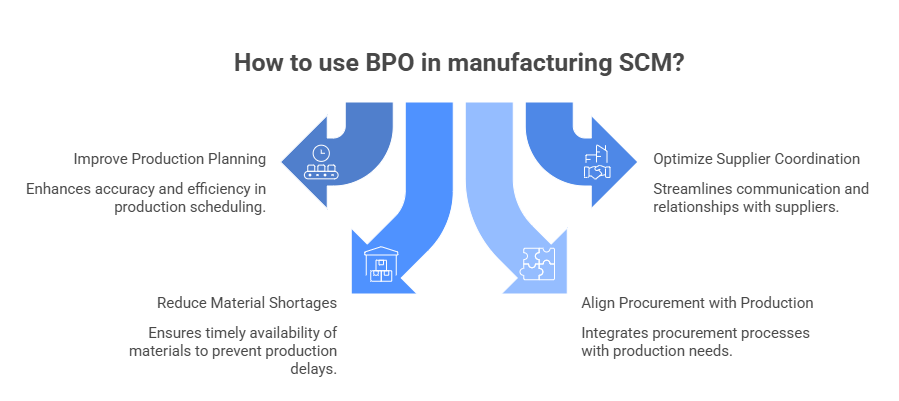 This creates a more stable and predictable manufacturing ecosystem, especially in high-volume or multi-location operations.
Why Businesses Choose Vserve
Vserve helps growing companies streamline operations through structured outsourcing solutions designed for scalability and efficiency.
With Vserve, businesses gain:
- Procurement and supply chain support expertise
- Scalable operational execution models
- Improved visibility across procurement workflows
- Reduced administrative burden
- Better cost control and efficiency
Whether the goal is improving procurement performance or stabilizing supply chain operations, Vserve delivers outsourcing solutions designed for real business impact, not just task execution.
Conclusion
Business Process Outsourcing has evolved from a cost-cutting tactic into a strategic growth solution for modern companies. As businesses expand, they often face higher operating costs, strained internal teams, supply chain inefficiencies, and the need for specialized expertise. Throughout this guide, we explored how BPO helps solve these challenges through cost efficiency, scalable operations, stronger procurement processes, better inventory visibility, improved forecasting, and reduced operational risk.
By outsourcing critical support functions such as procurement, manufacturing operations, inventory management, and supply chain planning, growing companies can stay focused on innovation, customer experience, and long-term growth. The right BPO strategy creates leaner operations and stronger decision-making across the business. With an experienced partner like Vserve, companies gain reliable execution, industry expertise, and flexible support systems that turn operational complexity into a competitive advantage. Ready to simplify operations and scale smarter? Partnering with Vserve can help you move faster with confidence.
Frequently Asked Questions
1. What functions are typically handled through BPO in procurement and supply chain?
BPO in procurement and supply chain typically includes vendor management, purchase order processing, inventory tracking, forecasting support, and reporting. These functions help companies reduce internal workload while improving accuracy and operational efficiency across procurement cycles.
2. Is BPO only useful for large enterprises?
No. Growing companies often benefit the most because they face scaling challenges earlier in their lifecycle. BPO allows them to access experienced teams and structured processes without investing heavily in full internal departments.
3. How does outsourcing improve supply chain performance?
Outsourcing improves supply chain performance by introducing standardized processes, better data visibility, and specialized expertise. This leads to fewer errors, improved forecasting accuracy, and faster decision-making across procurement and inventory management functions.
4. What is the difference between BPO and traditional outsourcing?
BPO focuses on end-to-end business processes rather than isolated tasks. It involves structured workflows, performance monitoring, and strategic alignment, whereas traditional outsourcing often focuses on single-function task execution.
5. Can BPO help reduce operational risk?
Yes. BPO reduces operational risk by standardizing processes, improving documentation accuracy, and ensuring consistent execution. It also helps businesses avoid dependency on internal bottlenecks by distributing workload across specialized external teams.