


Accounts Receivable Outsourcing Pricing Guide (2026): Costs, Models, and Hidden Fees Explained


Last updated on September 10th, 2026

Managing working capital in high-volume commercial environments requires strict alignment between cash forecasting and Order-to-Cash execution. Scaling finance operations internally often exposes structural friction caused by rising labor costs, expanding collection complexity across multi-channel buyer segments, and rapid growth in invoice volume. Enterprise finance leaders are restructuring their billing operations by transitioning from fixed overhead toward flexible accounts receivable outsourcing services.
44% of B2B credit sales are overdue across Asia, according to the 2025 Atradius Payment Practices Barometer, while bad debts average 5% of B2B invoices. The report identifies customer liquidity issues and inefficient payment processes among the key drivers of payment delays, underscoring the importance of effective credit administration and collections. Delegating credit administration and dunning processes to specialized accounts receivable services can help businesses improve collection efficiency, protect operating cash flow, and establish more predictable processing costs. This guide breaks down current market pricing, fee structures, integration considerations, and risk mitigation strategies to help organizations select the right AR delivery model.

Admin2
How the Pricing for Accounts Receivable Outsourcing Has Changed Over the Years
Over the past decade, commercial billing engagements transitioned from basic transactional offshore labor arbitrage toward outcome-driven managed service agreements. Legacy billing models relied heavily on unblended hourly rates, which penalized clients when processing volume fluctuated or system complexities created operational delays. Enterprise buyers now evaluate vendor relationships based on Days Sales Outstanding reduction, automated cash application accuracy, and total cost of processing per invoice.
Modern contracts frequently combine baseline infrastructure management with shared-risk incentives tied to collections performance. Organizations looking to outsource accounts receivable services benefit from standardized API integrations and cloud-based workflow engines that eliminate legacy manual entry fees.
Get specialized accounts receivable outsourcing services for end-to-end order-to-cash execution.
What Services Are Included?
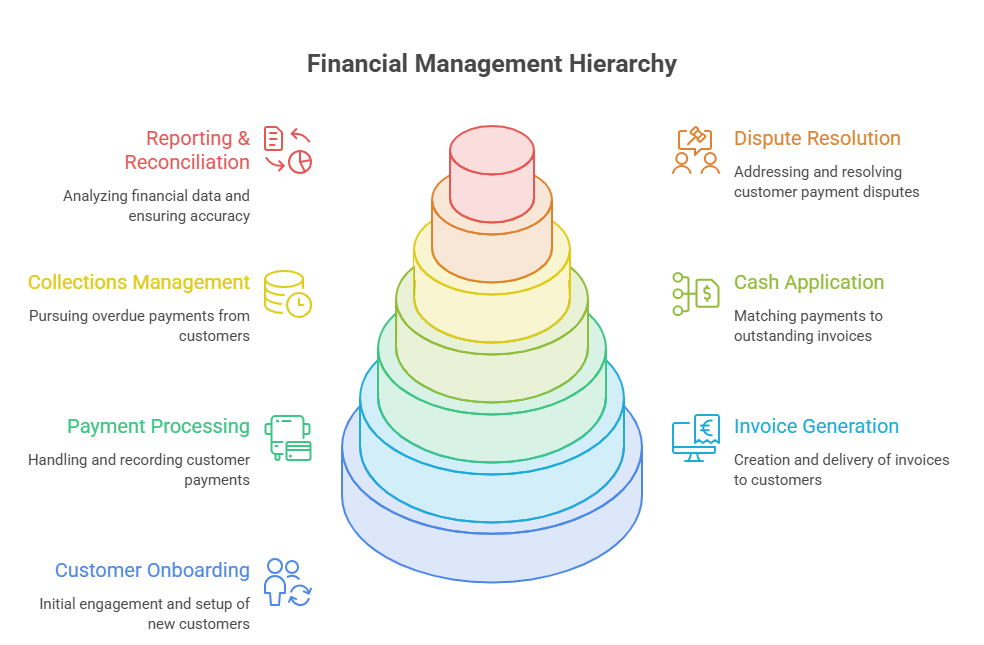
A comprehensive Order-to-Cash service agreement delegates routine administrative tasks while maintaining full corporate governance over credit policy and write-off authorizations. Enterprise organizations utilize accounts receivable outsourcing services to establish consistent operational modules across the receivables lifecycle.
Customer onboarding
Customer onboarding establishes the foundation for clean billing by verifying customer master data, tax exemption certificates, and credit limits before order fulfillment. Providers conduct real-time credit checks, configure payment terms inside your ERP, and set up electronic billing delivery preferences.
Invoice generation
Invoice generation transforms unbilled sales records into tax-compliant, buyer-formatted invoices across electronic data interchange, customer portals, and email channels. Delivery protocols include pre-bill validation audits to catch pricing variances and line-item discrepancies before transmission.
Payment processing
Payment processing manages multi-channel fund ingestion across automated clearinghouse networks, wire transfers, corporate credit cards, and physical lockbox files. Third-party processors enforce strict segregation of duties to maintain compliance with regulatory frameworks and corporate banking protocols.
Cash application
Cash application matches incoming payments against outstanding open invoices using automated remittance parsing and rule-based matching algorithms. Analysts resolve unapplied cash exceptions, short payments, and unallocated credits within strict daily operational SLA windows.
Collections management
Collections management enforces structured outreach cadences based on customer payment history, risk profiles, and aging buckets. Dedicated collection specialists engage past-due accounts via automated reminders, phone escalations, and tailored payment plan negotiations.
Dispute resolution
Dispute resolution identifies, categorizes, and routes billing friction points, short payments, and shipping deductions to internal commercial teams. Service providers log dispute reasons, track resolution turnaround times, and process root-cause operational adjustments.
Reporting and reconciliation
Reporting and reconciliation deliver real-time visibility into working capital health, aging schedules, roll-forward reports, and collection effectiveness indexes. Providers perform daily bank-to-ledger reconciliations to ensure complete auditability across all ledger accounts.
How Much Does Accounts Receivable Outsourcing Cost?
Pricing structures for accounts receivable services vary based on transaction volume, process complexity, and required level of human domain expertise. Providers utilize five primary billing models to align commercial terms with client operating requirements and budget preferences.
| Pricing Model | Typical Range | Best Suited For |
|---|---|---|
| Hourly Pricing | $8–$30 per hour | Project-based cleanups, short-term scaling, or variable volume support. |
| Dedicated Staffing | $1,500–$5,000 per month per FTE | Complex enterprise workflows requiring dedicated domain specialists. |
| Transaction-Based Pricing | Fixed rate per invoice ($0.50–$3.50) | High-volume standardized billing with predictable remittance patterns. |
| Retainer Model | Fixed monthly fee ($2,500–$15,000+) | Stable baseline receivables management with predefined task boundaries. |
| Hybrid Pricing | Base monthly rate + collection performance fee | Value-driven collections targeting aged portfolio recovery and DSO reduction. |
Selecting the right commercial model requires evaluating seasonal transaction swings alongside internal ERP integration requirements. Evaluating baseline costs against projected operational efficiency gains ensures your organization avoids unexpected cost overruns.
Factors That Influence Pricing
Vendor rate cards reflect the operational labor, technical integration, and governance overhead required to support a specific receivables portfolio. Partnering with an experienced a href="http://vservesolution.com/accounts-receivable-services/" target="_self">accounts receivable outsourcing firm ensures that your pricing structure matches your operational scope.
- Invoice Volume: Higher monthly invoice counts unlock economies of scale, significantly lowering the marginal processing cost per individual document.
- Customer Volume: Managing thousands of active buyer accounts requires broader communication channels and higher collection outreach capacity than servicing a consolidated buyer base.
- Industry Complexity: Specialized commercial sectors like industrial distribution, medical supply, and government contracting demand intricate billing rules, deduction codes, and compliance documentation.
- Geographic Coverage: Multi-region operations requiring multi-currency ledger reconciliations, localized language support, and regional tax compliance incur higher operational overhead.
- Technology Requirements: Standard integrations with tier-one systems like SAP, NetSuite, or Oracle require less custom engineering than connecting legacy proprietary accounting engines.
- Reporting Requirements: Custom executive dashboards, ad-hoc financial modeling, and granular audit trails increase ongoing management and analytical support hours.
- Service-Level Agreements: Stringent SLA commitments regarding cash application turnaround times, DSO targets, and dispute resolution windows carry higher financial performance guarantees.
Contracting teams must audit these variables during initial discovery to prevent scope creep after contract execution. Aligning clear operational definitions upfront protects both parties from unanticipated price adjustments.
How Much Can Businesses Save?
Transitioning to accounts receivable outsourcing services drives financial savings through reduced labor overhead, lower IT infrastructure costs, and faster working capital conversion. Organizations evaluate cost reduction potential based on their operating scale and current baseline process efficiency.
Small businesses
Small businesses generating modest transaction volumes cut operating costs by eliminating full-time administrative overhead and specialized billing software subscriptions. Outsourcing converts fixed payroll into variable expenses while reducing DSO by 5 to 10 days on average.
Mid-sized organizations
Mid-market companies achieve labor savings between 30% and 50% by delegating transactional cash application and routine collection follow-ups to external specialists. Operational centralization streamlines deduction workflows and eliminates the need to add internal headcount during revenue expansion.
Enterprise organizations
Enterprise entities drive multi-million dollar working capital improvements by combining global nearshore delivery centers with intelligent automation engines. Scaling standardized processes across multi-entity operations eliminates ledger fragmentation, reduces bad debt write-offs, and drives structural cost savings.
Questions to Ask Before Choosing a Provider
Selecting among competing accounts receivable outsourcing companies requires evaluating operational capability, technical security, and cultural alignment. Vetting potential partners against clear criteria ensures seamless integration and prevents service disruption.
- Which industries do you support? Verify that the vendor possesses deep domain experience handling specific billing terms, credit risk profiles, and deduction types unique to your market sector.
- What technology platforms do you use? Confirm whether the provider operates on your existing ERP platform or requires data migration into proprietary workflow platforms.
- How are service levels measured? Review specific KPI definitions, including target DSO ranges, unapplied cash turnaround times, and first-contact dispute resolution metrics.
- How do you protect customer data? Audit data encryption standards, access controls, SOC compliance certifications, and disaster recovery frameworks to safeguard confidential financial records.
- How are exceptions handled? Establish clear escalation protocols for complex billing disputes, VIP customer accounts, and credit limit overages to maintain commercial relationships.
Evaluating AR outsourcing companies through a structured RFP process mitigates long-term operational risk. Establishing explicit operational boundaries before signing protects client relationships and ensures accountability.
Why Businesses Combine Human Expertise and AI
Modern financial operations achieve optimal performance by blending intelligent automation engines with human judgment. High-performing accounts receivable services utilize artificial intelligence to process routine transaction streams while reserving human specialists for complex escalations.
- Automated Invoice Processing: Optical character recognition and machine learning parsers ingest customer remittance advice and match incoming payments with line-item accuracy.
- Intelligent Collections: Predictive algorithms analyze historical payment behaviors to segment customer portfolios and automatically trigger tailored outreach cadences.
- Predictive Analytics: AI models evaluate macroeconomic signals, buyer credit trends, and seasonal cash flow shifts to project future working capital positions accurately.
- Customer Communication: Conversational agents handle routine balance inquiries, resend missing invoice copies, and provide self-service payment links around the clock.
- Human Oversight: Experienced finance professionals manage high-value customer relationships, resolve complex trade deduction disputes, and authorize sensitive credit adjustments.
This hybrid delivery model maximizes operational throughput while maintaining customer trust across every touchpoint. Combining machine velocity with human empathy yields sustainable working capital optimization.
Conclusion
Scaling modern enterprise operations requires an agile Order-to-Cash infrastructure capable of adapting to shifting market demands. Transitioning transactional billing workflows to specialized accounts receivable outsourcing services lowers operational cost structures while accelerating working capital conversion.
By evaluating fee structures, hidden technical expenses, and hybrid human-AI capabilities, enterprise decision-makers can select a partner that drives measurable ROI. Evaluating qualified accounts receivable services empowers finance leaders to transform billing from a cost center into a strategic engine for growth.
Frequently Asked Questions
How long does it take to onboard an accounts receivable provider?
Standard implementation timelines range from 4 to 12 weeks depending on system complexity and process scope. Phase-one activities focus on ERP integration, process mapping, and establishing operational governance rules.
Will outsourcing affect my relationships with existing customers?
Professional service providers operate as an extension of your internal brand, following your corporate communication guidelines and tone. White-labeled customer portals and dedicated brand representatives maintain positive buyer relationships while accelerating collections.
How do outsourcing providers handle overdue accounts?
Providers execute pre-approved, tiered dunning strategies tailored to customer risk profiles and account histories. Complex disputes or severe delinquencies are escalated directly to your internal management team before third-party legal action is initiated.
Can we outsource specific AR functions instead of the full process?
Yes, modular outsourcing allows organizations to delegate targeted workflows like cash application or aged debt recovery while keeping billing and credit policy in-house. Selective delegation helps finance teams address immediate operational bottlenecks without full process re-engineering.
Services We Provide

Immerss is a live commerce platform designed to change the way DTC brands interact with their customers. With live video, shoppable chat and live streaming the online shopping experience is more interactive and immersive than ever before.

WAPI is a LogisticTech company – fulfillment, marketplace and courier aggregator. WAPI is your tool to enter new markets in just 7 days. They analyze your products and the products of your competitors, develop a strategy, create listings, and launch your sales on the biggest local marketplaces. WAPI prepares your products in accordance to Amazon regulations by storing, checking the quality & quantity, labeling, and shipping to Amazon.
Fulfillment: They store, label, prepare, and pick & pack your products at local warehouses all over the EU.
Final Mile Delivery: WAPI delivers your products to final customers in 24 to 48 hours via post, courier services, parcel terminals, COD and more.

Accelerating growth on Amazon since 2007. eComEngine createsowerful software to help Amazon sellers save time and increase profits. As the top-rated app on the Amazon Selling Partner Appstore, FeedbackFive is trusted by sellers all over the world to request and manage Amazon feedback and reviews. RestockPro simplifies FBA inventory management to help sellers stay in stock without overstocking.

BigCommerce’s mission is to help merchants sell more at every stage of growth, from small startups, to mid-market businesses, to large enterprises. As a leading Open SaaS solution, BigCommerce empowers merchants to build, innovate and grow their businesses online. Simply put, we focus on being the best commerce platform so our customers can focus on what matters most: growing their businesses