

How to Reduce Tail Spend in Procurement: 12 Proven Strategies to Cut Costs and Improve Spend Visibility


Last updated on September 9th, 2026

In our foundational guide on tail spend optimization, we analyzed how the bottom 20% of enterprise purchasing volume accounts for up to 80% of total vendor transactions. While strategic categories receive dedicated sourcing focus, unmanaged indirect purchases quietly erode operational margins and inflate administrative overhead across business units. Modern procurement leaders must transition from reactive spot-buying control to structured tail spend optimization frameworks that capture missed savings and eliminate processing friction.
According to research published by Boston Consulting Group (BCG), companies that digitize and manage tail spend reduce their annual expenditures by 5% to 10% on average, while eliminating up to 25% of unmanaged spend leakage across business units. When low-value requisitions bypass formal procurement controls, organizations suffer severe margin erosion, increased invoice processing expenses, and heightened vendor risk profiles. Implementing specialized tail spend management services allows enterprise teams to gain immediate visibility over decentralized transactions and enforce buying compliance across the enterprise.
Unaddressed tail spend creates significant operational drags, diverting procurement bandwidth away from strategic vendor negotiations toward low-value transaction handling. Enterprise decision-makers who deploy automated catalog controls, supplier consolidation programs, and dynamic analytics can systematically convert unmanaged purchasing into a predictable driver of bottom-line EBITDA expansion.

Admin2
Why Tail Spend Is Difficult to Control
Tail spend remains notoriously resistant to traditional sourcing approaches due to the sheer velocity and volume of small-dollar transactions across decentralized business units. Understanding these structural breakdown factors enables procurement directors to build targeted governance models that enforce spend compliance without creating operational bottlenecks.
Decentralized Buying
Decentralized purchasing environments allow individual department leads and plant managers to initiate purchases without central procurement oversight. This operational autonomy leads to fragmented purchasing habits, inconsistent payment terms, and widespread off-contract spending.
When site managers independently select local vendors for low-value supplies, corporate volume leverage is entirely lost. Establishing unified buying channels and guided purchasing workflows centralizes visibility while maintaining local operational agility.
Supplier Proliferation
Supplier proliferation occurs when enterprise systems accumulate thousands of active vendor records for one-off, non-recurring purchases. Managing an inflated vendor master file drives up administrative costs and degrades master data quality across ERP platforms.
Each additional supplier requires onboarding validation, tax compliance checks, and ongoing accounts payable processing overhead. Rationalizing the tail vendor base allows procurement teams to streamline supplier master files and eliminate redundant administrative maintenance.
Limited Spend Visibility
Fragmented transaction records spread across legacy ERPs, corporate purchasing cards, and local expense reports obscure true spend patterns. Without clean, taxonomy-aligned spend data, category managers cannot aggregate low-value purchases into strategic sourcing events.
Incomplete line-item descriptions and misclassified expense codes prevent procurement teams from recognizing recurring spend patterns within the tail. Deploying automated spend classification tools resolves data blind spots and exposes immediate sourcing aggregation opportunities.
Manual Procurement Processes
Processing low-value, high-volume requisitions through manual paper approvals or spreadsheets consumes excessive procurement bandwidth. The administrative cost to generate, approve, and match a manual purchase order often exceeds the dollar value of the underlying goods.
When procurement specialists spend their time handling routine spot buys, strategic sourcing initiatives suffer from a lack of resource allocation. Automating low-value purchasing workflows reduces transaction processing cycles and frees up strategic procurement talent.
Maverick Spending
Maverick spending occurs when employees intentionally bypass established preferred-supplier contracts to purchase through non-vetted commercial channels. This non-compliant purchasing behavior undermines negotiated contract value and exposes the organization to unmitigated commercial risks.
Without automated cart controls or strict policy enforcement at the point of requisition, off-contract buying flourishes across business units. Enforcing digital p-card controls and guided e-procurement marketplaces effectively redirects maverick buyers toward contracted vendor options.
Automate repeated spend management with our AI-driven tail spend management services team.
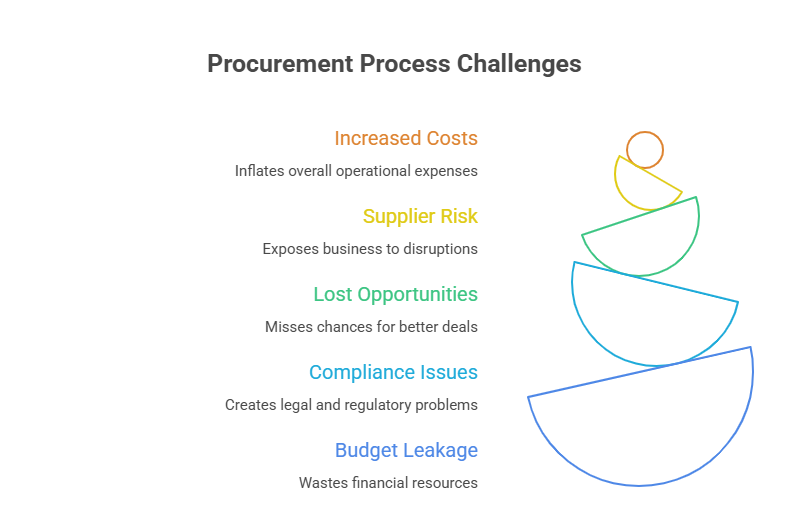
The Business Impact of Poor Tail Spend Management
Neglecting low-value purchasing categories inflicts severe financial and operational damage across enterprise procurement, finance, and supply chain functions. Identifying these core business impacts reinforces the necessity of establishing proactive governance over unmanaged tail categories.
Increased Administrative Costs
Processing thousands of micro-transactions through manual accounts payable workflows drives operational costs upward. The internal labor expenses associated with supplier onboarding, purchase order issuance, three-way invoice matching, and payment execution quickly outpace any perceived savings from spot purchasing. Streamlining low-value transaction execution is essential for lowering overall procure-to-pay operational overhead.
Higher Supplier Risk
Unvetted tail vendors frequently bypass standard legal, cybersecurity, and ESG risk screening protocols enforced during strategic sourcing events. Working with non-vetted suppliers exposes enterprises to severe supply chain disruptions, regulatory compliance penalties, and brand damage. Implementing structured vendor vetting protocols across all tail categories mitigates multi-tier operational risks.
Lost Negotiation Opportunities
Fragmented purchasing hides underlying volume trends that could otherwise be leveraged into strategic volume discounts or preferred pricing tiers. When business units purchase similar items independently from multiple local vendors, the enterprise loses significant commercial bargaining power. Aggregating tail volume through specialized tail spend management providers unlocks hidden margin expansion opportunities.
Compliance Issues
Bypassing formal procurement controls leads to widespread contract non-compliance, unauthorized spending limit breaches, and audit vulnerabilities. Non-compliant purchasing creates discrepancies between purchase orders, receiving logs, and final invoice amounts, stalling accounts payable operations. Enforcing digitized procurement rules guarantees strict compliance with corporate governance standards.
Budget Leakage
Unmanaged purchasing allows small price variances, unvalidated shipping fees, and off-contract price creep to steadily erode operating margins. Over time, these unmonitored micro-inefficiencies accumulate into millions of dollars in unnecessary corporate cash outflow. Systematic tail spend optimization captures this lost capital and returns it directly to enterprise bottom-line performance.
12 Proven Strategies to Reduce Tail Spend
Optimizing low-value enterprise spend requires combining process engineering, automated purchasing technology, and specialized external category oversight. Deploying these 12 operational strategies enables procurement teams to systematically capture lost value and establish total spend transparency.
- Conduct a Comprehensive Spend Data Analytics Cleanse Consolidate transactional data from all ERP systems, P-cards, and expense platforms into a single spend taxonomy. Cleansing and categorizing raw transaction lines reveals hidden purchasing patterns and pinpoints immediate supplier consolidation opportunities.
- Deploy Guided e-Procurement and Digital Marketplace Tools Implement intuitive e-procurement portals that direct internal requisitioners toward pre-approved digital catalogs and preferred vendor contracts. Guided purchasing interfaces prevent maverick buying by making compliant options the easiest choice for employees.
- Establish Standardized Purchasing Card (P-Card) Controls Mandate P-card usage for micro-purchases under defined dollar thresholds, backed by strict category controls, merchant code blocks, and individual spend limits. Standardizing P-card governance eliminates manual purchase order generation costs while preserving transaction visibility.
- Rationalize and Consolidate the Tail Vendor Base Systematically reduce the number of active tail suppliers by consolidating recurring purchases under core multi-category distributors. Vendor rationalization cuts accounts payable processing costs, streamlines master data management, and creates commercial volume leverage.
- Outsource Non-Core Tail Categories to Managed Service Partners Partner with a specialized tail spend management consulting company or managed service provider to handle high-volume, low-margin spot sourcing. Third-party experts leverage aggregate market scale, dedicated category expertise, and established sourcing desks to drive immediate cost reductions.
- Implement Automated Spend Analytics and Classification Tools Utilize AI-driven software to automatically categorize incoming line items and flag off-contract spend variances in real time. Deploying modern tail spend automation eliminates manual data entry errors and provides continuous visibility into emerging tail categories.
- Implement P2P Automation and Auto-PO Workflow Thresholds Automate the procure-to-pay pipeline by establishing touchless, auto-approval thresholds for routine, low-value catalog purchases. Streamlining approval workflows drastically accelerates cycle times and reduces administrative burden on procurement teams.
- Establish Dynamic Spot-Buying Sourcing Desks Create a centralized internal or outsourced spot-buying desk to handle non-catalog requisitions exceeding defined micro-purchase limits. Sourcing desks enforce competitive three-bid rules on uncontracted requests, capturing immediate price reductions on spot purchases.
- Standardize Tail Spend KPI Tracking and Executive Dashboards Track operational performance using dedicated KPI dashboards that measure contract compliance rates, vendor rationalization metrics, and cost avoidance figures. Executive visibility ensures cross-functional alignment and maintains institutional accountability across all business units.
- Institute Requisition Approval Gateways and Purchasing Thresholds Set hard, system-enforced approval limits based on department hierarchy, spend thresholds, and category classifications. Automated gatekeeping prevents unauthorized order releases and stops budget overruns before commitments are made with vendors.
- Leverage Group Purchasing Organizations (GPOs) for Indirect Categories Join established GPOs to access pre-negotiated, enterprise-grade pricing tiers on common indirect tail items like office supplies, MRO, and corporate travel. Tapping into external buying scale delivers immediate cost savings without requiring internal sourcing resources.
- Deploy End-to-End Tail Spend Management Systems Integrate a dedicated tail spend management system directly into your core ERP architecture to manage vendor onboarding, tactical sourcing, and catalog compliance. Unified tail spend management solutions establish perpetual operational control over long-tail procurement transactions.
Industry-Specific Tail Spend Example
A multi-site industrial manufacturing client operating 22 production facilities faced severe margin slippage driven by unmanaged indirect MRO (Maintenance, Repair, and Operations) and safety supply purchases. With over 3,500 active tail vendors scattered across regional facilities, the company experienced an extreme invoice processing backlog, high maverick spending, and zero corporate volume leverage.
To eliminate these operational bottlenecks, our team conducted a comprehensive spend analysis across all facility ERPs, consolidating 18 months of transactional data into a unified category taxonomy. We deployed specialized tail spend management services to rationalize the vendor base, transitioning 75% of fragmented MRO purchases onto a centralized digital catalog managed by core primary distributors. Additionally, we implemented an outsourced spot-buying desk to execute competitive sourcing for non-catalog tail requests exceeding $1,000.
Within 14 months of implementation, the manufacturer reduced its active tail supplier base by 68% and achieved an 11.2% net cost savings across unmanaged MRO categories, representing $4.3 million in annualized EBITDA improvement. Purchase order cycle times dropped from 6 days to under 4 hours for catalog items, while contract compliance expanded from 32% to 91% enterprise-wide.
Common Tail Spend Management Mistakes
Procurement executives seeking to optimize low-value categories must avoid common strategic and operational missteps. Recognizing these failure modes ensures that tail spend initiatives deliver sustainable cost reductions and process efficiencies.
- Ignoring Low-Value Purchases: Assuming small-dollar transactions do not warrant strategic attention allows millions in aggregate spend to leak away across decentralized business units.
- Overlooking Data Quality: Attempting to build tail spend strategies on uncleaned, misclassified ERP data guarantees flawed sourcing decisions and inaccurate vendor consolidation targets.
- Relying Solely on Manual Processes: Managing high-volume, low-value transactions through spreadsheets or manual approvals overburdens staff and creates extreme operational bottlenecks.
- Measuring the Wrong KPIs: Focusing exclusively on purchase price variance (PPV) while ignoring processing overhead, cycle time metrics, and supplier compliance rates leads to incomplete performance evaluations.
Conclusion
Reducing tail spend is one of the most immediate, high-impact opportunities for enterprise procurement leaders to eliminate cost leakage and increase operational agility. By addressing decentralized buying, deploying digital automation tools, and rationalizing the supplier base, procurement functions can systematically convert unmanaged purchasing into measurable bottom-line value.
Achieving sustainable tail spend control requires a balanced combination of clear governance policies, modern procure-to-pay technology, and specialized category expertise. Enterprise leaders who rigorously evaluate their unmanaged spend, implement structured buying workflows, and leverage external managed service partners will build resilient, high-performing procurement operations capable of driving long-term enterprise growth.
Frequently Asked Questions
What percentage of spend is considered tail spend?
Tail spend typically represents approximately 20% of an organization's total procurement spend volume, but accounts for nearly 80% of total vendor transactions and active supplier records. In highly decentralized or acquisition-heavy enterprises, tail spend can expand to cover up to 30% of overall corporate purchasing.
How much can organizations save by managing tail spend?
Organizations implementing structured tail spend optimization frameworks routinely capture between 7% and 15% in direct cost savings across managed tail categories. Additionally, automating procure-to-pay workflows reduces transaction handling costs by up to 70%, delivering substantial operational efficiency gains.
What is the difference between tail spend and maverick spend?
Tail spend refers to the high-volume, low-value, non-strategic purchases that lie outside core strategic category management. Maverick spend refers specifically to non-compliant purchasing that actively bypasses established corporate contracts, which can occur within both strategic and tail categories.
Which procurement software helps reduce tail spend?
Tail spend is best managed using integrated e-procurement platforms, AI-powered spend analytics engines, guided buying marketplaces, and automated procure-to-pay (P2P) suites. Leading solutions integrate directly with core ERPs to enforce digital catalog usage, automated approvals, and P-card controls.
Is outsourcing tail spend management worthwhile?
Yes, outsourcing tail spend management to specialized managed service providers delivers immediate scale, pre-negotiated vendor catalogs, and dedicated spot-sourcing bandwidth that internal teams rarely possess. External providers accelerate time-to-value while allowing internal procurement talent to remain focused on strategic core categories.