
Types of Supplier Risks: 12 Critical Risks Every Procurement Team Should Monitor

Last updated on July 27th, 2026

In an increasingly volatile global marketplace, managing third-party vulnerabilities has become a top priority for corporate leadership teams. Organizations can no longer assume that a vendor’s standard delivery schedule will remain secure without continuous active monitoring. Failing to anticipate hidden supplier disruptions frequently results in severe production shutdowns, sudden budget overruns, and catastrophic damage to corporate reputations.
Building an adaptable and resilient operation requires shifting away from reactive crisis management toward proactive risk prevention. In this comprehensive guide, we will break down the essential types of supplier vulnerabilities that procurement professionals must track continuously. We will also examine the unique structural differences between various risk categories and explore how deploying specialized supply risk management consulting services protects your long-term business continuity.
What Is Supplier Risk?
Supplier risk refers to the total probability and operational impact of an adverse event caused directly by a third-party vendor’s failures. These vulnerabilities can originate from a supplier’s internal financial instability, sudden operational bottlenecks, or lack of regulatory compliance. Left unmanaged, these localized problems quickly ripple outward, causing severe financial and logistical damage to the buying enterprise.
Implementing structural oversight is exceptionally important because modern businesses rely heavily on extended partner ecosystems to deliver core products. Relying on professional supply risk management solutions ensures that companies can systematically identify vendor weaknesses before they mutate into expensive operational crises. Common causes of these disruptions include macroeconomic shifts, poor supplier leadership, sudden geopolitical changes, and inadequate quality control mechanisms.
Supplier Risk vs. Supply Chain Risk
While these two technical terms are frequently used interchangeably, they represent different operational scopes and analytical viewpoints. Sourcing leaders must understand these distinct boundaries to deploy their risk mitigation budgets and internal tracking resources effectively.
Organizations can leverage external supply chain risk management services to gain complete macro visibility over their broader distribution networks. This extensive management model ensures that teams can protect both their immediate vendor touchpoints and their multi-tier global supply routes simultaneously.
| Feature | Supplier Risk | Supply Chain Risk |
| Scope | Focuses directly on the performance and stability of a specific third-party vendor. | Encompasses the entire end-to-end network, including logistics, weather, and macroeconomics. |
| Primary Causes | Vendor bankruptcy, localized factory strikes, equipment failures, or compliance fraud. | Global shipping container shortages, canal closures, regional wars, or border closures. |
| Mitigation Focus | Continuous vendor audits, financial tracking, and rigorous performance scorecards. | Diversifying global logistics routes, building safety stock, and geographical rebalancing. |
| Example Scenario | A critical component manufacturer goes insolvent and halts production lines immediately. | A major oceanic port shuts down due to extreme weather, delaying hundreds of diverse vendors. |
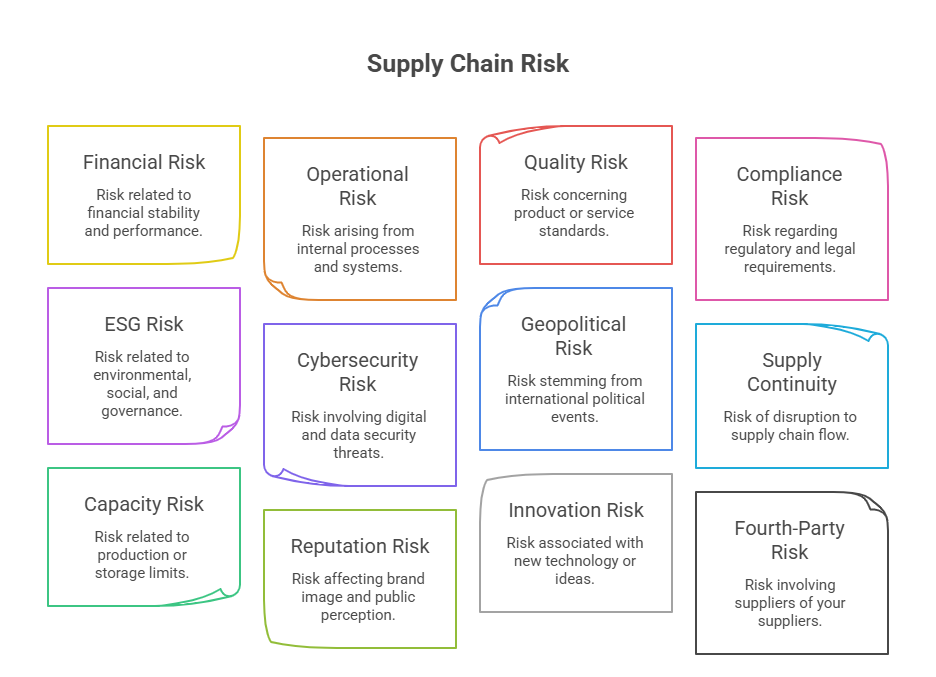
12 Types of Supplier Risks
Financial Risk
Supplier insolvency represents one of the most destructive threats to an enterprise because it can freeze your material pipelines without warning. Chronic cash flow issues and sudden credit deterioration serve as primary warning signs that a commercial partner is failing. To mitigate this threat, finance teams must regularly review credit scores and establish alternative backup sources for all critical materials.
Operational Risk
This vulnerability covers a vendor’s internal inability to meet day-to-day delivery commitments due to structural execution failures. Common operational triggers include unexpected equipment failures, localized labor disruptions, and severe raw material capacity shortages. When these failures occur, standard delivery timelines fall apart, creating expensive manufacturing bottlenecks for your internal business units.
Quality Risk
Receiving defective products or non-conforming components from a vendor can destroy your production efficiency and cause severe brand damage. If flawed items bypass internal tracking loops and reach consumers, the resulting product recalls can trigger massive financial penalties. Organizations must track precise supplier quality metrics, such as Defective Parts Per Million, to enforce strict compliance.
Compliance & Regulatory Risk
Modern corporations operate within a complex web of shifting international trade regulations, anti-bribery laws, and strict manufacturing standards. If a third-party vendor violates regional labor laws or trade compliance rules, the buying organization faces severe legal prosecution. Establishing rigorous audit workflows ensures that all supply partners strictly adhere to changing global legal frameworks.
ESG & Sustainability Risk
Consumers and global regulators are increasingly holding enterprises strictly accountable for the environmental and social impacts of their extended supply networks. Environmental compliance failures, human rights violations, and modern slavery within your supplier network can spark catastrophic public backlash. Companies must implement comprehensive carbon reporting mechanisms and ethical workplace audits to protect their corporate values.
Cybersecurity Risk
Third-party digital networks represent a primary entry point for malicious hackers looking to compromise secure enterprise databases. Vendor data privacy breaches and ransomware attacks on critical suppliers can immediately disrupt your automated ordering systems. Procurement teams must enforce strict vendor access management policies and thoroughly audit the cybersecurity infrastructure of every connected partner.
Geopolitical Risk
Sudden international trade restrictions, shifting economic sanctions, and political instability can sever long-term supply lines overnight. Regional conflicts can trap essential raw materials behind closed borders, forcing buyers to search for expensive local alternatives. Utilizing specialized supply risk management consulting services helps companies forecast geographic vulnerabilities and diversify their international footprint.
Supply Continuity Risk
Relying entirely on single-source suppliers exposes your organization to severe operational danger if a natural disaster hits that vendor’s region. Transportation disruptions, such as rail strikes or oceanic shipping delays, can keep critical components from reaching your facilities. Businesses must proactively build geographic diversity into their networks to ensure steady material streams during regional crises.
Capacity Risk
Production constraints occur when a vendor lacks the machinery infrastructure or staffing scalability required to handle sudden demand spikes. If your sales surge unexpectedly, an inflexible supply partner will cause your company to miss profitable market opportunities. Evaluating a vendor’s maximum scaling limitations during initial onboarding prevents these growth bottlenecks from stalling your corporate momentum.
Reputation Risk
A serious case of supplier misconduct, such as environmental dumping or illegal labor practices, can instantly trigger a massive social media crisis for your brand. Consumers rarely differentiate between the actions of a primary brand and the behavior of its background manufacturers. Maintaining complete transparency across your supply ecosystem is vital for protecting your hard-won corporate reputation.
Innovation Risk
Partnering with vendors who suffer from a significant technology lag can saddle your company with a severe competitive disadvantage. If your competitors collaborate with suppliers who possess superior research and development capabilities, your products will quickly become obsolete. Sourcing teams must evaluate a partner’s long-term technology roadmaps to ensure mutual innovation over multi-year contract lifecycles.
Fourth-Party Risk
Many primary suppliers outsource portions of their manufacturing obligations to subcontractors, creating dangerous, hidden dependencies across the supply chain. This lack of multi-tier supplier visibility means that a failure at an unvetted fourth-party facility can still derail your primary production line. Advanced supply risk management solutions map out these hidden relationships to eliminate systemic vulnerabilities.
 How to Assess Supplier Risks
Accurately evaluating third-party vulnerabilities requires building a standardized scoring matrix that measures both the probability of an adverse event and its total financial impact. Procurement departments can look to specialized supply chain risk management services to implement these data-driven risk heat maps effectively. This analytical approach replaces subjective guesswork with concrete statistical data, ensuring that corporate risk teams focus their attention where it matters most.
Once scoring is complete, organizations position their vendors inside a supplier criticality matrix to dictate appropriate administrative tracking levels. High-risk, single-source partners receive continuous automated monitoring and mandatory quarterly audits to guarantee business continuity. Meanwhile, readily available commodity providers are reviewed annually, allowing your internal risk managers to preserve valuable operational bandwidth.
Conclusion
Successfully identifying and monitoring the twelve critical types of supplier risks is an absolute necessity for protecting modern corporate profit margins. By building a proactive evaluation framework and utilizing structured heat maps, enterprises can survive severe market disruptions. Investing in robust mitigation strategies guarantees that your extended supply network remains a source of competitive advantage rather than a liability.
Frequently Asked Questions
1. What is supplier risk?
It is the total probability and business impact of an operational or financial failure caused directly by a third-party vendor. These vulnerabilities encompass twelve distinct dimensions, including financial insolvency, compliance violations, quality errors, cybersecurity breaches, and geopolitical disruptions.
2. What are the most common supplier risks?
The most frequent disruptions originate from supplier financial distress, unexpected quality non-conformance, operational capacity shortages, and logistics delays. Cybersecurity breaches within vendor networks are also rising sharply, making digital risk management a critical focus for modern procurement teams.
3. How do you identify supplier risks?
Risks are identified by combining automated continuous data collection with regular corporate audits, credit score monitoring, and multi-tier network mapping exercises. Utilizing specialized supply chain risk management services allows companies to aggregate these diverse data streams into a single dashboard.
4. What is the difference between supplier risk and vendor risk?
In most professional procurement contexts, these terms are used interchangeably to describe third-party vulnerabilities. However, some compliance frameworks use supplier risk to focus on raw material and manufacturing links, while vendor risk covers service providers and software applications.
5. How often should supplier risks be assessed?
Critical, high-value, or single-source partners must be monitored continuously using real-time automated alerts and formal quarterly reviews. Moderate or low-risk commodity providers can be evaluated semi-annually or annually to maximize internal administrative bandwidth.
6. What tools help manage supplier risk?
Organizations rely on automated digital platforms that feature real-time spend analytics, predictive risk scoring algorithms, and integrated vendor self-service portals. Combining these software applications with specialized supply risk solutions ensures that your technology, human workflows, and supplier tiers remain perfectly optimized.