
Supplier Performance Management (SPM): Complete Guide to Metrics, Scorecards, KPIs & Best Practices

Last updated on July 27th, 2026

Managing vendor relationships has become a critical pillar of corporate longevity and supply chain resilience. Procurement departments can no longer rely on guesswork or static data to judge whether their commercial partners are delivering true value. Failing to monitor vendor outputs systematically leads to severe production delays, unexpected compliance penalties, and unmitigated financial leakage.
By executing a structured evaluation framework, enterprises can easily turn basic transactional relationships into high-leverage strategic alliances. In this comprehensive guide, we will explore the core methodologies of modern performance tracking, essential scoring metrics, and standard auditing frameworks. We will also examine how utilizing specialized supplier identification services empowers businesses to build a highly agile, reliable, and compliant global vendor ecosystem.
Table of Contents
What Is Supplier Performance Management?
Why Supplier Performance Management Matters
Supplier Performance Management Lifecycle
Key Supplier Performance Metrics
Supplier Segmentation Framework
How to Measure Supplier Performance
Measuring ROI of Supplier Performance Management
What Is Supplier Performance Management?
Supplier Performance Management is a structured business practice for analyzing, measuring, and managing the operational capabilities of third-party vendors. This practice requires continuous data collection to ensure that business partners remain fully aligned with established contractual terms and corporate standards. By deploying these rigorous tracking methods, organizations protect their brand reputation and drive ongoing operational excellence.
The core objectives of this management framework are to minimize risk, maximize cost efficiency, and foster continuous collaboration across the supply network. Its strategic importance in modern procurement lies in its ability to prevent supply disruptions before they impact final customer delivery. Integrating this discipline with professional supplier evaluation and qualification services guarantees that only high-performing companies enter your corporate supply chain.
Why Supplier Performance Management Matters
Organizations that do not actively monitor their vendor networks often suffer from invisible cost escalations and slipping quality standards. Implementing a strict performance oversight system provides corporate leadership with the data needed to optimize procurement costs. This visibility allows teams to reward high-performing vendors while holding underperforming suppliers accountable.
Furthermore, systematic tracking significantly reduces global supply chain risks and ensures long-term business continuity. Monitoring vendor health allows companies to identify operational weaknesses early and switch to alternative sourcing routes smoothly. This proactive vigilance creates an environment ripe for joint innovation, which is further enhanced by leveraging expert supplier identification services.
Supplier Performance Management Lifecycle
Building a resilient supply chain requires a continuous, multi-stage management journey that connects everyday tracking with macro business goals. Procurement professionals use this structured cycle to guide a vendor from initial onboarding to long-term collaborative growth.
- Define Objectives: Corporate leaders establish clear procurement expectations regarding delivery speeds, product quality, financial limits, and compliance rules.
- Segment Suppliers: Sourcing teams divide the vendor base into distinct tiers based on business criticality, annual spending volume, and substitute availability.
- Establish KPIs: Managers draft specific, quantifiable performance indicators that align with both operational realities and broader business targets.
- Monitor Performance: Automated digital platforms continuously harvest transactional data from daily workflows to track real-time supplier activities.
- Conduct Reviews: Corporate executives hold scheduled evaluation meetings with vendors to discuss performance records and address friction points.
- Corrective Actions: Procurement teams collaborate with underperforming suppliers to establish structured process improvement paths or formal warning frameworks.
- Continuous Improvement: Sourcing specialists routinely refine their internal assessment models to adapt to shifting market trends and economic landscapes.
Key Supplier Performance Metrics
An effective monitoring system relies on a balanced mix of key performance indicators that cover multiple operational dimensions. Focusing exclusively on price can cause procurement managers to overlook hidden risks in quality or delivery reliability.
To gain a holistic view, businesses track delivery metrics such as On-Time In-Full rates to prevent manufacturing bottlenecks. Quality metrics monitor product defect rates and return frequencies, while cost metrics analyze purchase price variances. Leading companies also integrate service, innovation, environmental, social, and governance compliance scores alongside specialized risk ratings provided by comprehensive supplier identification and evaluation services.
Supplier Scorecards
A professional supplier scorecard acts as a single source of truth that communicates vendor performance data clearly to all stakeholders. This digital document combines diverse data streams into a standardized format, allowing for objective comparisons across your supply network.
The core components of a scorecard include specific category ratings, weighted scoring formulas, and historical performance trends over rolling quarters. Best practices dictate that companies share these results transparently with vendors to encourage self-correction and prevent billing disputes. Utilizing a weighted template ensures that critical factors, like product quality, receive higher analytical importance than minor administrative compliance habits.
Supplier Segmentation Framework
Not all corporate vendors require the same level of administrative tracking, executive interaction, or resource allocation. Applying a standard segmentation matrix allows procurement departments to dedicate their time and budget where it impacts the bottom line most.
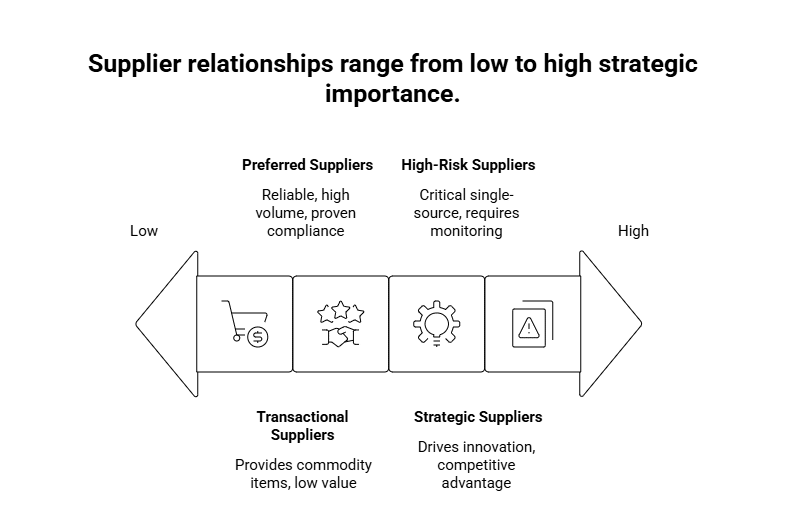 This classification ensures that procurement teams do not waste valuable analytical hours tracking commodity item providers. Instead, managers can focus their deep monitoring workflows on high-risk or strategic partners who directly influence business continuity. Partnering with professional supplier identification services can help organizations discover hidden, high-performing vendors to fill vacancies in critical tiers.
How to Measure Supplier Performance
Accurately measuring third-party outputs requires gathering clean, automated transactional data from your corporate enterprise resource planning software. Relying on subjective manual inputs creates internal bias and frequently leads to adversarial vendor negotiations.
To achieve objectivity, businesses combine automated data collection with regular performance reviews and cross-industry benchmarking exercises. Interactive reporting dashboards give executives a high-level view of vendor compliance trends, while Quarterly Business Reviews foster deep strategic alignment. This combined analytical approach allows organizations to make data-driven decisions that strengthen supply network resilience.
Technology & Automation
Modern procurement software eliminates tedious paperwork by gathering supplier transactional logs automatically in real time. These digital platforms use advanced artificial intelligence and machine learning to flag subtle supply anomalies before they lead to systemic delivery failures.
Additionally, predictive analytics engines can forecast potential vendor bankruptcies or geographic risks by studying global economic indicators. Seamless enterprise resource planning integration ensures that data flows smoothly between inventory management, accounting, and sourcing teams. Deploying these digital tools through reliable supplier evaluation and qualification services guarantees complete data visibility across your enterprise.
Supplier Development Programs
When a core supplier falls below contract standards, launching a development program is often more cost-effective than searching for an immediate alternative. These structured initiatives provide clear corrective action plans and coaching to fix localized production inefficiencies.
Furthermore, supplier collaboration encourages long-term innovation initiatives, such as shared material research or joint technology investments. This collaborative approach turns underperforming companies into reliable partners who understand your precise quality rules. Sourcing teams use expert supplier identification services to set realistic performance targets for these development programs.
Common Challenges
One of the most frequent hurdles in vendor management is poor data quality caused by disconnected legacy software applications. If your procurement data is fragmented, generating accurate, unbiased performance evaluations becomes nearly impossible.
Other critical obstacles include internal stakeholder misalignment, KPI overload, supplier resistance, and the complexity of managing global logistics. Forcing vendors to comply with too many complex metrics can cause operational exhaustion and strain commercial relationships. These challenges can be effectively resolved by utilizing external supplier identification and evaluation services to set up clear governance rules.
Best Practices
Establishing a strong governance structure with clear cross-functional ownership is essential for long-term performance management success. Sourcing, quality, and finance departments must all agree on how vendor metrics are calculated and escalated.
Organizations should also implement continuous monitoring workflows rather than relying solely on annual vendor check-ins. Providing positive performance incentives, such as extended contract terms or preferred payment status, encourages suppliers to prioritize your orders. Combining these best practices with a professional procurement outsourcing service ensures that your supply chain remains highly competitive.
Measuring ROI of Supplier Performance Management
Calculating the direct return on investment of an active monitoring program requires tracking specific financial improvements across the supply network. Key financial benefits include reduced material wastage, minimized expedited shipping fees, and fewer factory shutdowns.
Furthermore, preventing severe compliance penalties and eliminating unmonitored contract price changes significantly protects corporate profit margins. Organizations often discover that the financial savings gained from preventing a single supply chain disruption can fully fund their entire performance tracking infrastructure. This measurable value proves that managing vendor outputs is an investment that yields high operational and financial returns.
Choosing Supplier Performance Management Software
Selecting the right digital platform requires a thorough review of its data integration capabilities, security configurations, and user adoption rates. The software must connect easily with your existing accounting tools, warehouse systems, and customer relationship databases.
Organizations should also prioritize vendor solutions that offer flexible analytics modules tailored to their specific industry rules. It is equally important to choose applications that provide user-friendly self-service portals where suppliers can view their scorecards independently. Combining the right digital platform with professional supplier identification services ensures the fastest path to supply chain digital transformation.
Conclusion
Mastering Supplier Performance Management is a necessity for any enterprise looking to eliminate supply risks and optimize financial returns. By building structured lifecycles, using weighted scorecards, and setting clear KPIs, businesses can successfully protect their operational workflows.
To achieve the best results, companies must look at their supply networks holistically, combining digital tools with expert external support. Partnering with professional supplier evaluation and qualification services allows your internal teams to focus on strategic growth rather than manual administrative oversight. Take control of your vendor management today to ensure your supply chain can survive any global market disruption.
Frequently Asked Questions
1. What is the primary difference between SRM and SPM?
Supplier Relationship Management focuses on the broad, long-term strategic collaboration and mutual value creation between an enterprise and its key vendors. In contrast, Supplier Performance Management targets the objective, data-driven measurement of a vendor’s daily operational outputs against specific contractual targets.
2. Can small businesses implement supplier performance scorecards?
Yes, small businesses benefit significantly from using basic tracking models to monitor their primary source networks. Utilizing simple scorecards helps small business owners prevent unexpected cost increases, enforce quality rules, and make informed choices when expanding their supplier base.
3. How often should supplier scorecards be updated?
For high-volume, critical partners, scorecards are typically updated monthly or quarterly to ensure real-time visibility over operational risks. Transactional or low-risk vendors can be reviewed semi-annually or annually to preserve internal administrative bandwidth.
4. What is Maverick’s spend in procurement?
Maverick spend represents any unauthorized corporate purchase made outside of officially negotiated corporate vendor agreements. This scattered purchasing undermines the corporate sourcing strategy, causes significant capital leakage, and exposes the organization to unvetted third-party compliance risks.
5. How do you handle a supplier that rejects scorecard feedback?
When a vendor rejects performance data, procurement managers should schedule a formal review meeting to cross-examine the metrics alongside raw system logs. Providing objective, system-generated data usually resolves misunderstandings and opens up a transparent dialog regarding necessary process improvements.
6. What are ESG metrics in supplier management?
Environmental, social, and governance metrics measure a vendor’s carbon footprint, workplace safety records, labor compliance, and ethical business habits. Modern organizations monitor these scores closely to ensure their extended supply chain matches global environmental regulations and consumer values.
7. Can an organization skip supplier segmentation?
Skipping segmentation forces your sourcing team to treat every minor commodity supplier with the same administrative intensity as your core partners. This unorganized approach leads to operational exhaustion, wasted analytical budget, and a severe lack of focus on high-risk supply chain links.