


Last updated on March 27th, 2026
As a part of a fully functional management system in your e-commerce business, it is imperative to keep track of various departments within your organization. One such important department is your e-commerce customer service team, as they are your clients’ first point of contact. Today, customers expect answers at lightning speed, empathy in tone, and clarity. They do not wait. They compare, and they switch.
Higher employee engagement boosts customer satisfaction: Companies with high employee engagement scores see up to a 20 % increase in customer satisfaction ratings. This shows that engaged employees deliver measurably better service outcomes.
Taking care of this department is precisely what will help you with business growth, scalability, and customer retention. The secret lies in measurement. Clear customer service employee metrics help you see what is working and what is quietly breaking. When you track the right customer service productivity metrics, you are strengthening your team and their services.
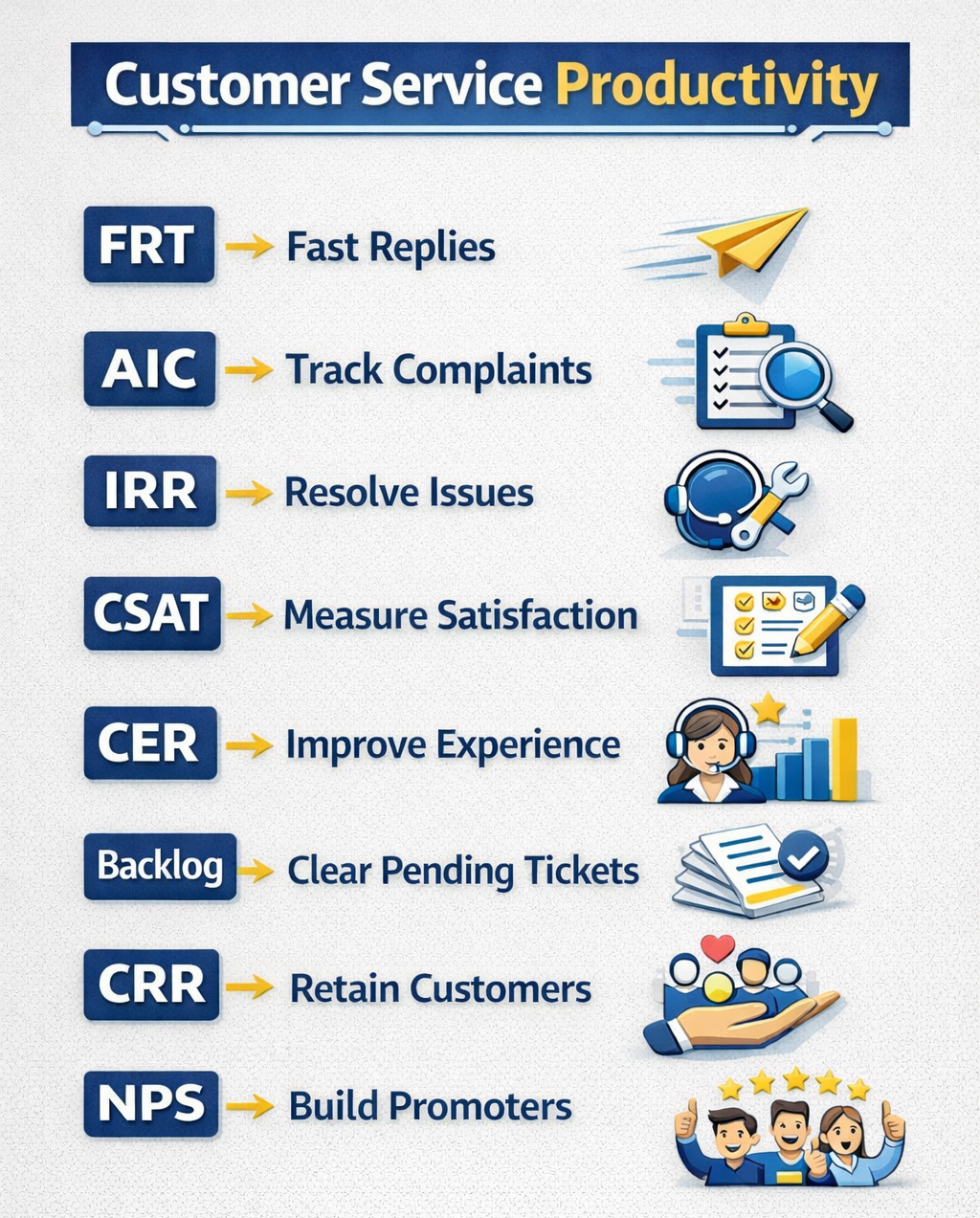
The 8 Key Metrics To Track Your eCommerce Customer Service Agency
Though there are many different eCommerce customer service metrics you need to track, the most important ones are listed below. These are practical and measurable. These shape your customer service scorecard metrics and help you build a smarter and more productive support team.
1. First Response Time (FRT) As A Core Efficiency Metrics Customer Service Indicator
FRT refers to the time taken by your support team to respond to a customer’s first query. It could be through chat, email, call, or social media. The longer the wait, the colder the customer’s interest becomes.
Ideally, your first response time should be less than one to two hours for emails and under a few minutes for chat. Today, with AI-assisted chat tools and automation workflows, even faster replies are possible.
Studies consistently show that customers are more likely to purchase when they receive quick responses. Speed creates a good impression on the customer, and this in turn creates revenue.
What Can You Do?
Review your average FRT weekly. If it is high, consider reallocating your workload. You can introduce automation tools and hire additional support staff. A live chat feature can significantly reduce response time and improve overall customer service productivity.
2. Average Issue Count (AIC)
Even the best eCommerce businesses receive complaints. That is normal. What matters is how often similar issues appear.
Average Issue Count measures the number of complaints or queries received over a specific period. Tracking this helps you identify patterns. Maybe delivery delays are frequent. Maybe product descriptions lack clarity. The numbers reveal what actions you should take.
What Can You Do?
Categorize issues daily, weekly, and monthly. Use dashboards to identify recurring problems. When you reduce repeated issues, you improve customer service productivity without increasing team effort.

3. Issue Resolution Rate (IRR)
Counting complaints is not enough. You must also track how many are resolved successfully.
IRR is calculated by dividing the number of resolved issues by the total number of issues received. A high IRR indicates strong efficiency metrics customer service performance. If resolution rates are low, customers feel unheard. Such customers rarely return.
What Can You Do?
Ensure your team has detailed product knowledge and clear escalation pathways. Provide updated scripts, training, and authority to resolve issues quickly. Review unresolved tickets regularly to understand where breakdowns occur.
4. Customer Satisfaction Score (CSAT) In Customer Service Scorecard Metrics
CSAT measures how satisfied customers are with a specific interaction. It is usually collected through quick surveys after a support conversation.
CSAT is one of the most common customer service employee metrics because it provides immediate feedback. Though subjective, it reflects emotional response, which matters deeply in eCommerce.
What Can You Do?
Place short surveys at the end of chats or emails. Ask simple questions like, “How satisfied are you with the support received?” Keep it easy and optional. Use insights to improve tone, speed, and clarity.
5. Customer Experience Rating (CER)
CER looks at the overall experience, not just one transaction. It evaluates communication style, professionalism, empathy, and ease of resolution.
Modern consumers value respectful communication. Many are willing to pay more for better service. A good tone and word choice can change the end result. Even punctuation can shift perception.
What Can You Do?
Conduct communication training regularly. Review sample interactions. Encourage clear, warm language. You can measure retention-related elements using formulas such as:
(E − N) / S × 100
Where E is total customers at end, N is new customers, and S is customers at start.

6. Ticket Backlog As a Customer Service Productivity Signal
Ticket backlog refers to unresolved queries that accumulate over time. It is a silent indicator of strain.
Even if FRT looks fine, a growing backlog shows inefficiency beneath the surface. This is a key part of customer service productivity metrics.
What Can You Do?
Monitor backlog weekly. If numbers rise, investigate root causes. It could mean staffing shortages, unclear workflows, or repeated issue types. Reducing backlog improves both morale and performance.
7. Customer Retention Rate (CRR)
Acquiring new customers costs more than retaining existing ones. CRR measures how many customers continue purchasing from your business over time.
High retention suggests strong customer service productivity and a positive support experience. Loyal customers often interact more with support teams, so their satisfaction reflects team effectiveness.
What Can You Do?
Develop follow-up emails, loyalty programs, and proactive support messages. Align customer service scorecard metrics with retention goals. This will ensure every interaction supports long-term relationships.
8. Net Promoter Score (NPS)
NPS measures how likely customers are to recommend your brand to others. Customers are categorized as promoters, passives, or detractors.
It captures brand perception beyond a single support ticket. This metric connects service quality with brand advocacy.
What Can You Do?
Send periodic NPS surveys. Segment results by demographics, behavior, or purchase history. Analyze feedback deeply. Use it to refine support touchpoints and training.

FAQs
1. What are customer service employee metrics?
Customer service employee metrics are measurable indicators that evaluate the performance, efficiency, and effectiveness of support staff in handling customer interactions.
2. Why are customer service productivity metrics important?
They help identify gaps, improve response times, enhance service quality, and support better decision-making for business growth.
3. How often should data from efficiency metrics customer service be reviewed?
Weekly reviews are ideal for operational metrics, while monthly or quarterly reviews work for strategic metrics like retention and NPS.
4. What is included in customer service scorecard metrics?
It typically includes FRT, IRR, CSAT, NPS, ticket backlog, and retention rate. It provides a full view of performance.
5. How can businesses improve overall customer service productivity?
Through training, automation tools, proper staffing, data analysis, and continuous feedback loops.
Conclusion
Tracking these metrics is not about pressure. It is about having knowledge about your performance. When you understand your customer service productivity metrics, you stop reacting blindly and start acting proactively. You see patterns and act accordingly. You build consistency.
In 2026, eCommerce competition is more impatient. Measuring the right customer service employee metrics ensures your support team becomes your strongest growth engine, not just a reactive department.
If you want to improve your overall customer experience without building everything from scratch, partner with Vserve. From live chat and email processing to full-scale outsourced support, Vserve helps you optimize customer service productivity. We give you structured processes and measurable results.
Let Vserve handle your customer conversations with care and precision.
Suggested Reads
https://vservesolution.com/blogs/10-best-practices-for-e-commerce-customer-support-services/ – Proven strategies for better eCommerce support
https://vservesolution.com/blogs/3-outsource-customer-service-models-support-global-fashion-shoppers/ – Outsourcing models explained for global brands
https://vservesolution.com/blogs/top-10-valued-skills-in-customer-support-to-enhance-customer-experience/ – Essential support skills for improved customer satisfaction
https://vservesolution.com/blogs/manage-remote-eCommerce-customer-support-team/ – Tips to manage remote support teams effectively