


Last updated on December 30th, 2025
In today’s retail landscape, the significance of product data management is gaining momentum. The reason is simple, yet layered. Sales channels are multiplying. eCommerce platforms are evolving faster than ever. And product information is a spreadsheet that keeps moving, expanding, fracturing, and reconnecting.
The growing complexity of channels and platforms demands smarter product data management services. Businesses now handle massive volumes of product attributes, images, videos, specifications, variants, and compliance details. When this information lacks structure or accuracy, the customer experience collapses quietly. When it is managed well, growth feels effortless.
Modern eCommerce product data management is no longer about operational support. It is about growth driving. It shapes trust, speed, discoverability, and conversion across every digital touchpoint.
Table of Contents
The Drift Towards a Connected Product Experience
Product Data Management Is No More a Chance but a Necessity
Product Data Management Best Practices
Frequently Asked Questions (FAQ)
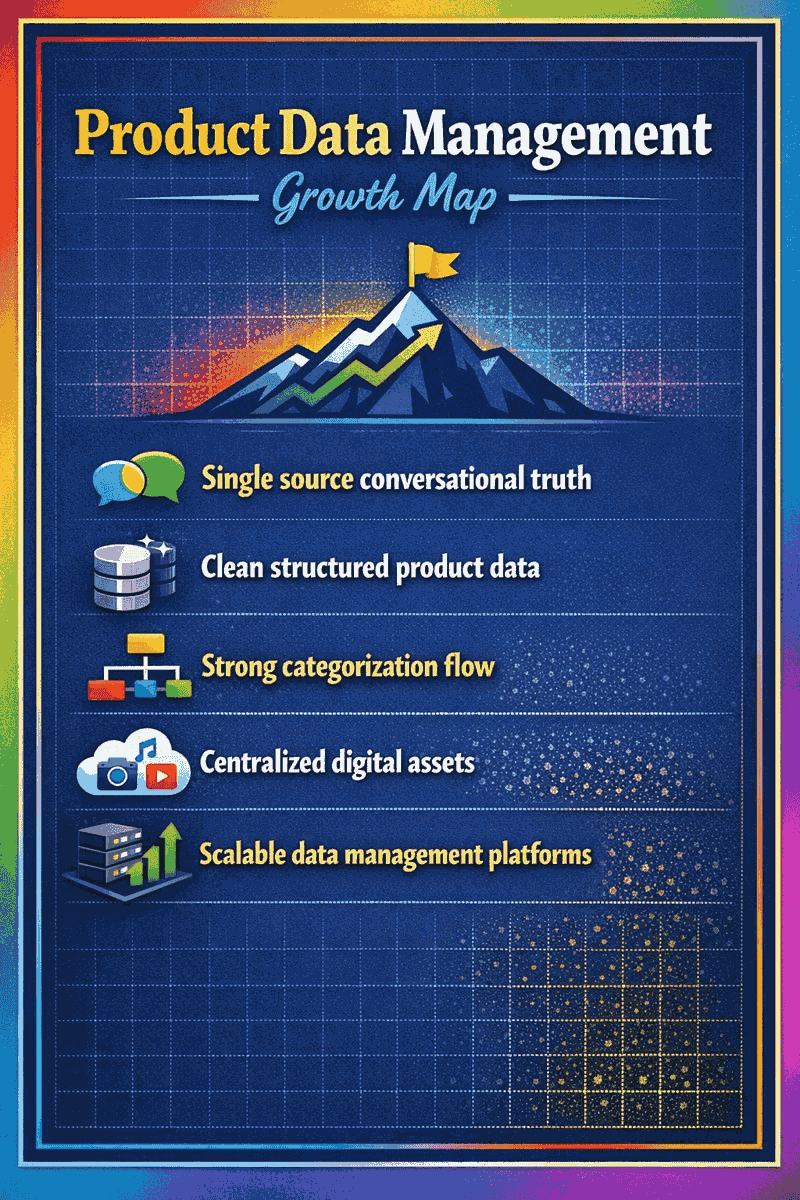
The Drift Towards a Connected Product Experience
The way modern-day shoppers search, compare, select, and finally buy a product is a collection of scattered actions. Everything happens at once. They scroll. They filter. They compare prices, features, reviews, and delivery timelines within seconds.
Every touchpoint must flow. Deals, offers, product details, stock availability, images, and descriptions must feel synchronized. This is where a connected product experience begins, and where the idea of a golden record of product data becomes essential.
A unified and accurate product record allows businesses to deliver consistency across websites, marketplaces, mobile apps, and offline systems. Top eCommerce players are constantly experimenting to enrich this experience. They invest in eCommerce product data management solutions that support faster updates and richer content.
Behind the scenes, digital asset management platforms quietly support this process. Images, videos, manuals, and banners are no longer scattered. They are managed centrally, connected directly to product data, ready to appear wherever the customer looks.
Product Data Management Is No More a Chance but a Necessity
The pandemic shifted priorities. Businesses of all sizes were forced to accelerate digital adoption. Offline and online systems needed to speak to each other, often overnight.
While full integration may feel complex for small businesses and startups, modern product data management services make it achievable. A well-structured data management system bridges gaps between suppliers, manufacturers, dropshippers, ERPs, and eCommerce platforms.
According to Ventana Benchmark Research, three in five organizations, nearly 61%, reported improved customer experience after investing in product information management. That statistic speaks quietly, yet powerfully.
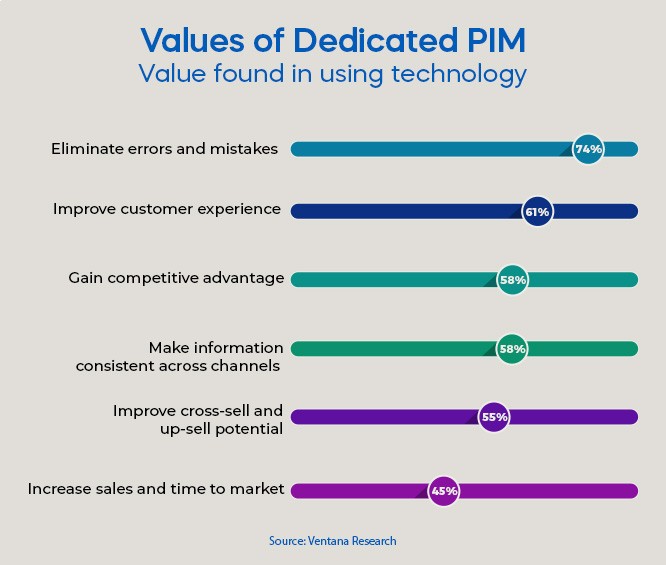
With a strong eCommerce product data management foundation, businesses can source, cleanse, enrich, and distribute product data from a single source of truth. Data management platforms store information and then orchestrate it.
Product Data Management Best Practices
Building a reliable product data management framework is not about perfection on day one. It is about giving it structure. The practices below focus on clarity, control, and consistency.
Understand Your eCommerce Product Data Management Goals and Define the Scope
The first step is observation. Study your current product data. Identify gaps. Spot inconsistencies. Define what success looks like for your business.
Clear goals shape better systems. Without them, even the best data management platforms feel confusing.
Common goals include:
- Enhancing customer experience
- Increasing marketing productivity
- Expanding into new sales channels
- Improving team collaboration
- Speeding up time-to-market
- Scaling into new geographies
- Onboarding supplier and vendor data
- Delivering better quality product information
Once goals are clear, define the scope. Should you model the entire catalog at once, or begin with a focused “land and expand” approach?
Large enterprises often benefit from phased implementation. Smaller businesses may find value in a comprehensive setup from the beginning, especially when working with experienced product data management services.
Invest in Categorizing Your Products
Product categorization is a silent guide. When done well, customers barely notice it. When done poorly, they leave. Industry sources summarizing Forrester data have noted that 68% of customers consider poor search experiences frustrating enough to quit a site, which aligns with the idea that poorly structured navigation or search reduces engagement and sales opportunities.
Effective categorization begins with empathy.
Think like your customer. Analyze how they search. If they look for products by material, usage, or compatibility, those attributes must exist and remain consistent.
Naming matters. Search synonyms matter more. A B2B audience expects industry-specific terminology. A B2C audience prefers familiarity and clarity. The structure that works for one will not always work for the other.
Consistency is non-negotiable. “Large” should not become “L” halfway through the catalog. Inches should not casually coexist with centimeters. Product data management thrives on uniformity.

Focus on Data Quality and Accuracy
Data quality sets the tone for trust. Accurate product data improves search visibility, reduces returns, and strengthens purchase confidence.
High-quality data is complete, consistent, timely, relevant, and accurate. It flows across platforms without distortion.
To achieve this:
- Collect data from verified sources
- Validate images, videos, specifications, and descriptions
- Eliminate duplicates and outdated records
- Update product data regularly
- Centralize information into a single source of truth
Digital asset management platforms play a crucial role here. They ensure visual content aligns perfectly with product attributes, without duplication or confusion.
Comprehensive product catalogs should include technical details, dimensions, usage instructions, inventory data, and compatible product combinations. Everything should be simple to understand. Complexity belongs behind the curtain.
Choose the Right eCommerce Product Data Management Solution
There is no universal solution. There never was.
Some data management platforms are built for global teams managing millions of SKUs. Others suit startups with lean teams and focused catalogs. The right choice depends on scale, budget, and workflow.
Key capabilities to look for include:
- Easy collaboration across teams
- Reduced development and publishing errors
- Budget alignment
- Productivity improvement
- Fast data retrieval
- Strong security standards
Popular product data management solutions include:
- Sales Layer, a PIM-focused platform with strong automation
- Salsify Product Experience Management Platform, known for content syndication and analytics
- Siemens PDM, widely recognized in enterprise environments
Regardless of the tool, the principle remains the same. Avoid unnecessary duplication across ERP, PIM, and eCommerce platforms. Integration matters more than accumulation.

Frequently Asked Questions (FAQ)
1. What is eCommerce product data management?
It is the process of organizing, enriching, and distributing product information across digital channels consistently.
2. Why are product data management services important for growth?
They improve data accuracy, customer experience, and operational efficiency across platforms.
3. How do digital asset management platforms support product data?
They centralize images, videos, and documents and link them directly to product records.
4. Is product data management useful for small businesses?
Yes, structured data management platforms help small businesses scale faster with fewer errors.
5. Can product data management improve SEO and conversions?
Accurate and complete product data improves search visibility and builds buyer trust.
Conclusion
Product data management is no longer a background process. It sits at the center of modern eCommerce growth. From connected product experiences to accurate catalogs and seamless syndication, everything flows through data.
Businesses that invest in structured eCommerce product data management today quietly outperform tomorrow. The systems may remain invisible to customers, but their impact never does.
Looking To Simplify And Scale Your Product Data?
Vserve delivers reliable product data management services designed for both B2B and B2C eCommerce businesses. From data cleansing to enrichment and platform integration, we help you reduce costs, improve accuracy, and accelerate growth.
Partner with Vserve and let your product data work smarter.
Suggested Reads
https://vservesolution.com/blogs/10-proven-benefits-of-outsourcing-product-data-management-services/ – Clear benefits of outsourcing product data management for scaling businesses
https://vservesolution.com/blogs/best-product-data-management-software-2025/ – Overview of modern product data management software and features
https://vservesolution.com/blogs/top-5-things-you-need-to-know-about-product-data-management/ – Key fundamentals every business should know about product data
https://vservesolution.com/blogs/impact-of-product-data-management-in-ecommerce-business/ – Explains how product data management directly impacts eCommerce success