

Outsource Vendor Reconciliation: How to Evaluate Providers, Costs, and Controls

Last updated on September 7th, 2026

Vendor statement reconciliation is often treated as a routine accounts payable activity, but at scale it can consume significant AP capacity. High statement volumes, fragmented vendor records, missing credits, payment discrepancies, and unresolved exceptions can create backlogs that affect cash visibility and supplier relationships.
For supply chain directors, procurement managers, finance leaders, and enterprise decision-makers, the question is not simply whether to outsource vendor reconciliation. The better question is whether an external provider can improve control, exception resolution, scalability, and total cost without weakening financial governance.
Organizations evaluating a vendor reconciliation service should therefore assess the operating model, technology compatibility, controls, reporting, and transition methodology along with the provider’s processing capacity.

Admin2
When Does It Make Sense to Outsource Vendor Reconciliation?
The decision to outsource vendor reconciliation should be based on operational complexity and total cost rather than transaction volume alone. A business can use the following framework to determine whether external support is justified.
Transaction and statement volume
High volumes of monthly vendor statements increase the effort required to compare supplier balances against AP records. As volumes grow, manual reconciliation can divert experienced AP professionals from payment controls, cash management, and higher-value financial activities.
Vendor complexity
A supplier base involving multiple currencies, business units, tax structures, payment terms, ERPs, and purchasing arrangements creates more reconciliation scenarios. Complex supplier environments are generally stronger candidates for standardized external reconciliation workflows.
Reconciliation frequency
Monthly vendor statement reconciliation may be sufficient for some suppliers, while strategic or high-value vendors may require more frequent review. The appropriate frequency depends on transaction velocity, payment value, risk exposure, and contractual requirements.
Internal AP capacity
If AP teams are already managing invoice processing, payment approvals, vendor queries, master-data maintenance, and month-end activities, reconciliation can become a lower-priority task. Outsourcing can provide dedicated capacity for vendor statement reconciliation without requiring permanent internal headcount.
Exception backlog
A growing backlog of unmatched invoices, unexplained balances, missing credit notes, and payment differences is a strong signal that the current process needs intervention. A capable provider should be able to separate routine matching from structured exception resolution.
Cost of maintaining the process internally
The internal cost of vendor statement reconciliation includes salaries, systems, supervision, training, quality assurance, overtime, and management time. APQC reports a median total cost of $1.36 per invoice line item for processing accounts payable across its benchmark sample.
Decision takeaway: Outsourcing is most justified when reconciliation volume or complexity is high, internal AP capacity is constrained, exceptions are accumulating, and the provider can deliver stronger process economics and controls than the existing model.
Get dedicated reconciliation expertise to reduce exception backlogs and improve vendor visibility.
How to Evaluate a Vendor Reconciliation Outsourcing Provider
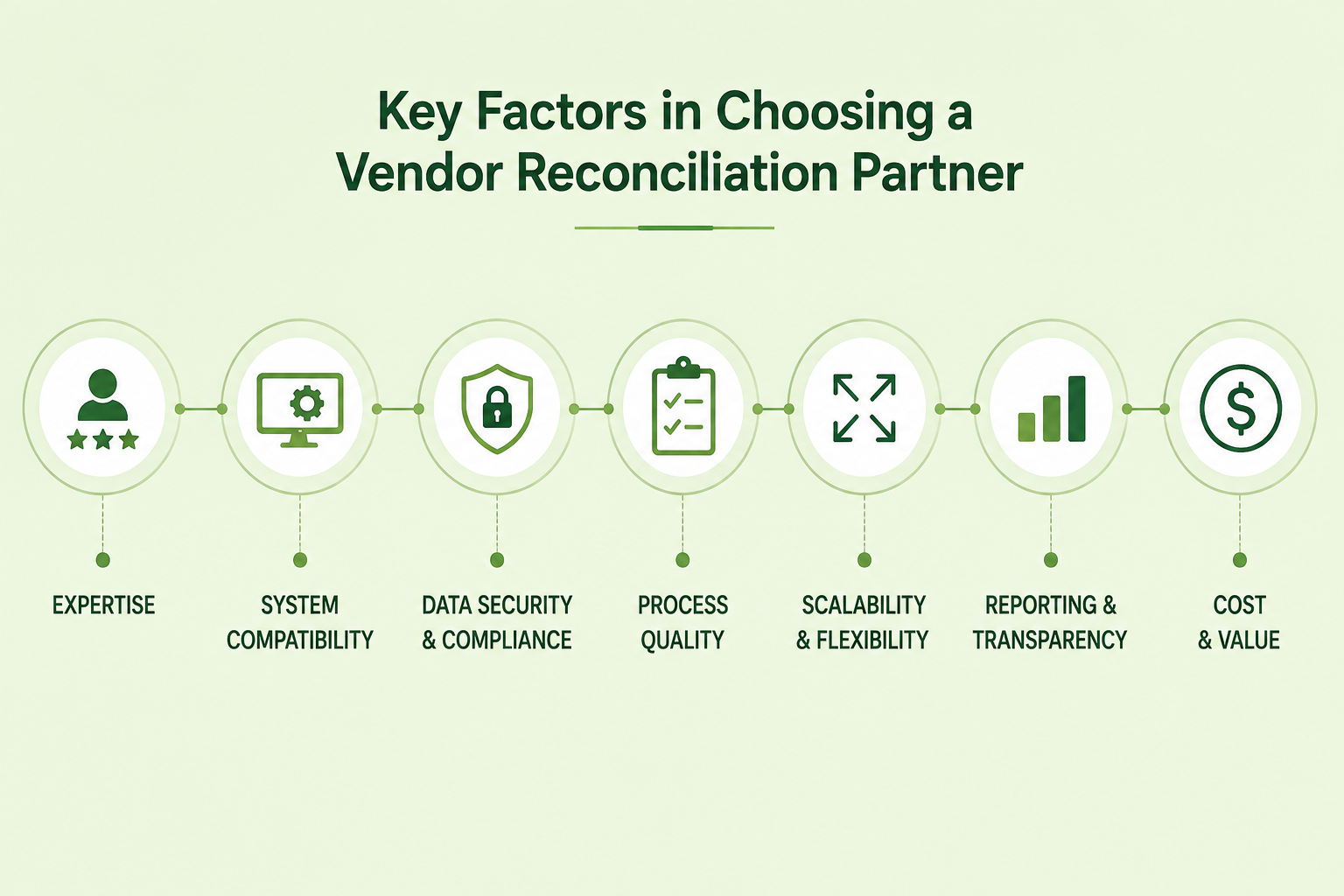
Choosing a provider requires more than comparing quoted processing rates. A practical provider scorecard should evaluate:
- Reconciliation expertise: Assess experience with supplier statements, open-item matching, credits, payments, and disputed balances.
- ERP/system compatibility: Evaluate integration and workflow compatibility with ERP, AP, procurement, and vendor-management systems.
- Data security: Review access controls, encryption, confidentiality measures, compliance standards, and data-handling procedures.
- Quality controls: Examine maker-checker controls, sampling processes, reconciliation sign-offs, audit trails, and quality reviews.
- Exception management: Verify defined workflows for identifying discrepancies, escalating issues, conducting investigations, and closing exceptions.
- Reporting: Assess reporting capabilities for aging, unmatched items, exception trends, turnaround times, and reconciliation status.
- Scalability: Determine whether the provider can handle seasonal peaks, acquisitions, new suppliers, and growing transaction volumes.
- Business continuity: Review backup processes, workforce redundancy, disaster recovery capabilities, and service continuity measures.
- Pricing and TCO: Consider transaction fees alongside implementation, management, technology, exception handling, and transition costs.
- Transition methodology: Evaluate the provider’s approach to process discovery, SOP development, knowledge transfer, testing, stabilization, and ongoing governance.
A strong provider should also demonstrate how it maintains segregation of duties and preserves an auditable record of reconciliation decisions.
When comparing providers, organizations should distinguish between a low processing price and a genuinely lower total cost of ownership. APQC notes that AP process costs can include personnel, systems, overhead, other costs, and outsourced costs, reinforcing the importance of evaluating the complete economics of the process.
This is particularly important when considering supply chain vendor coordination because vendor statement reconciliation outcomes can depend on timely communication between AP, procurement, operations, and suppliers.
How Outsourced Teams Handle Vendor Reconciliation Exceptions
Effective vendor statement reconciliation does not end when a balance fails to match. The provider needs a defined exception workflow that identifies the cause, assigns ownership, obtains supporting evidence, and records the resolution.
Duplicate invoice
The reconciliation team compares vendor statements with the AP ledger and invoice records to identify duplicate invoice numbers, amounts, dates, or references. The duplicate is investigated against payment status before any correction is recommended.
Missing payment
A vendor may show an outstanding invoice even though the company has already made the payment. The team verifies payment records, bank references, remittance information, and posting dates before determining whether the issue is timing, misapplication, or an unposted transaction.
Price mismatch
Price differences can result from purchase-order changes, contract pricing, quantity differences, freight charges, taxes, or vendor billing errors. The reconciliation team compares the statement, invoice, PO, receipt, and applicable commercial terms.
Incorrect vendor
Payments or invoices can sometimes be associated with the wrong vendor account because of duplicate supplier records, master-data errors, or incorrect coding. The provider should validate the vendor master record and escalate changes through the appropriate approval controls rather than altering records without authorization.
These controls become especially valuable when businesses are dealing with recurring vendor delays and PO-related issues that create downstream AP and inventory impacts.
How Outsourced Vendor Statement Reconciliation Resolves a Discrepancy
Consider a fictional industrial distributor that reconciles a strategic supplier's monthly statement.
The supplier statement shows an outstanding balance of $125,000, while the AP ledger shows $120,000. The initial $5,000 mismatch is therefore flagged as an exception.
The outsourced reconciliation team follows a controlled investigation:
- Vendor statement: The team obtains the supplier's latest statement and supporting transaction details.
- AP ledger: Open invoices, payments, credits, and adjustments are compared against the company's ledger.
- $5,000 mismatch: The difference is isolated and traced to a specific invoice period.
- Investigation: The team reviews invoice records, payment postings, purchase documentation, and vendor correspondence.
- Missing credit note: A $5,000 credit note issued by the supplier is identified but has not been posted in the AP ledger.
- Vendor confirmation: The supplier confirms the credit note and provides supporting documentation.
- Correction: AP records the credit through the approved accounting workflow.
- Reconciliation sign-off: The updated ledger now agrees with the supplier statement, and the exception is formally closed.
This example illustrates why vendor statement reconciliation should be measured by more than the percentage of statements processed. The quality of investigation, documentation, escalation, and closure determines whether reconciliation actually improves financial control.
Conclusion
Vendor statement reconciliation should be viewed as a financial-control process. When statement volumes, supplier complexity, and exception backlogs exceed internal AP capacity, outsourcing can provide dedicated resources, standardized workflows, stronger reporting, and scalable support.
The right provider should demonstrate reconciliation expertise, system compatibility, security, quality controls, transparent exception management, measurable SLAs, and a structured transition plan. Organizations should also compare the complete economics of internal versus external delivery before making a decision.
For businesses ready to evaluate an accounts payable reconciliation model, the objective should be measurable improvement in accuracy, visibility, exception resolution, and operating efficiency along with a lower labor cost.
Frequently Asked Questions
1. What is vendor reconciliation outsourcing?
Vendor reconciliation outsourcing means assigning supplier statement matching, balance verification, exception investigation, and reconciliation reporting to an external service provider under defined controls and service levels.
2. Is vendor statement reconciliation part of accounts payable outsourcing?
Yes. Vendor reconciliation is commonly included within broader accounts payable outsourcing because it supports invoice accuracy, supplier balance verification, payment visibility, and AP control.
3. How often should outsourced vendor reconciliation be performed?
Frequency depends on transaction volume, supplier risk, payment value, and business requirements. Monthly vendor statement reconciliation is common, while high-value or high-volume suppliers may require more frequent reviews.
4. What documents are required?
Typical inputs include vendor statements, AP ledgers, invoices, payment records, credit notes, purchase orders, goods-receipt information, remittance details, and approved vendor correspondence.
5. Can vendor statement reconciliation be automated?
Yes. Automation can support statement ingestion, data matching, duplicate identification, exception classification, and reporting. Human review remains valuable for complex discrepancies and approval decisions.
6. How much does it cost to outsource vendor reconciliation?
Costs vary according to statement volume, transaction complexity, reconciliation frequency, ERP environment, exception rates, service scope, and reporting requirements. Buyers should compare total cost of ownership rather than processing price alone.
7. Is it safe to outsource vendor reconciliation?
It can be, provided the provider uses appropriate access controls, data-security measures, segregation of duties, audit trails, confidentiality procedures, and business-continuity controls.
8. What should remain in-house?
Organizations typically retain ownership of accounting policies, payment authorization, financial decisions, vendor master-data governance, material dispute resolution, and final approval controls.
9. How do you measure an outsourced reconciliation provider?
Key metrics include reconciliation completion rate, exception aging, turnaround time, unmatched balance value, first-pass accuracy, exception closure rate, quality scores, SLA compliance, and audit findings.
10. Can an outsourced team communicate directly with vendors?
Yes. Depending on the operating model, an outsourced team can manage approved vendor communications for statements, missing documents, payment clarifications, credit notes, and reconciliation discrepancies, with defined escalation rules.