
Supply Chain Solutions Provider: How to Choose the Right Partner for More Efficient Operations

Last updated on August 11th, 2026

Global supply chains are now more connected. They are driven by data and focused on customer needs more than ever before. Today, businesses work with suppliers in different regions and manage inventory across many sales channels. They have to deliver customer orders on time and keep product information precise. Even small supply chain problems or incorrect product data can cause stock shortages and shipping delays. This leads to higher operating costs and unhappy customers.
This is where a supply chain solutions provider becomes an important business partner. Instead of only handling logistics, today’s providers offer complete end-to-end supply chain management services. They combine technology, automation, analytics, and product data expertise. Their goal is to improve visibility, simplify daily operations, and lower costs. They make sure accurate information moves smoothly across procurement, warehousing, transportation, and commerce systems.
If you are a manufacturer, distributor, retailer, or ecommerce business, it is time to start thinking about modern supply chain management solutions. They will help you make better decisions while building a stronger and more reliable supply chain.
Table of Contents
What Is a Supply Chain Solutions Provider?
Core Services Offered by a Supply Chain Solutions Provider
Benefits of Working with a Supply Chain Solutions Provider
How Technology Is Transforming Supply Chain Management
How to Choose the Right Supply Chain Solutions Provider
Key KPIs to Measure Supply Chain Success
Common Supply Chain Challenges and How Providers Solve Them
What Is a Supply Chain Solutions Provider?
A supply chain solutions provider offers connected services, technologies, and industry expertise. They help businesses manage every stage of the supply chain, be it sourcing raw materials or delivering finished products to customers.
Learn how end-to-end supply chain solutions improve visibility, reduce costs, and optimize operations from procurement to final delivery.
Traditional logistics companies used to mainly focus on transportation. Unlike them, modern providers manage procurement, inventory planning, warehouse operations, supplier collaboration, product information management, fulfillment, and analytics. They can do this effortlessly through one connected system.
Core Services Offered by Supply Chain Solutions Providers
The core services leading providers usually offer are:
- Procurement management
- Inventory planning
- Warehouse operations
- Transportation coordination
- Order fulfillment
- Supplier onboarding
- Product information management
- Supplier data management
- Product data enrichment
- Supply chain analytics
- AI-powered forecasting
- Compliance monitoring
Modern supply chains include many suppliers, warehouses, transportation partners, and online sales channels. Managing all these activities manually often leads to scattered information, communication gaps, and slower operations.
A trusted logistics solutions provider helps businesses:
- Improve supply chain visibility
- Reduce inventory costs
- Increase operational efficiency
- Improve supplier collaboration
- Standardize product information
- Speed up product launches
- Improve customer satisfaction
Experienced supply chain partners help companies simplify operations and improve product data quality. They build a supply chain that can adapt more easily to changing customer and market needs.
Benefits of Working with a Supply Chain Solutions Provider
Working with an experienced supply chain solutions provider gives businesses many measurable benefits.
- Lower Operational Costs: Automation reduces manual work, lowers errors, and helps businesses use resources more efficiently.
- Better Inventory Visibility: Real-time inventory tracking supports faster decision-making and reduces inventory differences.
- Faster Order Fulfillment: Connected systems speed up warehouse operations and help deliver customer orders more quickly.
- Improved Customer Satisfaction: Accurate inventory, faster shipping, and reliable product information create a better customer experience.
- Better Supplier Collaboration: Digital collaboration tools improve communication and help build stronger supplier relationships.
- Higher Forecast Accuracy: AI-powered forecasting helps businesses make better purchasing decisions while reducing inventory risks.
- Enhanced Product Data Quality: High-quality product information improves procurement, inventory accuracy, ecommerce performance, and customer trust.
How Technology Is Transforming Supply Chain Management
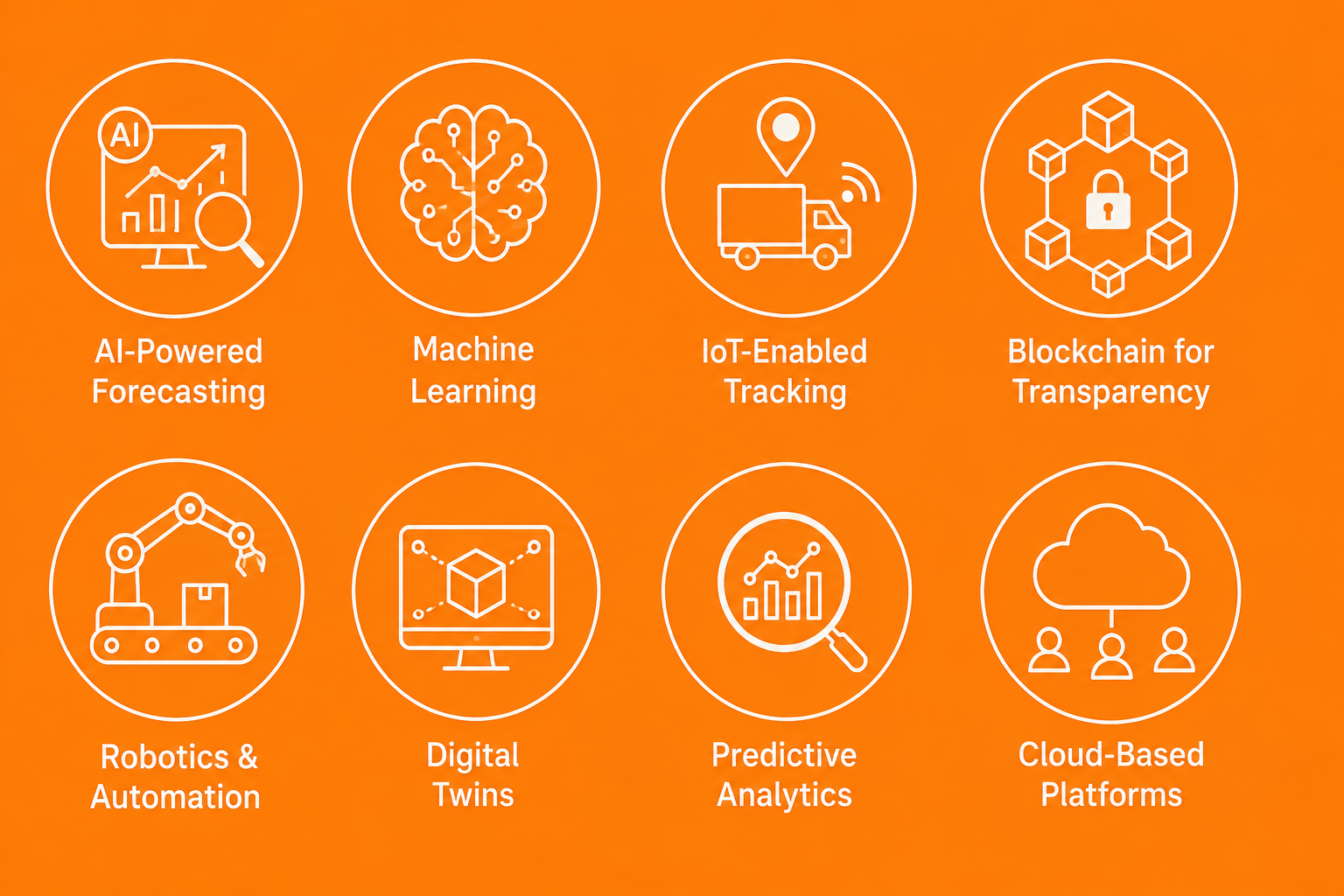
Modern supply chains are becoming faster, smarter, and more connected. Businesses no longer depend only on manual planning and spreadsheets. New technologies help companies predict demand and reduce errors. They improve inventory control and deliver products on time. When you opt for a reliable supply chain solutions provider, you get access to these technologies to improve every stage of end-to-end supply chain management.
AI-Powered Forecasting
AI-powered forecasting studies past sales, seasonal trends, market changes, and customer behavior to predict future demand. This helps businesses order the right products at the right time, reducing stock shortages and excess inventory. Better forecasting also improves planning across procurement, warehousing, and transportation.
Machine Learning
Machine learning helps supply chains improve continuously by learning from historical and real-time data. It identifies patterns that humans may miss and makes demand forecasts. These insights make inventory planning, supplier selection, and delivery schedules more accurate. As more data becomes available, recommendations become even better.
IoT-Enabled Tracking
Internet of Things (IoT) devices such as GPS trackers, RFID tags, and smart sensors provide real-time visibility across the supply chain. Businesses can monitor shipments, warehouse conditions, and equipment performance from a single dashboard. This improves inventory tracking, reduces delays, and allows faster responses when problems occur.
Blockchain for Transparency
Blockchain creates a secure and shared record of supply chain transactions. Every update is recorded and cannot be changed without approval. Thus, product movement is easier to verify. This improves supplier trust, product traceability, regulatory compliance, and customer confidence.
Robotics and Warehouse Automation
Modern warehouse management solutions use robots and automation to speed up picking, packing, sorting, and inventory movement. Automated systems reduce manual work and lower operating costs. It improves order accuracy and increases warehouse productivity.
Digital Twins
A digital twin is a virtual copy of a physical supply chain. Businesses can test different scenarios before making real-world changes. This helps companies improve warehouse layouts, transportation routes, production schedules, and inventory strategies with less risk.
Predictive Analytics
Predictive analytics studies historical and live data to identify possible risks. They work on them before they become problems for the supply chain. Businesses can prepare proactively for supplier delays, transportation disruptions, inventory shortages, or sudden demand changes. They can thus reduce costly interruptions.
Cloud-Based Supply Chain Platforms
Cloud platforms connect suppliers, manufacturers, warehouses, logistics teams, and retailers through one centralized system. Everyone works with the same real-time information for improved collaboration and faster decision-making. Besides, you get better operational visibility across the entire supply chain.
Industries That Benefit Most
Almost every industry depends on efficient supply chain management services. Some sectors gain even greater value from advanced supply chain solutions.
Manufacturing
Manufacturers rely on steady material supply, production planning, and inventory control. Better supply chain management reduces production delays, lowers costs, and improves delivery performance.
Retail
Retail businesses manage thousands of products across multiple stores and channels. Strong supply chain solutions help maintain stock availability, reduce overstocking, and improve customer satisfaction.
Ecommerce
Online retailers process large numbers of daily orders while managing warehouses, shipping partners, and returns. A reliable logistics solutions provider improves fulfillment speed, order accuracy, and delivery performance.
Healthcare
Hospitals and healthcare suppliers require accurate inventory management for medicines, medical equipment, and emergency supplies. Supply chain solutions help maintain product availability while meeting strict quality and compliance standards.
Automotive
Automotive manufacturing depends on thousands of parts arriving at the right time. Better supplier coordination and inventory planning reduce production delays and improve operational efficiency.
FMCG
Fast-moving consumer goods require rapid inventory movement and frequent replenishment. Supply chain solutions improve forecasting, warehouse operations, and transportation to keep products available without creating excess stock.
Electronics
Electronics companies manage complex global supplier networks and fast-changing product demand. Better supply chain visibility improves procurement, inventory control, and product availability. It reduces costly shortages.
How to Choose the Right Supply Chain Solutions Provider
Selecting the right supply chain solutions provider can have a major impact on business performance. The right partner should offer technology, industry knowledge, and scalable services that support long-term growth.
Industry Expertise
Choose a provider with experience in your industry. They will better understand common challenges, regulatory requirements, and customer expectations.
Geographic Coverage
If your business operates across multiple regions or countries, select a provider with strong local and global support networks to ensure smooth operations.
Technology Capabilities
Modern providers should offer AI, automation, analytics, cloud platforms, and real-time visibility to improve supply chain performance.
Integration with ERP, WMS, TMS, and PIM
Your provider should integrate easily with ERP systems, warehouse management solutions (WMS), transportation management systems (TMS), and product information management (PIM) platforms to create a connected workflow.
Smooth Expansion
Business needs change over time. Choose a provider that can handle increasing order volumes, new markets, additional warehouses, and expanding product catalogs.
Certifications and Compliance
Look for providers that follow industry standards and maintain strong data security, quality management, and regulatory compliance.
Customer Support
Reliable customer support helps resolve operational issues quickly. Dedicated account managers and responsive service teams reduce downtime and improve business continuity.
Pricing Models
Compare pricing carefully. The lowest price may not deliver the best value. Focus on service quality, technology, flexibility, and long-term business benefits.
Service Level Agreements (SLAs)
Clear SLAs define expected performance, response times, delivery targets, and support commitments. They help ensure accountability and measurable service quality.
Key KPIs to Measure Supply Chain Success
Measuring performance helps businesses identify strengths, improve weak areas, and maximize the value of their supply chain management services.
| KPI | Why It Matters |
| OTIF (On Time In Full) | Measures whether orders arrive complete and on schedule. |
| Inventory Turnover | Shows how efficiently inventory is sold and replaced. |
| Order Accuracy | Measures the percentage of error-free customer orders. |
| Fill Rate | Indicates how well customer demand is met from available inventory. |
| Perfect Order Rate | Tracks orders delivered without delays, damage, or errors. |
| Cash-to-Cash Cycle | Measures the time between paying suppliers and receiving customer payments. |
| Warehouse Utilization | Evaluates how efficiently warehouse space is used. |
| Transportation Cost per Shipment | Tracks shipping efficiency and helps control logistics expenses. |
Regular KPI monitoring allows businesses to continuously improve supply chain performance.
Common Supply Chain Challenges and How Providers Solve Them
Supply chains face constant changes that affect inventory, transportation, suppliers, and customer demand. Experienced providers use technology and process improvements to reduce these risks.
- Demand Fluctuations: AI forecasting and predictive analytics improve demand planning. This helps businesses avoid stock shortages and excess inventory.
- Supplier Disruptions: Supply chain providers monitor supplier performance, identify alternative vendors, and reduce dependency on single suppliers. This improves business continuity.
- Inventory Imbalances: Real-time inventory visibility and automated replenishment maintain healthier stock levels across warehouses and distribution centers.
- Rising Transportation Costs: Route optimization, shipment consolidation, and better carrier management lower shipping expenses while maintaining delivery performance.
- Global Trade Complexities: Experienced providers help manage customs documentation, regulatory compliance, international shipping, and changing trade requirements.
- Returns Management: Efficient reverse logistics improves product returns, inspections, restocking, and refunds. They reduce operational costs and improve customer satisfaction.
Future Trends in Supply Chain Solutions
Supply chain technology continues to evolve, helping businesses become more agile, connected, and efficient.
Generative AI
Generative AI analyzes large amounts of business data to support planning, reporting, document creation, supplier communication, and decision-making.
Autonomous Warehouses
Automation, robotics, and AI are creating warehouses that perform many daily operations with minimal human intervention. These tools increase speed and accuracy.
Sustainable Logistics
Businesses are reducing environmental impact through optimized transportation routes. They are using energy-efficient warehouses and eco-friendly packaging.
Circular Supply Chains
Companies are designing supply chains that support product repair, reuse, refurbishment, and recycling. This helps to reduce waste and improve sustainability.
Hyperautomation
Hyperautomation combines AI, robotics, machine learning, and workflow automation. They can thus automate entire business processes across the supply chain.
Real-Time Control Towers
Supply chain control towers provide centralized visibility across suppliers, warehouses, transportation, and customer orders. This enables faster decisions and proactive problem-solving.
Conclusion
Today’s supply chains are more complex than ever. Businesses need accurate planning, real-time visibility, efficient inventory management, and reliable logistics to stay competitive. Modern technologies like AI, automation, IoT, and cloud platforms help companies improve operations while reducing costs and delays.
Choosing the right supply chain solutions provider is crucial. It gives businesses access to the expertise, technology, and support needed to manage every stage of the supply chain. Be it procurement, warehousing, transportation, or fulfillment, the right partner helps create a more efficient and resilient operation.
For manufacturers, retailers, ecommerce businesses, healthcare providers, and global enterprises, investing in the right supply chain solutions company can improve customer satisfaction, increase operational efficiency, and support long-term business growth. As supply chains continue to evolve, working with an experienced provider will help your business stay prepared for future challenges and opportunities.
Frequently Asked Questions
1. What does a supply chain solutions provider do?
A supply chain solutions provider manages and improves procurement, inventory, warehousing, transportation, fulfillment, supplier collaboration, and logistics through technology, automation, and expert services.
2. How is it different from a logistics provider?
A logistics provider mainly handles transportation and shipping. A supply chain solutions provider manages the complete supply chain, including planning, procurement, inventory, warehousing, fulfillment, supplier management, and logistics.
3. What industries benefit the most?
Manufacturing, retail, ecommerce, healthcare, automotive, FMCG, and electronics companies gain significant benefits from modern supply chain solutions.
4. How much does outsourcing supply chain management cost?
Costs vary based on business size, order volume, services required, technology integration, and geographic coverage. Many providers offer flexible pricing models to match different business needs.
5. What technologies should a modern provider offer?
Look for AI, machine learning, cloud platforms, predictive analytics, IoT tracking, automation, blockchain, real-time reporting, and seamless ERP, WMS, TMS, and PIM integration.