

Ecommerce Operational Challenges: 15 Common Problems and How to Solve Them

Last updated on July 30th, 2026

Managing an online store requires balancing multiple moving parts across inventory, logistics, technology, and customer support. As digital storefronts expand, managing these interconnected workflows becomes increasingly complex and prone to human error. Addressing ecommerce operational challenges early prevents revenue loss and builds a resilient foundation for long-term brand scaling.
Ignoring operational bottlenecks results in delayed shipments, stockouts, high return rates, and frustrated buyers who abandon your brand for competitors. Partnering with experienced ecommerce service providers allows growing brands to delegate complex fulfillment and data tasks to dedicated external teams. This comprehensive guide breaks down the top fifteen operational friction points and outlines actionable strategies to optimize your supply chain.
TLDR Table
The table below summarizes the fifteen core operational hurdles facing digital brands alongside their root causes, commercial impacts, and actionable solutions. Reviewing this quick snapshot provides immediate guidance for optimizing your fulfillment and inventory workflows.
| Challenge | Why It Happens | Business Consequence | Quick Fix |
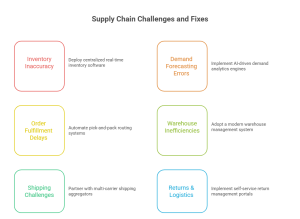
| Inventory Inaccuracy | Manual tracking and un-synced inventory channels | Overselling, stockouts, and dissatisfied buyers | Deploy centralized real-time inventory software |
| Demand Forecasting Errors | Reliance on intuition instead of predictive data | Capital tied in excess inventory or missed sales | Implement AI-driven demand analytics engines |
| Order Fulfillment Delays | Slow manual picking and fragmented workflows | Increased cart abandonment and negative reviews | Automate pick-and-pack routing systems |
| Warehouse Inefficiencies | Poor layout design and paper-based processes | High labor costs and slow order processing | Adopt a modern warehouse management system |
| Shipping & Last-Mile Challenges | Carrier delays and inefficient route planning | Soaring shipping costs and missed delivery dates | Partner with multi-carrier shipping aggregators |
| Returns & Reverse Logistics | Clunky return forms and slow processing | Margin erosion and tied-up secondary inventory | Implement self-service return management portals |
| Product Data Inaccuracy | Disorganized spreadsheets and multi-channel errors | Product returns, low rankings, and customer distrust | Centralize data inside a product information manager |
| Omnichannel Inventory Gaps | Disconnected POS systems and online stores | Double-selling stock and poor cross-channel experiences | Integrate unified omnichannel management tools |
| Peak-Season Scaling Issues | Fixed warehouse space and temporary staffing shortages | Order backlogs, shipping delays, and staff burnout | Outsource seasonal spikes to external 3PL partners |
| Customer Support Bottlenecks | High ticket volumes during promotional peaks | Low CSAT scores, bad reviews, and lost sales | Deploy AI helpdesk tools and automated chat |
| Payment Fraud & Security Risks | Sophisticated fraud bots and weak verification | Costly chargebacks, lost stock, and merchant fees | Integrate AI risk scoring and chargeback protection |
| Technology Integration Issues | Legacy systems that fail to share data cleanly | Siloed operational data and manual workarounds | Transition to API-first cloud platform architectures |
| Marketplace & Multi-Store Complexity | Managing multiple channel rules and pricing manually | Listing errors, price conflicts, and policy penalties | Use centralized multi-channel listing tools |
| International Operations | Cross-border tariffs, customs, and currency friction | High landed costs and customs transit holds | Leverage localized fulfillment hubs and DDP logistics |
| Lack of Operational Visibility | Disconnected tools without unified reporting | Inability to spot bottlenecks or control costs | Build unified analytics dashboards with live KPIs |
Delegate your complex fulfillment and customer support workflows to experienced ecommerce service providers
The 15 Biggest Ecommerce Operational Challenges
1. Inventory Inaccuracy
Inventory discrepancies happen when recorded stock levels in your database do not match physical warehouse counts. This issue typically stems from manual data entry errors, unrecorded damages, or disconnected sales channels.
Failing to maintain accurate stock records leads to overselling out-of-stock items or holding excess safety stock that ties up capital. Deploying real-time inventory tracking software and conducting regular cycle counts resolves stock discrepancies before they impact shoppers.
2. Demand Forecasting Errors
Predicting future product demand without analyzing historical sales trends, market seasonality, and consumer behavior leads to inaccurate purchasing plans. Relying on gut feeling rather than quantitative analytics creates compounding supply chain imbalances.
Overestimating product demand leads to high holding costs and forced inventory clearance liquidations, while underestimating demand results in stockouts and lost revenue. Utilizing predictive analytics platforms helps brands align purchasing orders with real consumer demand trends accurately.
3. Order Fulfillment Delays
Fulfillment delays occur when order processing, item picking, and packaging workflows take too long after a customer checks out. Bottlenecks in the packing area slow down delivery times across all sales channels.
Slow order handling directly damages customer retention, increases cancellation rates, and drives negative public reviews. Streamlining warehouse pick paths, using barcode scanners, and setting up automated order routing speeds up daily shipping cycles.
4. Warehouse Inefficiencies
Poor physical warehouse layouts and disorganized product storage force picking staff to walk unnecessary distances during daily fulfillment routines. Disorganized storage slows down overall warehouse throughput.
Inefficient facility arrangements inflate labor costs, increase order picking errors, and limit daily order processing capacity. Re-architecting warehouse slotting configurations based on product turnover velocity optimizes picking routes and maximizes space utilization.
5. Shipping and Last-Mile Delivery Challenges
Last-mile logistics problems arise from carrier capacity constraints, driver shortages, address errors, and unexpected weather disruptions. The final delivery leg is frequently the most expensive and unpredictable step in the supply chain.
Carrier delays create anxious buyers who flood support channels with tracking inquiries, eroding brand loyalty. Partnering with multi-carrier shipping aggregators provides rate shopping options and dynamic route optimization to ensure reliable deliveries.
6. Managing Returns and Reverse Logistics
Reverse logistics challenges occur when brands lack clear, organized systems to inspect, restock, or dispose of returned products. High return volumes during holiday sales strain warehouse processing teams.
Delayed return processing ties up inventory in inspection limbo, delays customer refunds, and degrades overall profitability. Implementing automated return portals combined with standardized inspection criteria speeds up item restocking and customer refund workflows.
Working with reliable ecommerce service providers streamlines reverse logistics workflows, returning sellable inventory to available stock pools rapidly.
7. Maintaining Product Data Accuracy
Product data inaccuracies happen when item descriptions, sizing charts, images, or technical specs contain errors or vary across channels. Managing product information across manual spreadsheets causes catalog drift.
Inconsistent product specifications confuse prospective buyers, increase product return rates, and hurt organic search engine rankings. Centralizing catalog management inside a Product Information Management platform ensures consistent, accurate product data across all channels.
8. Omnichannel Inventory Synchronization
Omnichannel synchronization issues occur when online storefronts, physical retail locations, and third-party marketplaces operate on disconnected inventory systems. Unsynced platforms fail to update available stock in real time.
Selling the same item simultaneously on different channels leads to stock cancellations, marketplace penalties, and customer frustration. Integrating a centralized inventory management platform updates stock availability instantaneously across all retail channels.
9. Scaling During Peak Seasons
Operational scaling issues arise during holiday surges or viral marketing campaigns when order volumes exceed normal daily processing capacity. Fixed warehouse space and limited staff create fulfillment bottlenecks during key sales events.
Order backlogs lead to missed delivery deadlines, exhausted employees, and lost sales opportunities during high-traffic periods. Partnering with flexible third-party logistics providers allows brands to scale warehouse space and labor dynamically without high fixed costs.
10. Customer Support Bottlenecks
Customer support bottlenecks occur when rapid order growth leads to a surge in inquiries regarding tracking, returns, and order edits. High ticket volumes quickly overwhelm small support teams.
Slow customer response times lead to high cart abandonment rates, negative brand perception, and reduced customer lifetime value. Implementing self-service knowledge portals and AI-driven helpdesks resolves routine questions, allowing agents to focus on complex cases.
Outsourcing routine helpdesk tasks to experienced ecommerce service providers resolves backlog spikes and maintains high customer satisfaction scores.
11. Payment Fraud and Security Risks
Payment security challenges stem from sophisticated fraudulent orders, stolen credit cards, and automated bot attacks on checkout pages. Expanding sales volumes increases exposure to cyber threats and chargebacks.
Fraudulent transactions result in expensive chargeback fees, lost merchandise, and potential penalties from payment processors. Deploying automated fraud detection tools with real-time risk scoring filters out fraudulent transactions while keeping checkout smooth for legitimate buyers.
12. Technology Integration Challenges
Integration friction happens when legacy enterprise systems, ecommerce platforms, warehouse software, and accounting tools fail to communicate smoothly via APIs. Siloed applications require manual data transfers.
Manual data entry between systems causes operational delays, increases error rates, and prevents real-time reporting across departments. Adopting modern API-first software architectures ensures seamless data flow across your entire ecommerce technology stack.
13. Marketplace and Multi-Store Management
Managing multiple storefronts and third-party marketplaces introduces operational complexity due to differing listing standards, fee structures, and fulfillment rules. Keeping listings synced across platforms requires constant manual updates.
Errors in channel listings, inconsistent pricing, and policy violations can result in channel suspensions and lost brand trust. Utilizing centralized multi-channel management software unifies product listings, order routing, and inventory updates within a single dashboard.
14. International Ecommerce Operations
Expanding into international markets introduces cross-border logistical hurdles, including complex customs regulations, import duties, and localized currency conversions. Cross-border shipping often encounters unpredictable customs transit delays.
Unexpected customs fees and extended delivery timelines frustrate international buyers and increase package refusal rates. Utilizing localized international fulfillment centers and clear Delivery Duty Paid checkout options eliminates surprise customs charges.
15. Lack of Operational Visibility
Operational visibility gaps occur when businesses lack unified data dashboards that aggregate real-time metrics across inventory, fulfillment, and finance. Disconnected reporting tools obscure performance issues.
Without clear operational data, business leaders cannot identify inventory bottlenecks, calculate accurate customer acquisition costs, or optimize fulfillment budgets. Building real-time analytics dashboards brings complete visibility to critical performance metrics across all operational departments.
Sustained growth requires actively addressing ecommerce operational challenges through structured automation, process redesign, and modern technology.
How AI and Automation Improve Ecommerce Operations
Modern technology is transforming online store management by replacing slow manual tasks with smart, automated workflows. Integrating artificial intelligence across your supply chain helps prevent bottlenecks, reduces operational overhead, and drives profitable scaling.
AI demand forecasting models analyze historical sales data, weather patterns, and market trends to predict stock needs accurately. Automated inventory systems trigger replenishment orders automatically, preventing both stockouts and excess inventory holding costs. Warehouse robotics and automated picking systems streamline daily order fulfillment, reducing human errors and speeding up package dispatches.
Intelligent order routing engines analyze recipient locations and carrier rates to assign orders to the optimal fulfillment center automatically. AI customer support tools handle routine tracking inquiries and return requests around the clock, freeing support agents for high-value interactions. Automated fraud detection tools evaluate buyer risk signals in real time, protecting business margins from chargebacks without slowing down legitimate orders.
Partnering with expert ecommerce service providers helps brands implement these advanced AI systems without requiring massive internal engineering teams.
Frequently Asked Questions
1. What are the biggest ecommerce operational challenges?
The most critical hurdles include inventory inaccuracy, demand forecasting errors, fulfillment delays, and managing returns efficiently. As businesses grow, multi-channel synchronization, customer support backlogs, and international logistics also become significant pain points. Resolving these core challenges requires a combination of automated software, optimized workflows, and flexible logistics strategies.
2. How can ecommerce businesses improve operational efficiency?
Companies improve operational efficiency by automating manual tasks, centralizing product and inventory data, and streamlining warehouse picking workflows. Integrating modern software systems eliminates duplicate data entry and reduces costly human fulfillment errors. Regularly auditing operational processes and tracking key performance metrics helps managers catch and fix bottlenecks early.
3. What KPIs should ecommerce operations track?
Essential operational metrics include order accuracy rate, inventory turnover, average fulfillment time, return rate, and cost per order. Tracking customer service metrics like first contact resolution rate and ticket response time evaluates support performance accurately. Monitoring these key metrics helps leaders identify operational friction points and optimize resource allocation.
4. How does automation reduce operational costs?
Automation lowers operational expenses by eliminating manual data entry, reducing warehouse picking errors, and accelerating daily order fulfillment cycles. Automated inventory tools prevent costly stockouts and overstocking, optimizing working capital allocation across your catalog. Streamlining routine helpdesk tasks with automated support tools reduces staffing costs while maintaining fast response times.
5. What technologies improve ecommerce operations?
Key operational software includes Warehouse Management Systems, Product Information Management platforms, Enterprise Resource Planning tools, and automated inventory systems. AI analytics platforms improve demand forecasting, while multi-carrier shipping aggregators streamline last-mile delivery workflows. Connecting these applications via robust APIs builds a scalable, efficient operational framework.
6. How do operational challenges differ for global ecommerce businesses?
Global operations must navigate complex international customs tariffs, localized payment preferences, cross-border shipping delays, and multi-currency accounting rules. Language barriers and time zone differences complicate international customer service management without localized helpdesks. Managing international logistics requires distributed warehouse networks and specialized cross-border logistics expertise.
Conclusion
Overcoming ecommerce operational challenges is essential for maintaining brand profitability, customer satisfaction, and long-term market competitiveness. Addressing core operational issues like inventory inaccuracies, fulfillment delays, and reverse logistics bottlenecks establishes a solid foundation for sustainable growth.
Partnering with specialized ecommerce service providers provides the operational infrastructure, advanced technology, and expertise needed to scale efficiently. Combining process automation, intelligent software platforms, and strategic outsourcing helps online stores eliminate friction, reduce costs, and deliver exceptional customer experiences.