
Procurement Outsourcing Explained: Choosing the Right Model and Measuring Success

Last updated on June 23rd, 2026

Procurement is no longer just about purchasing goods and services. It is now a strategic function that directly affects cost efficiency, supplier resilience, and business scalability. As noted by the Association for Supply Chain Management (ASCM), resilient procurement systems and digitally enabled sourcing strategies significantly improve cost efficiency, supplier performance, and long-term supply chain stability. As companies expand, many struggle with procurement complexity, fragmented supplier networks, and limited internal expertise. This is where procurement outsourcing becomes a strategic advantage.

Modern organizations are increasingly adopting end-to-end procurement outsourcing solutions to streamline operations, reduce risk, and improve decision-making through data-driven insights. At the same time, advanced solutions such as AI procurement operations outsourcing are reshaping how procurement teams operate by introducing automation and predictive intelligence.
However, most businesses still lack clarity on which procurement outsourcing model best aligns with their goals, operational requirements, and budget constraints. Many also struggle to determine how outsourcing performance should be evaluated beyond simple cost savings. This article covers key procurement outsourcing models, their benefits and challenges, and emerging trends like AI-driven procurement.
Table of Contents
What Procurement Outsourcing Really Means
When Procurement Outsourcing Makes Sense
Comparison of Procurement Outsourcing Models
Framework for Choosing the Right Procurement Outsourcing Model
Step-by-Step Guide to Implementing Procurement Outsourcing
Real-World Example: World Bank Procurement System
What Procurement Outsourcing Really Means
Procurement outsourcing refers to delegating part or all of a company’s procurement activities to a third-party provider. These activities may include sourcing, supplier management, contract negotiation, spend analysis, and procurement operations.
Today, companies also integrate AI procurement operations outsourcing to improve forecasting, supplier selection, and spend optimization.
When Procurement Outsourcing Makes Sense
Businesses typically consider outsourcing procurement when they face:
- Rapid business growth requires scalable procurement support
- Supplier pricing instability is affecting budgets
- Limited internal procurement expertise
- High supplier complexity across regions
- Procurement team overload
- Poor spend visibility across departments
- Technology limitations in procurement systems
- Expansion into new geographic markets
In these cases, GenAI procurement operations outsourcing can enhance decision-making speed and accuracy by analyzing procurement data at scale.
Comparison of Procurement Outsourcing Models
Procurement outsourcing is not one-size-fits-all. Here are the key models:
Procurement Outsourcing Models
- Full Procurement Outsourcing
- Selective Procurement Outsourcing
- Category-Based Outsourcing
- Transactional Procurement Outsourcing
- Strategic Procurement Outsourcing
Comparison Table
| Model | Scope | Cost | Control Level | Resource Requirement |
| Full Outsourcing | Entire procurement function | High initial, optimized long-term | Low internal control | Low internal team needed |
| Selective Outsourcing | Specific functions | Moderate | Medium | Moderate |
| Category-Based | Specific spend categories | Variable | Medium-high | Category expertise needed |
| Transactional | Purchase orders and admin tasks | Low | High internal control | Low |
| Strategic | Supplier strategy and negotiations | High | Shared control | High expertise required |
Companies using end-to-end procurement outsourcing often combine multiple models for flexibility.
Framework for Choosing the Right Procurement Outsourcing Model
Selecting the right procurement outsourcing model requires more than simply comparing service providers. Organizations must evaluate their internal capabilities, procurement goals, operational complexity, and long-term growth plans to determine which approach delivers the greatest value. By assessing the factors below, businesses can identify an outsourcing strategy that aligns with both current needs and future objectives.
1. Procurement Maturity
The maturity of your procurement function is one of the most important factors in choosing an outsourcing model. Organizations with well-established procurement processes, experienced teams, and strong supplier management capabilities often benefit from selective or strategic outsourcing, allowing them to retain control of core activities while leveraging external expertise where needed.
In contrast, companies developing procurement functions may gain more value from end-to-end procurement outsourcing. A comprehensive outsourcing model can provide immediate access to proven processes, technology, and procurement specialists while reducing the burden on internal teams.
2. Internal Resource Availability
Many businesses turn to procurement outsourcing because they lack the internal bandwidth to manage sourcing, supplier negotiations, contract administration, and procurement analytics effectively. Staffing shortages can slow procurement cycles and create inefficiencies that impact business performance.
When internal resources are limited, broader outsourcing coverage can help maintain operational continuity and improve responsiveness. Outsourcing also allows organizations to access specialized procurement expertise without the cost and time associated with recruiting and training additional employees.
3. Procurement Complexity
Procurement requirements vary significantly across organizations. Companies operating in multiple regions, managing diverse supplier networks, or sourcing across numerous product and service categories often face greater procurement complexity and risk.
As complexity increases, outsourcing can provide access to specialized category experts, advanced procurement technologies, and established supplier management frameworks. This support helps organizations improve visibility, strengthen supplier relationships, and maintain consistency across procurement activities.
4. Business Objectives
The right outsourcing model should align closely with the organization’s strategic goals. Some businesses prioritize cost reduction and operational efficiency, while others focus on accelerating procurement cycles, improving supplier innovation, or enhancing risk management.
Clearly defining procurement objectives before selecting an outsourcing model helps ensure that the partnership delivers measurable value. Different outsourcing approaches offer varying strengths, making it essential to choose a model that directly supports the outcomes the business wants to achieve.
5. Budget Considerations
Budget constraints often play a significant role in procurement outsourcing decisions. While outsourcing can generate substantial savings over time, organizations must carefully evaluate implementation costs, service fees, and the expected return on investment.
Decision-makers should consider both short-term financial impacts and long-term strategic benefits. A lower-cost outsourcing option may not always deliver the greatest value if it lacks the expertise, technology, or scalability required to support future growth.
Increasingly, organizations are using AI procurement operations outsourcing solutions to evaluate these factors more effectively. By leveraging data analytics, predictive insights, and automation, businesses can make more informed outsourcing decisions based on measurable performance indicators rather than assumptions alone.
Step-by-Step Guide to Implementing Procurement Outsourcing
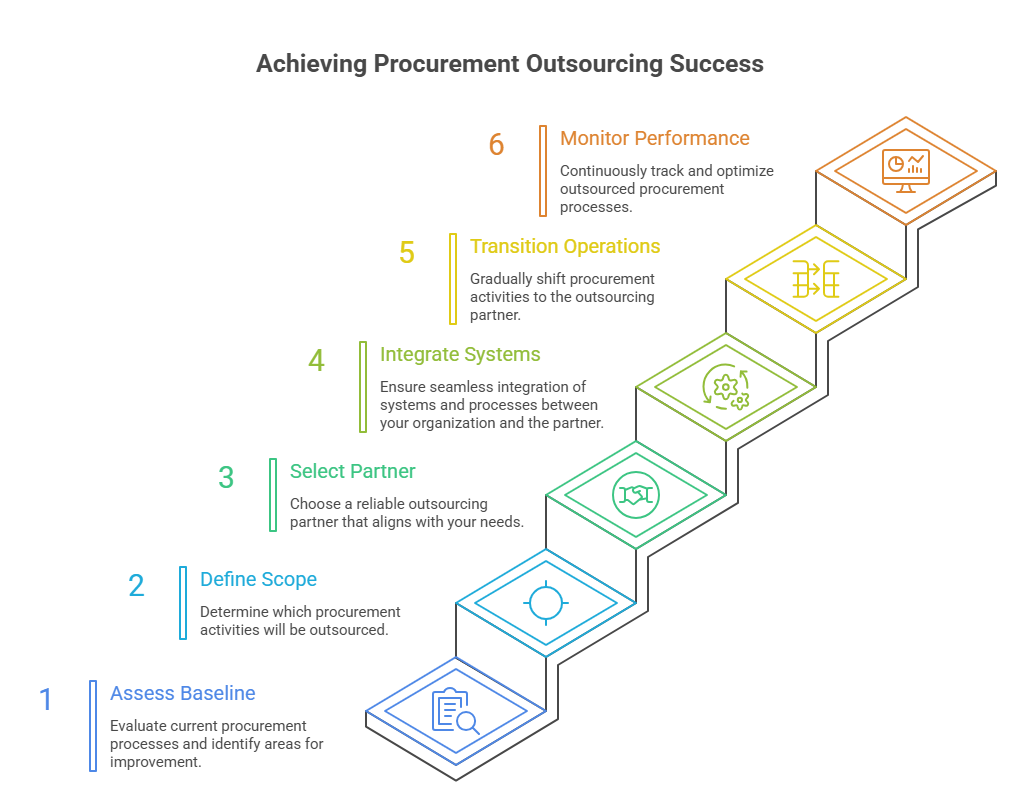
Successfully outsourcing procurement requires careful planning and execution. Without a clear implementation strategy, organizations may face challenges such as operational disruptions, stakeholder resistance, data inconsistencies, or unmet performance expectations. Following a structured process helps ensure a smooth transition, minimizes risk, and allows businesses to maximize the value of their procurement outsourcing investment from the outset.
Step 1: Assess Your Procurement Baseline
Before outsourcing any procurement function, organizations should conduct a comprehensive assessment of their current procurement environment. This includes analyzing spending patterns, supplier performance, procurement workflows, technology capabilities, and existing inefficiencies.
Establishing a clear baseline provides visibility into improvement opportunities and creates a benchmark for measuring future outsourcing success. It also helps identify which procurement activities are best suited for external management.
Step 2: Define the Scope of Outsourcing
Organizations must determine which procurement functions will be outsourced and which will remain in-house. Some businesses choose end-to-end procurement outsourcing to transfer responsibility for the entire procurement lifecycle, while others prefer selective outsourcing for specific activities such as sourcing, supplier management, or procurement analytics.
Clearly defining the scope prevents misunderstandings, establishes accountability, and ensures both parties share the same expectations regarding responsibilities and deliverables.
Step 3: Select the Right Outsourcing Partner
Choosing the right procurement outsourcing provider is critical to achieving long-term success. Businesses should evaluate potential partners based on their industry experience, category expertise, technology capabilities, service delivery model, and track record of measurable results.
A strong outsourcing partner should function as a strategic extension of the procurement team, providing both operational support and valuable insights that contribute to business objectives.
Step 4: Integrate Systems and Processes
Effective procurement outsourcing depends on seamless communication and data sharing between the organization and the service provider. This often requires integrating procurement platforms, ERP systems, supplier management tools, and reporting solutions.
Proper system integration improves visibility, enhances collaboration, and enables real-time access to procurement data, which supports faster and more informed decision-making.
Step 5: Transition Operations Gradually
Rather than transferring all procurement responsibilities at once, organizations should adopt a phased transition approach. Gradual implementation allows teams to address potential issues, refine processes, and ensure business continuity throughout the transition period.
A well-managed transition also helps employees, suppliers, and stakeholders adapt to new workflows while minimizing disruptions to day-to-day procurement activities.
Step 6: Monitor Performance and Optimize Continuously
Once procurement outsourcing is fully operational, organizations should regularly measure performance against predefined KPIs and service-level agreements. Metrics such as cost savings, supplier performance, procurement cycle times, compliance rates, and risk indicators provide valuable insight into outsourcing effectiveness.
Continuous monitoring allows businesses to identify improvement opportunities, strengthen provider relationships, and ensure procurement activities remain aligned with evolving business goals.
Organizations that leverage GenAI procurement operations outsourcing solutions can often accelerate implementation and optimization efforts. By using automation, predictive analytics, and intelligent process recommendations, these solutions help streamline transitions, improve decision-making, and deliver faster procurement outcomes.
Real-World Example: Capgemini’s Global Procurement Transformation
A recent example of procurement transformation comes from Capgemini, which sought to improve visibility and control across its global procurement operations. The company faced challenges stemming from fragmented systems, inconsistent processes, and limited transparency across its multi-billion-euro procurement spend.
The transformation resulted in approximately 95% of spend being brought under management, significantly improving procurement transparency, compliance, and operational efficiency. This illustrates how a structured procurement operating model, supported by technology and process standardization, can deliver the same benefits organizations seek through end-to-end procurement outsourcing.
This example is more relevant for a modern procurement outsourcing guide because it reflects current priorities such as digital procurement, spend visibility, process integration, and data-driven decision-making rather than a public-sector procurement framework developed years ago.
Procurement KPIs and Success Metrics
Implementing procurement outsourcing is only the first step; organizations must also measure whether the initiative is delivering the expected business value. Tracking the right procurement KPIs helps businesses evaluate cost savings, operational efficiency, supplier performance, and overall procurement effectiveness. By monitoring these metrics consistently, organizations can identify improvement opportunities, ensure accountability, and maximize the return on their outsourcing investment.
Cost Saving Metrics
- Total procurement cost reduction
- Cost avoidance percentage
Efficiency Metrics
- Cycle time reduction
- Purchase order processing speed
Supplier Metrics
- Supplier delivery performance
- Contract compliance rate
Spend Management Metrics
- Spend under management
- Maverick spending reduction
Operational Metrics
- Procurement workload reduction
- Automation rate
Companies using AI procurement operations outsourcing gain real-time KPI dashboards that improve decision-making speed.
Conclusion
Procurement outsourcing is no longer just a cost-saving strategy. It is a transformation lever for businesses aiming to scale efficiently, improve supplier relationships, and gain real-time visibility into spending.
By understanding outsourcing models, building a structured selection framework, and tracking the right KPIs, companies can fully leverage end-to-end procurement outsourcing as a competitive advantage.
Businesses that adopt these models early position themselves for stronger resilience and long-term growth.
FAQ
1. How long does it take to see results from procurement outsourcing?
Most organizations begin seeing measurable improvements within three to six months, depending on complexity. Full optimization of processes and supplier networks may take up to a year, especially when transitioning to structured outsourcing models.
2. Can procurement outsourcing work for small businesses?
Yes, small businesses benefit significantly from outsourcing because it removes the need for a large internal procurement team. It also improves supplier access, cost efficiency, and operational scalability without requiring heavy infrastructure investment or specialized procurement staff.
3. What technologies support modern procurement outsourcing?
Modern outsourcing often integrates ERP systems, spend analytics platforms, and AI-driven tools. These technologies enable better forecasting, supplier evaluation, and cost optimization, especially when combined with automation and intelligent procurement systems.
4. Is procurement outsourcing suitable for global expansion?
Yes, it is highly effective for global expansion because it provides access to regional supplier networks, ensures compliance with local regulations, and reduces the complexity of managing procurement across multiple countries and markets.