

A Complete Guide to Supply Chain Management Services for Enterprises

Last updated on April 24th, 2026

A delayed shipment. An unexpected supplier disruption. Rising freight costs. Excess inventory is sitting in one warehouse while another location runs out of stock. For many enterprises, supply chain problems do not begin with one dramatic failure; they build quietly through disconnected systems, reactive decisions, and processes that can no longer keep pace with growth.
That is why leading companies are rethinking how they operate. Instead of treating logistics, sourcing, inventory, and supplier coordination as separate functions, they are investing in integrated supply chain management services that improve visibility, reduce waste, and create faster, smarter decision-making across the business. In 2026, supply chain performance is no longer just an operational issue; it is a competitive advantage.
According to the OECD Supply Chain Resilience Review (2025), efficient logistics, transport, financial, and digital services are essential to smooth supply chain operations. The report also states that reducing barriers and improving interoperability can lower costs, improve flexibility, and strengthen supply chains, which directly supports why many companies turn to outsourced supply chain specialists with established capabilities.
Table of Contents
Why Supply Chain Management Matters More Than Ever
What Are Supply Chain Management Services?
Core Functions of Enterprise Supply Chain Services
Key Benefits for Growing Enterprises
Industry Applications Across High-Impact Sectors
How to Choose the Right Supply Chain Partner
Why Supply Chain Management Matters More Than Ever
Enterprise growth often creates complexity faster than internal teams can manage. As supplier networks expand and customer expectations rise, manual coordination becomes slower, costlier, and riskier. Consequently, even profitable businesses can experience delays, stock imbalances, and missed revenue opportunities.
Moreover, modern supply chains are affected by global events, changing regulations, and shifting demand patterns. Therefore, companies need structured systems and expert support rather than reactive fixes provided by capable supply chain management services.

What Are Supply Chain Management Services?
Supply chain management services help businesses plan, source, move, store, and deliver products more efficiently from supplier to customer. Rather than focusing on one isolated task, these services connect procurement, inventory, logistics, and fulfillment into one coordinated operational strategy.
Today, many companies also choose to outsource supply chain management functions to improve efficiency, reduce overhead costs, access specialized expertise, and scale faster without expanding internal teams. Instead of building every capability in-house, businesses use outsourcing to strengthen performance while staying focused on core growth priorities.
Typically, enterprise support for supply chain management may include:
- Procurement and supplier management
- Inventory planning and replenishment
- Logistics coordination
- Demand forecasting
- Returns and reverse logistics
- Risk monitoring
- Performance reporting
As a result, leadership teams gain better control over cost, service levels, and long-term scalability.
Core Functions of Enterprise Supply Chain Services
-
Strategic Sourcing and Supplier Coordination
Strong supplier relationships are essential, but unmanaged sourcing often creates inconsistency. A structured supply sourcing solution helps enterprises evaluate vendors, negotiate effectively, improve quality standards, and maintain continuity across categories.
In specialized sectors, this may also include telecom sourcing services for network equipment, infrastructure components, and vendor lifecycle management.
-
Risk Monitoring and Business Continuity
Supply disruptions can come from geopolitical issues, weather events, financial instability, or single-source dependency. Therefore, proactive risk planning is critical.
With modern supply risk management solutions, enterprises can identify vulnerabilities early, diversify suppliers, build contingency plans, and reduce the impact of unexpected disruption.
-
Inventory and Fulfillment Optimization
Too much inventory ties up cash. Too little inventory damages customer trust. Consequently, inventory optimization is one of the most valuable parts of an enterprise supply chain strategy.
Through better forecasting, reorder planning, and location balancing, businesses improve service levels while lowering carrying costs.
-
Reverse Logistics and Customer Experience
The sale is no longer the end of the journey. In many industries, returns are now a major operational function.
Professional returns management services help companies process returns faster, recover inventory value, improve customer satisfaction, and reduce manual workload across support teams.
-
Operational Coordination and Daily Execution
Even the best strategy fails without execution. That is why many enterprises rely on scalable supply chain support services for reporting, vendor communication, shipment coordination, documentation, and day-to-day process management.
As operations grow, this support becomes essential for consistency and speed.
Key Benefits for Growing Enterprises
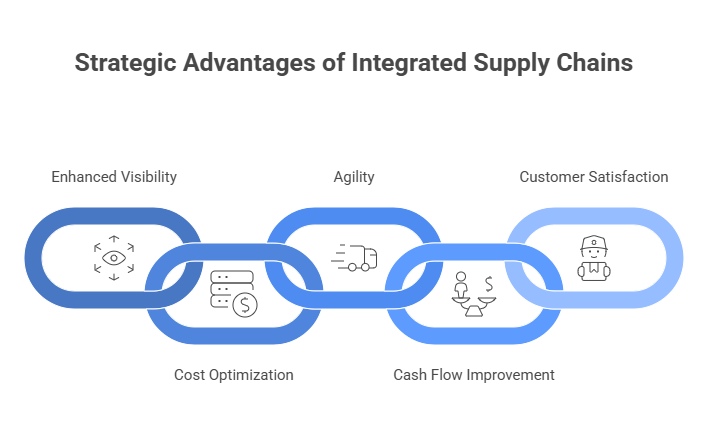
1. Better Visibility Across Operations
Disconnected systems create blind spots. However, integrated supply chain services provide clearer insight into suppliers, inventory, demand, and fulfillment performance.
2. Lower Costs Without Cutting Service
Smarter sourcing, optimized inventory, and stronger planning reduce waste while protecting customer experience.
3. Faster Response to Change
When demand shifts or disruptions happen, structured workflows enable quicker decisions and faster execution.
4. Improved Cash Flow
Balanced stock levels and stronger supplier terms reduce unnecessary working capital pressure.
5. Stronger Customer Satisfaction
Reliable delivery, accurate stock availability, and smoother returns all improve customer loyalty.
Industry Applications Across High-Impact Sectors
Agriculture and Distribution
Complex seasonal demand and regional fulfillment challenges require strong coordination. That is why many organizations invest in agriculture distribution support services to improve product movement, supplier alignment, and delivery readiness.
Automotive and Industrial Supply Chains
High-volume parts environments depend on timing and precision. As a result, enterprises use automotive/industrial parts supply chain BPO services to improve supplier scheduling, inventory flow, and procurement efficiency.
Ecommerce and Direct-to-Consumer Brands
Fast shipping expectations and volatile demand make agility essential. Therefore, brands increasingly rely on eCommerce D2C brand supply chain BPO services to improve fulfillment coordination, inventory planning, and customer delivery performance.
How to Choose the Right Supply Chain Partner
Not all providers deliver strategic value. Therefore, evaluate partners based on:
- Industry experience
- Scalability across locations
- Reporting and visibility capabilities
- Procurement and sourcing expertise
- Risk management processes
- Technology readiness
- Process discipline and communication standards
The right partner should improve performance, not add complexity.
Why Businesses Choose Vserve for Supply Chain Management
Vserve helps enterprises streamline sourcing, procurement, and operational workflows through scalable support models designed for real business outcomes.
With Vserve, companies gain:
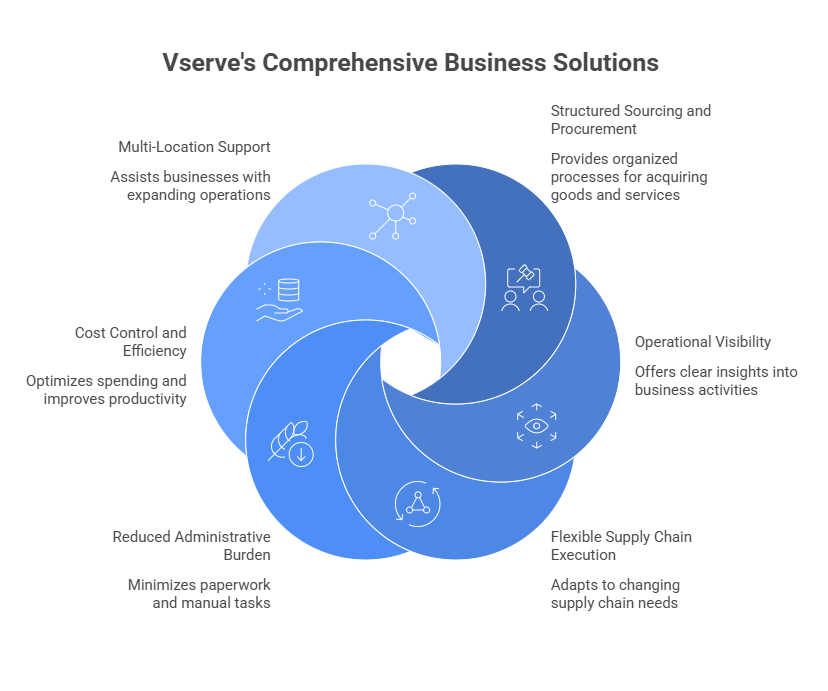
- Structured sourcing and procurement support
- Better operational visibility
- Flexible supply chain execution capacity
- Reduced administrative burden
- Stronger cost control and efficiency
- Reliable support for growing multi-location operations
 Whether the challenge is supplier coordination, inventory pressure, or process inefficiency, Vserve helps transform complex operations into manageable, scalable systems.
Conclusion
Modern supply chains require more than logistics management; they require visibility, agility, and coordinated execution across every moving part of the business. Throughout this guide, we explored how supply chain management services help enterprises solve common challenges such as sourcing inefficiencies, rising operational costs, inventory imbalances, supplier risk, and returns complexity.
By combining strategic sourcing, risk planning, inventory optimization, operational support, and data-driven decision-making, enterprises can build stronger and more resilient operations. Most importantly, the right partner turns supply chain complexity into measurable performance gains. With Vserve, businesses gain the expertise and support systems needed to scale efficiently, improve control, and compete with confidence.
Frequently Asked Questions
1. What are supply chain management services for enterprises?
Supply chain management services help enterprises manage sourcing, procurement, inventory, logistics, supplier coordination, and operational planning. These services improve efficiency, reduce costs, and create stronger control across complex multi-location business operations.
2. How do supply risk management solutions help businesses?
They help identify supplier vulnerabilities, reduce dependency risks, improve contingency planning, and strengthen business continuity. As a result, companies can respond faster when disruption occurs.
3. Why are returns management services important?
Returns affect cost, customer satisfaction, and inventory accuracy. A structured returns process helps businesses recover value faster while reducing manual delays and operational friction.
4. What industries benefit most from supply chain support services?
Manufacturing, telecom, agriculture, retail, ecommerce, healthcare, and distribution businesses often see strong results because they depend on supplier coordination, inventory flow, and timely fulfillment.
5. How do I choose the right supply chain outsourcing partner?
Look for proven experience, scalability, reporting strength, sourcing expertise, communication standards, and the ability to solve operational problems with measurable results.