


Last updated on December 26th, 2025
This is a digital-first universe, and the rise of online shopping has completely transformed how businesses operate. Consumers now prefer tapping screens over walking around aisles of shopping malls. This has pushed small and large brands to dive into the world of eCommerce store development and digital marketing.
This global eCommerce market is growing consistently each year, as even the smallest business can now reach global audiences. They can compete with industry giants and open up new channels of revenue. The global e-commerce sales are projected to hit around US $6.86 trillion in 2025, up from about US $4.98 trillion in 2021.
However, success is not guaranteed. Studies reveal that nearly 80–95% of eCommerce startups fail within their first few years. Though it is easy to build a store, running one successfully and getting results long term is another story altogether. Insufficient funding, inefficient eCommerce web development, and poor marketing strategies often are the top reasons for failure.
Many new businesses adopt a “trial and error” approach. But truth be told, a strategic roadmap can do wonders. It can help you reduce risks, maximize returns, and build a sustainable eCommerce empire.
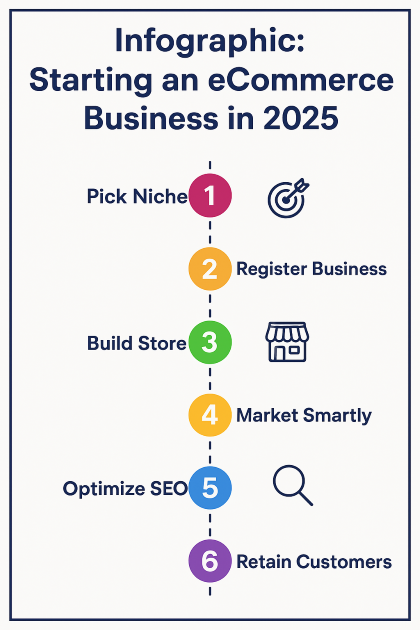
So here’s your eCommerce startup guide. This is an elaborate blueprint to help you launch and sustain a successful online store right from scratch.
Table of Contents
Understanding the Basics of eCommerce Business Models
eCommerce Business Registration
Choosing The Right eCommerce Software
Attracting Customers To Your Site
Email Marketing for eCommerce Business
Understanding the Basics of eCommerce Business Models
It’s tempting to dream big. But remember, every eCommerce model has its own structure. What works for one business may not suit another.
If you’re a small business owner with limited funds, a dropshipping model may be your best bet. It allows you to sell products through third-party vendors. Here, you do not have to maintain an inventory. Tools like Oberlo, a Shopify plugin, can make this entire process easy for you.
Now, you may have a product idea that is unique, but you lack manufacturing capacity. You can consider custom manufacturing, private labeling, or white labeling. Here, your products are made and branded for you. You get exclusivity without factory investments.
The secret is to choose a business structure that aligns with your capabilities. You have your own goals and budget, not someone else’s success story.

eCommerce Niche Selection
Tools like Google Trends, Keyword Planner, or even community forums like Reddit and Quora can guide you. They tell you about the trending products and the untapped markets.
For example, “electronics” is a broad category, while “mobile accessories” is a profitable micro-niche within it.
Selecting a niche helps you:
- Build a sharper brand identity.
- Increase demand consistency.
- Attract the right audience.
Understand your audience. Who are they? What do they need? What problems can you solve?
Competitive product pricing is the key to success. Ideally, offer 35–50% profit margins. Avoid products with thin margins or those requiring heavy infrastructure.
And above all, follow your passion. Without genuine enthusiasm for your product, no strategy can keep your store alive long-term.
eCommerce Business Registration
Once your plan takes a definite shape, it is time to formalize it. Legal registration not only protects your business but also builds credibility.
Steps to register your business:
- Choose a name that’s memorable and SEO-friendly.
- Get an Employer Identification Number (EIN) to manage taxes and open a business account.
- Acquire the required licenses and permits.
- Create a professional logo and maintain consistent branding visuals.
Having your business registered sets a firm foundation before you jump into eCommerce Store Development.
eCommerce Store Development
Here’s where your idea transforms into a living, digital storefront.
The process includes:
- Registering your domain name (via GoDaddy.com or Domain.com).
- Designing your website using platforms like Shopify, WordPress, or BigCommerce.
- Configuring the right eCommerce web development framework.
- Launching and testing your store.
If you’re still not confident, try partnering with an experienced eCommerce outsourcing services provider. This can save you time and frustration. Bringing both design and expertise, they ensure that your store looks professional and operates smoothly.

Choosing The Right eCommerce Software
Selecting the ideal eCommerce store development platform is crucial. Consider these features:
- Compatibility with multiple payment gateways.
- A secure checkout system.
- SEO-friendly architecture and responsive design.
- Adaptability to your business structure.
- Excellent backend support and scalability options.
Magento is perfect for those who have technical expertise. It’s open-source and customizable with a big scope for your store, but you need developer input to bring your store to life.
BigCommerce offers SaaS-based ease. Ideal for non-tech users, it comes with a monthly subscription.
Shopify is intuitive and design-friendly. It is less flexible when it comes to SEO.
For smaller businesses, opt for simplicity. Choose a platform that’s cost-effective and efficient. It should fit your vision without excess features.
Selling In A Marketplace
Want to test the waters before diving in? Start selling on marketplaces like Amazon FBA.
Marketplaces offer instant access to massive audiences. However, they do often come with trade-offs, like reduced profit margins and limited control.
You can blend both strategies. You can sell on marketplaces to gather insights and simultaneously build your own eCommerce store to develop long-term brand value.
Attracting Customers To Your Site
Your online store is not a place where you just wait for buyers to appear. Once your eCommerce web development project goes live, it is time to draw them in.
Use SEO to get your website ranking high on Google. Use tools like Ahrefs, Google Keyword Planner, and SEMrush to get trending keywords. Identify search terms relevant to your niche.
Use long-tail keywords to attract a more targeted audience. Optimize every product page, URL, and blog post.
Create social media presence across Facebook, Instagram, and X (Twitter). This will increase your engagement and awareness.
For startups, cost-effective marketing methods like SEO, content marketing, and email campaigns can yield good returns. They are less expensive than ad campaigns.
Increase Sales
Driving traffic is one thing; converting it is another. Design your site for usability.
Focus on:
- Seamless navigation.
- A quick and simple checkout.
- Well-written, informative product descriptions.
- Live chat and email support for any immediate assistance.
Tools like Google Analytics or Buzzsumo help you measure performance. These analytics tools help you understand user behavior.
Email Marketing for eCommerce Business
Email marketing builds long-term relationships with your customers. Start with a subscriber list. Offer incentives when you can. Give discounts, exclusive deals, and early access.
Send regular updates on any new arrivals, shipping details, and sales events. Be consistent and authentic with email campaigns. Personalize while creating email campaigns to get repeat purchases.
FAQs
1. What is the best platform for eCommerce store development?
For startups, Shopify or BigCommerce are great choices. For larger businesses needing customization, Magento excels.
2. How do eCommerce outsourcing services help new businesses?
They handle everything from web development to marketing. They help startups save time and scale faster.
3. How Important Is SEO in eCommerce web development?
It is extremely important. SEO ensures visibility, traffic, and conversions.
4. What’s the ideal profit margin for eCommerce products?
Aim for 35–50% margins to balance costs and competitiveness.
5. Should I sell on my own site or marketplaces like Amazon?
A mix of both works best. Use marketplaces for reach, and your site for brand identity.
Conclusion
Copying existing models is not going to help you launch an eCommerce business. You need to craft your own. Find a clear niche and a reliable eCommerce web development partner. This is because strong marketing strategies can make all the difference.
The new-age entrepreneur uses a channelized approach and consistent marketing. Besides, adaptability gives you the edge. Yet, if time and resources hold you back, eCommerce
Outsourcing Services like Vserve can help you. They help you focus on what you do best: growing your business.
We’d love to hear your thoughts. Share your experiences and perspectives in the comments below to keep the conversation alive.
Want more insights on offshore customer support and the latest trends? Follow Vserve on Facebook, Instagram, and LinkedIn. Stay connected with us as we explore and navigate the fast-shifting world of eCommerce together.
Ready To Build Your eCommerce Dream?
Partner with Vserve, your trusted eCommerce Outsourcing Services expert. From eCommerce Store Development to digital marketing and backend support, we help you scale efficiently, cost-effectively, and globally.
Connect with our specialists today!
Suggested Reads
Why Businesses Are Turning to Outsource Email Support Services for 24/7 Customer Care – Discover why outsourcing customer care is a game-changer.
Outsource Email Support Services to the Philippines: Here’s How to Pick the Perfect BPO – Learn how to choose the right outsourcing partner.
Key Considerations in Store Development: From Concept to Launch – Steps to build a flawless eCommerce store efficiently.
How a Store Management Virtual Assistant Can Free Up Your Time and Increase Efficiency – See how virtual assistants streamline store management.