


Last updated on January 2nd, 2026

Data is no longer stored quietly in spreadsheets. It constantly gives signals about how your business is performing. In today’s retail world, data drives decisions, shapes customer journeys, and predicts buying intent even before a shopper clicks “add to cart.”
For eCommerce brands facing heavy competition, intuition alone is not enough. To maintain steady traffic and real conversions, your eCommerce business must create experiences that go beyond physical limits. Screens replace store shelves. Dashboards replace guesswork.
This is where retail business intelligence plays an important role. It acts as a silent support system that answers sales questions, uncovers gaps, and simplifies decision-making. Retail business intelligence does more than collect data. It explains it. It brings order to complex information. And it turns numbers into clarity and confidence.
Table of Contents
What Is Retail Business Intelligence?
Retail Business Intelligence Solutions for Your eCommerce Business
eCommerce Business Intelligence to Identify Profitable Customers and Increase Sales
How Does an eCommerce Business Intelligence Work?
The Techniques in eCommerce Business Intelligence
Factors to Consider While Using Retail Business Intelligence
Frequently Asked Questions (FAQ)
What Is Retail Business Intelligence?
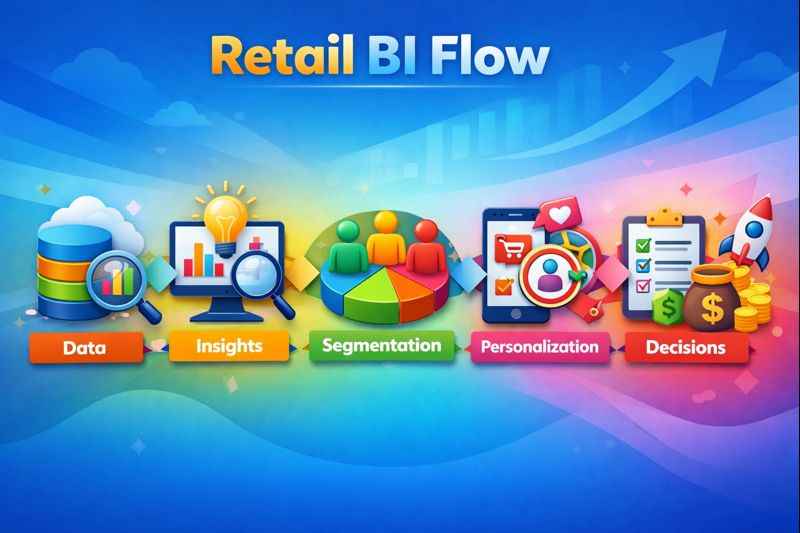
Retail business intelligence focuses on collecting, processing, and analyzing data created across your eCommerce ecosystem. This includes customer behavior, sales results, marketing campaigns, pricing changes, and market trends.
Using business intelligence in e commerce, raw data is transformed into dashboards, visual reports, and clear insights. This reduces manual work, speeds up decisions, and removes uncertainty. A strong retail intelligence platform helps businesses understand what is happening, why it is happening, and what could happen next.
In simple words, it connects information that would otherwise remain disconnected. A large majority of retailers are prioritizing data-driven decisions: Over 78% of retailers say data-driven decision-making is a key priority, and 66–71% are adopting advanced analytics and AI-based tools (including BI) to improve operations like customer insights and pricing optimization.
Retail Business Intelligence Solutions for Your eCommerce Business
Business intelligence eCommerce tools help businesses make smarter decisions using customer, competitor, and market data. When used correctly, these solutions improve visibility and sharpen business strategies.
Some key retail business intelligence solution capabilities include:
- Advanced customer segmentation based on buying history and behavior
- Personalized customer journeys with targeted discounts and offers
- Identifying trending products and adjusting prices in real time
- Customer churn analysis to improve retention
- Customer lifecycle tracking to find areas for improvement
With business intelligence for retail industry use cases growing fast, eCommerce brands can respond quicker than competitors.

eCommerce Business Intelligence to Identify Profitable Customers and Increase Sales
Not all customers contribute the same value. Some only browse, and some buy once. Others return again and again.
eCommerce business intelligence helps you identify which customers bring the most profit. By studying purchase behavior, order frequency, order value, and engagement signals, retail business intelligence highlights customers worth focusing on.
It also explains why customers leave. Retention becomes easier when exit reasons are clear. Marketing campaigns become stronger when preferences are known. Business intelligence allows sales teams to focus their efforts where revenue naturally grows.
Profit is not always about finding new customers. Often, it is about understanding the customers you already have.
How Does an eCommerce Business Intelligence Work?
When working with online retailers, business intelligence in e commerce follows a structured process that turns data into insights.
Data Quality Management
Accurate insights depend on accurate data. Data quality management ensures data is correct, consistent, and complete across all sources. Each eCommerce business creates its own process based on its systems. A reliable retail intelligence platform works across tools while maintaining data accuracy.
Data Integration
Data is collected from multiple sources such as CRM systems, social media platforms, eCommerce tools, and marketing software. This information is stored in a central location. From there, business intelligence eCommerce tools analyze the data and generate insights that can be acted upon.
Customer Segmentation and Advanced Analytics to Instill Deeper Insights
Customers are grouped using behavior, demographics, and interests. External data from social platforms adds more depth. AI-powered retail business intelligence systems then suggest actions. Web pages become personalized. Checkout becomes easier. Purchase encouragement happens smoothly and quietly.

The Techniques in eCommerce Business Intelligence
1) Data Visualization
Raw numbers can be accurate but hard to understand. Data visualization converts data into charts, graphs, and dashboards that clearly show patterns. With visuals, teams understand performance faster. Sales trends appear. Conversion gaps become visible. Decisions are made faster.
This technique alone can improve revenue, customer retention, and acquisition.
2) Reporting
Reporting is where business intelligence for retail industry supports management teams. Sales reports, performance summaries, reconciliation reports, and cost-saving reports are automated. These reports are shared regularly with stakeholders, keeping everyone aligned without manual follow-ups.
3) Data Mining
Data mining finds hidden links between different data points. It is used for:
- Shopping basket analysis
- Fraud detection through behavior tracking
- Identifying product combinations
- Customer risk analysis
- Compilation analysis
These insights directly influence marketing and merchandising strategies.
4) Statistical Analysis
Statistical analysis confirms whether trends are reliable. Patterns, behavior changes, and performance shifts are measured using numbers and probabilities. This ensures that decisions based on retail business intelligence are backed by facts, not assumptions.

Factors to Consider While Using Retail Business Intelligence
When using retail business intelligence, businesses should:
- Set clear goals for each use case
- Follow structured change management practices
- Choose tools designed specifically for eCommerce
- Work with vendors that offer long-term technical and strategic support
Choosing the right retail business intelligence solution decides whether insights stay theoretical or drive real growth.
Frequently Asked Questions (FAQ)
1. What is retail business intelligence in eCommerce?
Retail business intelligence uses data analysis to improve sales, customer experience, and decision-making for eCommerce businesses.
2. How does business intelligence eCommerce data improve sales?
It identifies trends, profitable customers, pricing opportunities, and churn risks, enabling smarter sales strategies.
3. Is business intelligence for retail industry suitable for small businesses?
Yes, many retail intelligence platforms are scalable and suitable for small and growing businesses.
4. What data sources are used in business intelligence in e commerce?
Common sources include CRM systems, transaction data, marketing tools, and social media platforms.
5. Can retail business intelligence predict customer behavior?
Yes, advanced analytics and AI models help predict buying patterns and preferences.
Conclusion
Retail markets are no longer guided by instinct alone. They are driven by data signals. Retail business intelligence helps decode those signals and turn uncertainty into clear direction.
By understanding changing needs and applying BI techniques carefully, eCommerce brands gain visibility into trends, customer intent, and market movement. Sales increase not by chance, but by thoughtful planning and informed decisions.
Drive Smarter Decisions With Vserve
Vserve offers advanced business intelligence solutions that help you analyze every data point across your eCommerce ecosystem. From customer behavior to competitive insights, Vserve helps you see clearly, act confidently, and grow strategically in today’s crowded digital marketplace.
Suggested Reads
https://vservesolution.com/blogs/top-7-operational-benefits-of-business-intelligence-services/ – Operational advantages gained through effective business intelligence adoption
https://vservesolution.com/blogs/how-to-use-business-intelligence-in-eCommerce-sales-a-universal-guide/ – Step-by-step guide to using business intelligence in eCommerce
https://vservesolution.com/blogs/ways-to-find-the-right-business-intelligence-solution-provider/ – How to choose the right business intelligence partner
https://vservesolution.com/blogs/8-tips-to-frame-perfect-business-intelligence-strategy/ – Practical tips for building a strong BI strategy