



Last updated on January 30th, 2026
Running an e commerce site selling business in 2026 is not so easy. Trends rise, dip, vanish, and return wearing new names. Yet some things remain stubbornly important. One of them is how customers search. Another is how you protect your margins while selling across online retail platforms and eCommerce marketplace selling business models.
Today’s shoppers are restless. They tap, speak, swipe, mistype, abandon, and return. If your eCommerce site search cannot keep up, even the best products lose their voice. That is why modern eCommerce search features are no longer bonuses. They are survival tools. They help trending eCommerce websites stay discoverable, usable, and profitable.
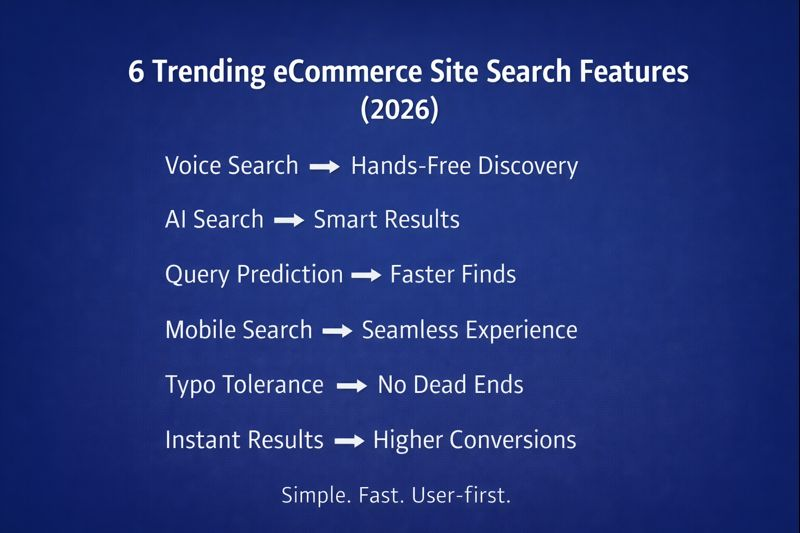
This guide revisits and reshapes the six essential eCommerce site search features for 2026. The plan remains familiar, but the expectations are sharper. When implemented correctly, these features power the best eCommerce search experiences and quietly protect your profit margins.
Table of Contents
Voice Search and eCommerce Search Platform Evolution
Artificial Intelligence and eCommerce Search Engine Intelligence
Anticipating Search Queries in eCommerce Website Search
Mobile-Optimized Search For Online Shopping Web Page Success
Accommodate Typos With eCommerce Search Best Practices
Quick Search Results and eCommerce Onsite Search Speed
Frequently Asked Questions (FAQ)
1. Voice Search and eCommerce Search Platform Evolution
Voice search no longer feels futuristic. It feels normal. Smart speakers, in-car assistants, and mobile voice tools are now a part of daily life. By the middle of this decade, voice-driven interactions became a natural habit across trending eCommerce sites.
For eCommerce website search, voice search introduces new complexity. Queries are longer, and language is casual. Intent is layered. A strong eCommerce search solution must understand tone, context, and meaning rather than just keywords.
A voice-enabled search engine for eCommerce websites must distinguish between product names, attributes, quantities, and even vague human phrasing. When done well, voice search removes friction. It lets users shop while cooking, walking, or multitasking. That convenience quietly boosts conversions and encourages online platforms to sell products.
2. Artificial Intelligence and eCommerce Search Engine Intelligence
Artificial intelligence has matured. It is no longer a buzzword floating above strategy decks. It is embedded inside eCommerce search platforms, learning silently from every click, scroll, and exit.
AI-powered eCommerce site search analyzes customer behavior patterns, purchase history, and browsing signals. It then adjusts results in real time. This is how trending eCommerce websites feel personal without being intrusive.
AI also encourages eCommerce analytics tools by connecting search behavior with conversion data. It helps online retail platforms identify what customers want before they clearly say it. For any e commerce marketplace selling business, AI-driven search relevance is now a baseline expectation.

3. Anticipating Search Queries in eCommerce Website Search
Anticipation is quite a help here. Autocomplete and autosuggestion features guide users without interrupting them. They shorten search time and reduce frustration. They quietly improve results.
In eCommerce onsite search, anticipating queries means understanding popular terms, seasonal behavior, and product relationships. Autosuggestions play in a similar fashion to familiar search engines, making users feel instantly comfortable on your site.
For business tips selling online insights, this feature also reduces bounce rates. Customers reach relevant products faster. Faster discovery often equals faster decisions.
4. Mobile-Optimized Search for Online Shopping Web Page Success
Mobile traffic dominates today. Fingers are clumsy, and screens are small. Besides, patience is thin.
A mobile-optimized eCommerce site search respects these realities. Search boxes must be visible, accessible, and readable. Results must load smoothly. Filters must respond without hesitation.
For business owners with e commerce platform selling, mobile search optimization directly affects conversion rates. A poorly placed search box or cramped input field can quietly drain revenue across online retail platforms.
Tip: A 27-character search box still works well in 2026. It balances visibility with usability.

5. Accommodate Typos With eCommerce Search Best Practices
Humans make mistakes, fingers slip, and autocorrect rebels. Names are forgotten.
Strong eCommerce search best practices include typo tolerance and intelligent spell checking. A resilient eCommerce search engine recognizes misspellings, brand variations, and phonetic similarities.
This flexibility causes users to trust a brand. Customers feel understood rather than corrected. Over time, this kindness improves engagement and supports consistent growth across eCommerce marketplace selling business models.
6. Quick Search Results and eCommerce Onsite Search Speed
Speed remains sacred. Slow search results quietly kill intent.
Even the most advanced eCommerce search solution fails if it hesitates. Users expect near-instant results, regardless of catalog size. Search speed influences perception. Fast results suggest reliability. Slow results suggest friction.
For web commerce solutions, ongoing performance monitoring makes a huge difference. Continuous optimization ensures that eCommerce website search remains responsive even during peak traffic periods.

Frequently Asked Questions
1. What are eCommerce search features?
eCommerce search features help users find products quickly and accurately on a website.
2. Why is eCommerce onsite search important?
It improves user experience and directly impacts conversions and revenue.
3. How does AI improve eCommerce search?
AI personalizes results and improves relevance using behavioral data.
4. Is voice search necessary in 2026?
Yes, voice search is now an expected convenience across trending eCommerce websites.
5. Can better search protect profit margins?
Yes, efficient search reduces drop-offs and increases conversion efficiency.
Conclusion
Search is a conversation between your brand and your customer. In 2026, eCommerce site search must feel fast, forgiving, and intuitive. When these six features work together, they create search journeys that feel effortless.
The best eCommerce site search experiences guide. They anticipate and respond. And in doing so, they protect margins while supporting growth across online retail platforms.
At Vserve, we help businesses design and optimize eCommerce search solutions that convert curiosity into revenue. From intelligent eCommerce search platforms to analytics-driven optimization, our experts build search experiences that scale. From operating a single online shopping web page or a full eCommerce marketplace selling business, Vserve helps you grow efficiently while protecting your profit margins.
Suggested Reads
https://vservesolution.com/blogs/eCommerce-map-monitoring-your-guide-to-grow-and-protect-your-profit-margin/ – Deep dive into MAP monitoring strategies and profit protection
https://vservesolution.com/blogs/emerging-business-opportunities-2025/ – Insights into fast-growing digital commerce opportunities
https://vservesolution.com/blogs/eCommerce-product-data-entry-solutions/ – How structured product data improves eCommerce performance
https://vservesolution.com/blogs/eCommerce-call-center-outsourcing-strategies/ – Customer support strategies for scalable eCommerce growth