


Last updated on January 9th, 2026
Remote work is no longer a response to disruption. In 2025, it is a deliberate business model.
Recent workforce trends show that many eCommerce businesses continue to expand their use of consultants, contract specialists, and intermittent employees. 62% of eCommerce businesses use freelancers or remote contractors for specialized tasks, showing a significant share of companies relying on non-permanent talent. Virtual teams are no longer an experiment. They are infrastructure.
Yet building a successful virtual team still comes with challenges. Culture does not form naturally when people are separated by screens and time zones. Alignment must be designed. Expectations must be written, and communication must be intentional.
For businesses working with virtual assistants for eCommerce, communication remains the single most important factor. Overcommunication is not excess but an insurance. In a remote environment where people work independently toward shared goals, clarity keeps momentum alive.
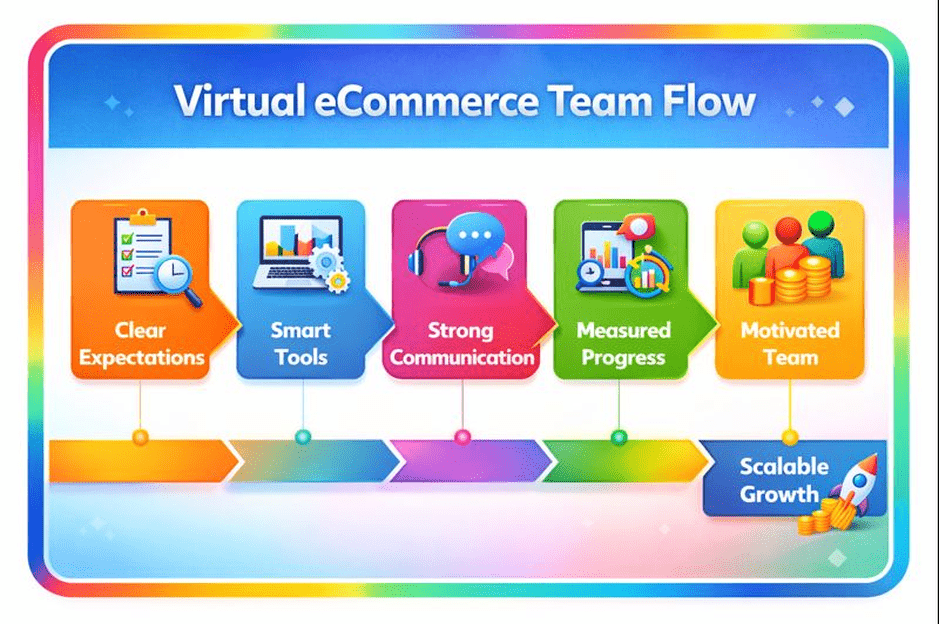
Below are 10 tried and tested tips to manage your virtual eCommerce team in 2025, especially if you rely on eCommerce virtual assistant services or plan on hiring a virtual assistant for eCommerce.
Table of Contents
Set Clear Expectations for eCommerce Virtual Assistant Teams
Be Specific About the Deadlines
Agree Upon a Process When You Hire eCommerce Virtual Assistants
Don’t Just Type, Talk With Virtual Assistants for eCommerce
Set Targets Based on eCommerce Virtual Assistant Skills
Track Progress Without Micromanagement
Use the Right Tools for eCommerce Virtual Assistant Services
Encourage and Reward Your Virtual eCommerce Team
Frequently Asked Questions (FAQ)
1. Set Up a Meeting Rhythm
In 2025, async work is common. But alignment still needs touchpoints.
During the early stages of working with an eCommerce virtual assistant, regular meetings help establish clarity around goals, workflows, and expectations. Daily check-ins may work for some teams. Weekly reviews work for others.
What matters is consistency. Each meeting should have a reason. Each conversation should end with clear next steps. Ask your team to document meeting notes so nothing gets lost across platforms or time zones.
2. Have Your Calendar Available
Availability should never feel mysterious.
Share your calendar with your remote team so your virtual assistants for eCommerce know when you are reachable and when you are focused. This reduces unnecessary interruptions and encourages thoughtful communication.
Block time for collaboration, and block time for deep work. In 2025, boundaries are productivity tools.

3. Set Clear Expectations for eCommerce Virtual Assistant Teams
Unspoken expectations create silent friction.
When working with eCommerce virtual assistant services, document everything. Note down the working hours, reporting frequency, task ownership, approval processes, and tools to be used.
Clarity gives your eCommerce virtual assistant confidence. Confidence improves output, and ambiguity slows everything down.
4. Be Specific About the Deadlines
Speed matters in eCommerce. When you hire eCommerce virtual assistants, define deadlines clearly. Use dates, use time zones, and confirm feasibility.
Deadlines should guide effort, not create panic. A quick question today prevents missed delivery tomorrow.
5. Agree Upon a Process When You Hire eCommerce Virtual Assistants
Processes scale people. Define how instructions are shared, how tasks move from request to completion, how revisions are handled, and how escalation works.
With a defined process, your eCommerce virtual assistant delivers consistent quality whether managing product listings, order workflows, content updates, or store maintenance.
6. Don’t Just Type, Talk With Virtual Assistants for eCommerce
Text is fast, and voice is clearer. In 2025, video communication is frictionless. Use it. A short call often resolves what hours of messages cannot.
With nearly 90% of communication being non-verbal, face-to-face interaction helps prevent misinterpretation. Use Zoom, Google Meet, Slack huddles, or quick stand-up calls. Talking restores human context.
7. Set Targets Based on eCommerce Virtual Assistant Skills
Direction drives results. Studies continue to show that written goals significantly increase achievement rates. Set KPIs aligned with eCommerce virtual assistant skills.
Keep sales targets for sales support teams, accuracy metrics for catalog teams, and conversion improvements for optimization roles.
Document goals, review them, and adjust them. Goals turn effort into measurable growth.
8. Track Progress Without Micromanagement
Visibility does not require control. Use tools like Asana, Trello, or ClickUp to track progress transparently. These platforms allow your eCommerce virtual assistant services team to update work naturally while giving you insight into timelines and bottlenecks.
Trust supported by systems works better than supervision driven by anxiety.
9. Use the Right Tools for eCommerce Virtual Assistant Services
Efficiency depends on enablement. When hiring a virtual assistant for eCommerce, provide tools that reduce friction. Email alone is outdated. Use Slack for communication, and Google Drive for shared access. Use Zoom for discussions, and Trello or ClickUp for task flow.
Train your team. Keep the tech stack simple, as complexity slows execution.
10. Encourage and Reward Your Virtual eCommerce Team
Recognition still matters, especially remotely. Acknowledge achievements, celebrate consistency, and reward initiative. Review meetings should include appreciation, not just corrections.
When virtual assistants for eCommerce feel valued, they contribute beyond assigned tasks. They anticipate needs, and they solve problems early.
Frequently Asked Questions (FAQ)
1. What are virtual assistants for eCommerce?
Virtual assistants for eCommerce are remote professionals who manage operational, technical, and support tasks for online stores.
2. How do eCommerce virtual assistant services support growth?
They improve efficiency, reduce overhead, and allow businesses to scale without increasing internal complexity.
3. Which eCommerce virtual assistant skills are most valuable in 2025?
Platform knowledge, data accuracy, communication, adaptability, and analytical thinking are critical.
4. Is hiring a virtual assistant for eCommerce still effective in 2025?
Yes. It remains one of the most cost-effective ways to access specialized skills on demand.
5. How do I ensure accountability with an eCommerce virtual assistant?
Clear expectations, documented processes, regular check-ins, and transparent tracking tools ensure accountability.
Conclusion
Remote work in 2025 is not temporary. Managing a virtual eCommerce team requires structure, clarity, and trust. Businesses that invest in communication and systems scale faster and operate leaner. Those that resist remote adaptation fall behind quietly.
Virtual teams are no longer a backup plan. They are a competitive advantage.
Drive Smarter Growth With Vserve
Vserve provides reliable eCommerce virtual assistant services tailored for modern eCommerce businesses. From skilled virtual assistants for eCommerce to dedicated program managers and 24×7 support, Vserve helps you scale efficiently while maintaining control and quality.
Contact Vserve for your execution to run smoothly while you focus on growth.
Suggested Reads
https://vservesolution.com/blogs/eCommerce-product-data-entry-solutions/ – Accurate listings, faster uploads, and structured product catalog management.
https://vservesolution.com/blogs/eCommerce-call-center-outsourcing-strategies/ – Customer communication strategies for higher satisfaction and retention.
https://vservesolution.com/blogs/eCommerce-support-services-for-business/ – End-to-end operational support for growing eCommerce brands.
https://vservesolution.com/blogs/emerging-business-opportunities-2025/ – Key trends shaping digital commerce and service outsourcing.