


Last updated on December 31st, 2025

Retail businesses are changing fast. Technology moves quickly. New ideas appear and disappear almost every day. Many sellers who once depended on brick-and-mortar stores are now thinking it is apt to shift to online platforms. As a result, the digital marketplace feels more crowded and competitive than ever. Customers are surrounded by choices. Their buying decisions are shaped by online reviews, product details, images. They look at how well a catalog is organized.
In these times, customer satisfaction and conversion rates depend heavily on your catalog. A clear, consistent, and reliable catalog builds confidence. It helps customers move forward instead of stepping away. This is why catalog content management matters more than ever.
Strong content and catalog management ensures that customers find the right information at the right moment. It keeps product data accurate, visible, and easy to understand. In simple words, catalog content becomes the quiet engine behind your online growth.
Are you planning to build a catalog that feels simple, useful, and persuasive at the same time? Below are 11 practical tips to help you develop and maintain catalog content that supports big goals.
Table of Contents
Focus on Data Quality in Catalog Content Management
Keep Your Content Updated for Better Catalog Content
Create Impactful Product Descriptions With Catalog Content
Optimize Your Product Content for Content and Catalog Management
Categories Your Products for Strong Catalog Content Management
Include Upselling and Cross-Selling Features
Find the Right eCommerce Catalog Content Management Tool
Partner With eCommerce Product Catalog Services
Frequently Asked Questions (FAQ)
Focus on Data Quality in Catalog Content Management
Do visitors trust your product information? Do they feel safe clicking “Buy Now”?
If the answer feels uncertain, data quality may be the reason. Customers look for accurate, complete, and consistent data. Trust builds slowly but strongly. When catalog content changes from page to page, customers hesitate, and sometimes, they leave.
Good catalog content management means keeping product names, descriptions, prices, sizes, and specifications aligned across the entire catalog. This gives customers confidence that the information is real and dependable. Clear data removes doubt. Doubt kills conversions.
Keep Your Content Updated for Better Catalog Content
Product details may stay stable, but inventory does not remain stable. Stock levels change. New products arrive, and old ones retire quietly.
Keeping catalog content updated is essential. Outdated information confuses customers and damages trust. Many businesses choose to onboard a virtual assistant or content specialist to track updates daily.
Price changes, feature upgrades, and availability shifts should reflect instantly. Content and catalog management is not a one-time task. It is a continuous rhythm. Slow updates create friction, and fast updates make the shopping journey smooth and create comfort.

Create Impactful Product Descriptions With Catalog Content
Product descriptions are your voice when no one is speaking. They explain and remove your doubts, coaxing you to buy.
Strong catalog content uses simple words with a clear meaning. Descriptions should be helpful, honest, and easy to scan. Customers want to know what a product does, how it helps, and why it matters.
Avoid copying manufacturer descriptions. Duplicate content feels flat and invisible to search engines. Instead, one should create original, SEO-friendly product descriptions. These descriptions should reflect your brand tone. With expert copywriting support, catalog content becomes more human and more searchable at the same time.
Optimize Your Product Content for Content and Catalog Management
Optimization is not just for search engines. It is also for tired eyes and busy minds.
To balance customer needs and SEO goals, focus on these simple practices:
- Write short paragraphs that match your brand voice.
- Use relevant keywords naturally within catalog content.
- Highlight benefits clearly.
- List specifications using bullet points.
Good content and catalog management means clarity wins over cleverness. When content is easy to read, decisions feel easier too.
Work on Your Visual Content
Images speak before words. Nearly 22% of product returns happen because products look different from their images. High-quality visuals reduce confusion and returns. They help customers understand size, texture, and use.
Modern catalog content needs more than one image. Use visuals to recreate the offline shopping experience online. Add multiple angles, and show details.
A 360° product view allows customers to zoom, rotate, and explore. It brings in confidence without adding words.

Categories Your Products for Strong Catalog Content Management
A messy catalog drives customers away.
Product categorization improves navigation and speeds up browsing. This directly supports better sales. Let customers guide the structure. Use their language, and learn their terms. Build taxonomy around how they search, not how you store data internally.
While categorizing products, ensure:
- Product tags and units of measure stay consistent.
- Extra attributes are added when needed.
- Custom fields help identify products faster.
Smart catalog content management starts with structure before style.
Include Upselling and Cross-Selling Features
Selling to existing customers is easier than finding new ones. In fact, existing customers convert at much higher rates.
Upselling and cross-selling inside catalog content helps increase order value quietly. Show “similar items,” “often bought together,” or “customers also bought.” These suggestions feel helpful, not pushy.
Content and catalog management should guide discovery, not force decisions. Subtle suggestions work better than loud promotions.
Set Your SKUs Right
SKUs keep order behind the scenes. When done right, everything flows.
Clear SKUs ensure the right product reaches the right customer. They reduce returns and replacements. They also make multi-channel catalog content management easier.
If you work with multiple suppliers, custom SKUs become even more important. They help track inventory, manage listings, and avoid confusion across platforms.

Personalize Your B2B Catalogs
B2B catalogs are complex, large, and constantly growing. Modern B2B buyers expect personalized pricing, tailored content, and relevant product visibility. Generic catalogs no longer work.
Choosing the right eCommerce catalog content management solution helps personalize experiences without manual effort. Personalization turns complexity into clarity.
Find the Right eCommerce Catalog Content Management Tools
Not all tools fit all businesses. While selecting a catalog content management tool, consider business size. Think about growth plans, catalog complexity, and internal resources. Common options include:
- Standalone eCommerce platforms
- Spreadsheet-based systems
- Product Information Systems
- ERP-integrated eCommerce platforms
Whatever you choose, maintain a single source of truth. Duplication creates errors, and errors damage trust.
Partner With eCommerce Product Catalog Services
Many businesses choose outsourcing, and wisely so.
Partnering with an eCommerce catalog content management service provider brings expertise. They have the right tools and tested processes. Outsourcing reduces workload, saves time, and improves accuracy.
Experts stay updated on trends and best practices. They help catalogs stay fresh, clear, and scalable. With the right partner, catalog content becomes a growth asset, not a burden.

Frequently Asked Questions (FAQ)
1. What is catalog content management?
Catalog content management is the process of organizing, updating, and maintaining product data across platforms.
2. Why is content and catalog management important for eCommerce?
It ensures accurate information, better user experience, and higher conversion rates.
3. How does catalog content affect customer trust?
Clear and consistent catalog content builds confidence and reduces purchase hesitation.
4. Can catalog content management improve SEO?
Yes, optimized catalog content improves visibility and search engine rankings
5. Is outsourcing catalog content management a good idea?
Yes, outsourcing brings expertise, saves time, and ensures accuracy at scale.
Conclusion
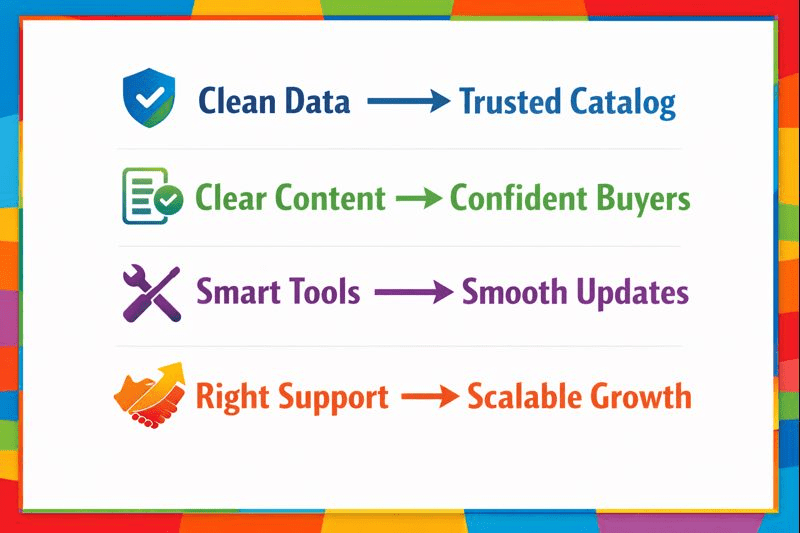
Online customers decide quickly. They scan, compare, and decide. Catalog content management keeps pace with this speed. It connects clarity with trust. When content feels clean and current, customers feel confident.
Content and catalog management are not about perfection. It is about consistency, quiet reliability, and clear flow. When your catalog speaks clearly, customers listen, and they return.
Ready to simplify catalog operations while improving customer experience?
Vserve helps brands manage catalog content with accuracy, speed, and care. From updates to optimization, we support scalable and human-focused catalog content management that drives real results. Let’s build catalogs that work harder, quietly.
Suggested Reads
https://vservesolution.com/blogs/why-your-ecommerce-business-needs-multi-platform-customer-support/ – Explains why consistent support across platforms improves customer trust.
https://vservesolution.com/blogs/chat-support-advantages-of-installing-it-on-your-website/ – Shows how chat support boosts engagement and faster issue resolution.
https://vservesolution.com/blogs/how-to-keep-your-customer-service-agent-engaged-during-long-work-days/ – Practical tips to maintain agent focus and motivation daily.