
RFI vs RFP vs RFQ: Key Differences, Examples & When to Use Each

Last updated on July 27th, 2026

In the modern supply chain landscape, organizations use a specific family of sourcing documents collectively known as RFx processes to engage with external vendors. These formal requests act as communication bridges, ensuring companies gather information, evaluate capabilities, and secure competitive pricing systematically. Choosing the wrong document type can confuse suppliers, waste valuable administrative hours, and lead to poor vendor selection.
What Are RFIs, RFPs, and RFQs?
Sourcing professionals rely on a structured toolkit of documents to navigate the marketplace and manage diverse vendor engagements. Understanding the basic definitions of these information-gathering tools is the first step toward building an agile enterprise procurement function.
What is an RFI?
A Request for Information is a preliminary procurement document used to gather high-level data about a market’s overall capabilities and supplier landscape. It does not contain direct purchasing commitments but helps buyers understand what solutions are currently available from external vendors.
What is an RFP?
A Request for Proposal is a comprehensive document used to solicit detailed, structured solutions from suppliers for complex business needs or projects. It outlines a specific operational problem and invites vendors to propose their unique methodology, technical approach, staffing, and financial structures.
What is an RFQ?
A Request for Quote is a highly targeted document sent to suppliers when an organization knows exactly what technical specifications or products it requires. This document focuses almost exclusively on price per unit, delivery timelines, payment terms, and volume discount structures.
RFI vs RFP vs RFQ at a Glance
Comparing these foundational documents side by side helps procurement teams select the most efficient tool for their immediate commercial goals. Organizations utilizing professional source-to-contract outsourcing frameworks use these precise distinctions to eliminate administrative delays and lower transactional costs.
| Feature | RFI | RFP | RFQ |
| Primary Purpose | Gather high-level market knowledge and vendor capabilities. | Solicit detailed solutions for complex business challenges. | Obtain exact pricing for highly standardized goods. |
| Procurement Stage | Initial research phase prior to project specification. | Mid-stage planning where solution design is required. | Final purchasing stage before contract execution. |
| Supplier Audience | Broad market to identify potential corporate partners. | Shortlisted vendors with proven domain expertise. | Qualified suppliers capable of meeting specifications. |
| Expected Response | Overview of capabilities, trends, and options. | Detailed project proposal and implementation strategy. | Clear line-item pricing sheet and delivery schedule. |
| Pricing Request | General cost estimates or non-binding models. | Comprehensive commercial and cost breakdown. | Fixed, legally binding price per unit or service fee. |
| Evaluation Criteria | Market capability and general vendor alignment. | Technical innovation, experience, and total value. | Price competitiveness and delivery speed. |
| Timeline | Short preparation and quick vendor response times. | Long creation, review, and negotiation cycles. | Fast turnaround based on standard price lists. |
| Best-Fit Scenario | Exploring new technology or unfamiliar markets. | Hiring specialized consulting or software development. | Purchasing standard raw materials or bulk hardware. |
Procurement Lifecycle – Where Does Each RFx Fit?
The upstream procurement journey requires a logical progression from initial market exploration to formal supplier selection and contract finalization. Within comprehensive S2C services, each request document occupies a distinct chronological slot that keeps sourcing activities organized and compliant.
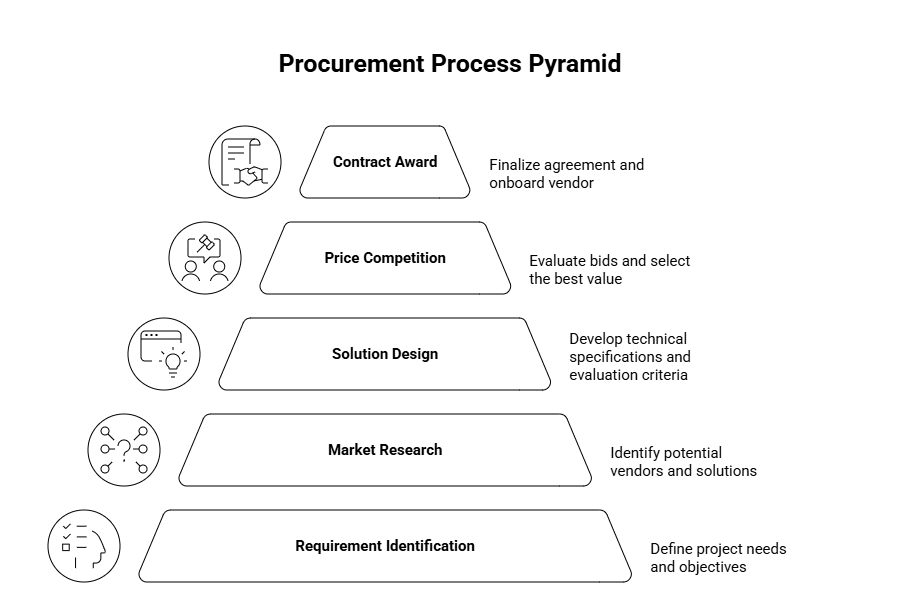 This structural flow ensures that organizations do not request binding prices before they understand the technical solutions available in the market. Passing through these phases sequentially reduces risk, minimizes misunderstandings, and guarantees that the final contract is backed by rigorous competitive data.
When Should You Use an RFI?
An organization should issue an information request when it enters an unfamiliar market or explores emerging technology spaces. This document is ideal when your internal team lacks the technical data required to write a detailed project specification sheet.
The primary benefit of this phase is that it educates your procurement department about current industry standards, potential obstacles, and innovative vendor capabilities. For example, a company looking to migrate its legacy database to the cloud might send out an initial request to discover available security architectures and hosting models before committing to a specific infrastructure design.
When Should You Use an RFP?
A proposal request is essential when a business challenge requires specialized human expertise, customized software configuration, or creative problem-solving. These scenarios involve many moving parts where the lowest initial price tag does not necessarily represent the best long-term organizational value.
Enterprises deploy these detailed files during large-scale software implementations, global corporate consulting projects, and complex third-party logistics arrangements. Sourcing managers look beyond basic costs to evaluate a vendor’s cultural fit, technical engineering capabilities, and long-term support infrastructure. Managing these detailed proposals is a core component of source-to-contract outsourcing programs designed to maximize returns on high-value corporate investments.
When Should You Use an RFQ?
A quotation request should be reserved for commodities, highly standardized manufacturing components, or routine repeat purchases where differentiation between products is virtually nonexistent. Because the technical requirements are completely set, buyers can focus their attention almost entirely on driving intense price competition among pre-qualified suppliers.
Using this tool streamlines purchasing cycles for items like office printing paper, standardized industrial fasteners, or generic computer memory upgrades. It eliminates unnecessary administrative narrative reviews, allowing buyers to quickly award orders based on clear cost metrics and immediate availability. Integrating this fast-track bidding process within your automated s2c services ensures that raw materials reach your production lines without delay.
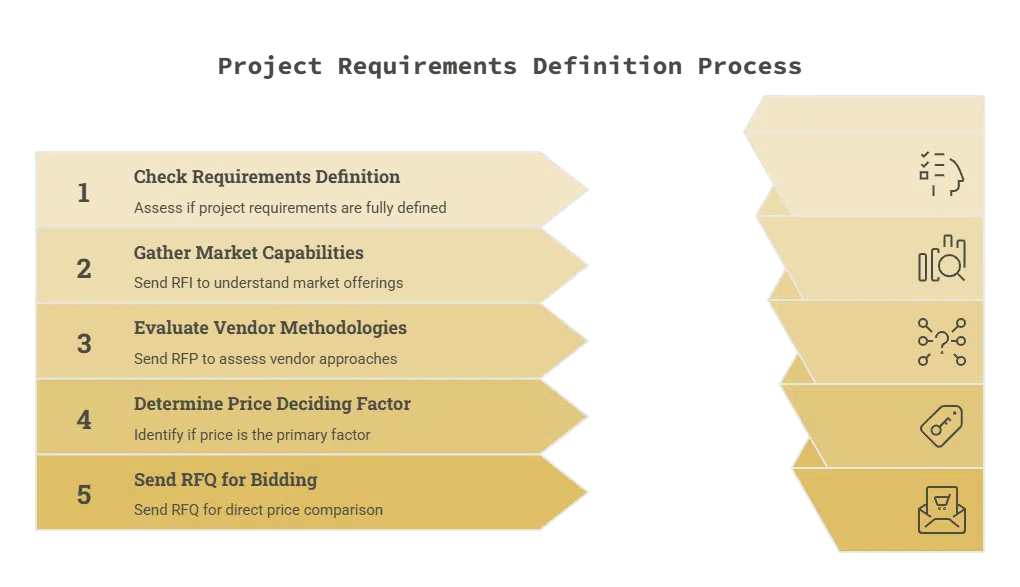
Decision Tree – Should You Send an RFI, RFP, or RFQ?
Navigating the choosing process requires a quick analysis of your current project requirements and market familiarity. Following a step-by-step decision framework prevents teams from deploying overly complex documents for simple commercial transactions.
 Common RFx Mistakes to Avoid
One of the most frequent errors in procurement is rushing into a quotation process before internal project expectations are fully defined. This timing error forces suppliers to make pricing assumptions, leading to sudden budget overruns or unexpected change orders after work begins.
How AI Is Transforming RFx Management
Artificial intelligence is completely revolutionizing upstream procurement workflows by automating the creation of complex request templates based on historical buying data. Advanced machine learning systems analyze market landscapes instantly, discovering highly qualified suppliers that human sourcing teams might easily overlook.
Furthermore, natural language processing tools allow software platforms to read, categorize, and score hundreds of vendor proposal pages automatically within minutes. This automated assessment highlights hidden compliance risks, flags non-standard pricing formulas, and provides objective comparison summaries for leadership teams. Embracing these advanced capabilities allows modern S2C services to deliver unprecedented speed, data accuracy, and cost savings to global enterprises.
Best Practices for Successful RFx Processes
Standardizing your templates across the entire enterprise ensures brand consistency, reduces document creation times, and simplifies the review process for your supplier base. Establishing cross-functional evaluation teams that include legal, finance, and technical experts guarantees that every submitted proposal is thoroughly vetted from multiple organizational angles.
It is equally vital to utilize objective evaluation scorecards to maintain total transparency and compliance throughout the vendor selection journey. Continuous improvement metrics should be embedded into your post-event reviews to identify process bottlenecks and refine future sourcing activities. Organizations that combine these best practices with a structured source-to-contract outsourcing strategy consistently achieve superior supply chain resilience and higher financial returns.
Conclusion
Understanding the distinct boundaries of RFI vs RFP vs RFQ processes empowers modern finance teams to engage the supply market with maximum strategic impact. Deploying the correct document type at each phase of the sourcing lifecycle protects your operational resources and ensures you capture maximum commercial value.
To achieve the best results, enterprises must transition away from slow, manual document compilation and embrace digital procurement tools. Collaborating with specialized providers of S2C services provides immediate access to advanced automated frameworks and deep market intelligence. Take the next step toward operational excellence today by building a highly structured, data-driven vendor engagement strategy.
Frequently Asked Questions
1. Can you skip the RFI?
Yes, organizations frequently bypass the information-gathering stage if their internal team already possesses deep market familiarity and fully defined project requirements. Skipping this phase accelerates the procurement cycle for familiar goods or services, allowing teams to launch an immediate proposal or quotation event.
2. Can an RFQ follow an RFP?
Yes, a quotation request often follows a proposal request once the technical evaluation phase is fully complete and only a few finalists remain. This sequential approach allows procurement teams to lock in technical requirements first before driving intense final price competition among the top-rated suppliers.
3. Is pricing included in an RFP?
Yes, proposals almost always include a comprehensive commercial section where vendors outline their fee structures, implementation costs, and ongoing support expenses. However, this pricing is evaluated alongside technical capabilities, whereas a quotation event focuses almost exclusively on the lowest unit cost.
4. What is the difference between RFQ and tender?
A quotation request is typically less formal, has faster turnaround times, and is used primarily in the private sector for standardized purchasing. A tender represents a highly regulated, strictly binding legal process used extensively by government entities and public sectors to ensure absolute fairness and transparency.
5. What is RFx?
The acronym RFx serves as a blanket term that encompasses the entire family of request documents used in procurement, where the “x” stands for information, proposal, or quote. It represents the standardized methodology organizations use to approach the vendor market during strategic sourcing initiatives.
6. Which industries use RFIs most?
Information requests are heavily utilized in rapidly evolving sectors like information technology, healthcare pharmaceuticals, aerospace engineering, and large-scale public infrastructure construction. These industries deal with complex, fast-changing technologies where buyers must continuously update their understanding of available market solutions.
7. How long should an RFP remain open?
The active bidding window typically ranges from two to six weeks depending on the overall complexity of the project requirements and the level of customization needed. Providing vendors with sufficient time ensures they submit high-quality, deeply thought-out solutions that match your corporate goals.
8. What evaluation criteria should be used?
Comprehensive proposal evaluations should look beyond initial price to measure technical competence, historical vendor experience, financial stability, and implementation timelines. Modern organizations also include strict compliance ratings, data security standards, and sustainability metrics within their primary sourcing scorecards.