

Top 7 Product Design and Development Solutions That Drastically Slash Your Support Costs

Last updated on May 22nd, 2026

Support costs are quietly eating into business profitability. Research published by Harvard Business Review involving 75,000 participants suggests that ease of experience is the primary driver of loyalty. Specifically, reducing the friction customers face leads to better service outcomes, significant cost savings, and higher retention rates.
 Stop treating customer support as a cost center and start seeing it as a design flaw. Every ticket your team receives is a roadmap pointing directly to a gap in your product’s clarity. By shifting your focus from answering questions to preventing them, you can slash overhead and boost loyalty simultaneously.
This article breaks down seven proven solutions that help businesses reduce support volume while improving customer satisfaction.
Table of Contents
Why Support Costs Keep Rising for Businesses
Solution 1: User Centric Product Documentation
Solution 2: Structured User Manual Design
Solution 3: Integrated Onboarding Experience
Solution 4: Design for Fewer Errors
Solution 5: Modular Product Documentation Systems
Solution 6: Cross Functional Product Design Alignment
Solution 7: Continuous Documentation Optimization
Why Support Costs Keep Rising for Businesses
Support costs increase when customers struggle to understand how a product works. This usually stems from unclear documentation, inconsistent product design, and fragmented onboarding experiences. When customers cannot find answers quickly, they reach out to support, increasing staffing, training, and operational costs.
Smart businesses address the root cause rather than scaling support endlessly.
Solution 1: User Centric Product Documentation
Clear documentation is one of the most effective ways to reduce repetitive support tickets.
Key benefits include:
- Anticipates common user questions before they become issues
- Reduces dependency on live agents
- Improves customer confidence and product adoption
High quality user manual design services focus on clarity, task based instructions, and real user scenarios. When documentation mirrors how customers actually use the product, support demand drops naturally.
Reduce support costs by optimizing product design and development, improving usability and minimizing customer issues
Solution 2: Structured User Manual Design
Many manuals fail because they overwhelm users with unorganized information.
A well structured manual:
- Uses logical content hierarchy
- Includes quick start guides for faster onboarding
- Provides visual cues for complex steps
Professional product manual writing services apply information architecture principles so users can locate answers within seconds instead of minutes.
Solution 3: Integrated Onboarding Experience
Product onboarding should not rely on documentation alone.
Effective onboarding integrates:
- Product design cues
- Contextual help
- Supporting manuals and guides
When onboarding is aligned with documentation, customers make fewer mistakes early on, which is when most support tickets are generated.
Solution 4: Design for Fewer Errors
Thoughtful product design minimizes user mistakes.
This includes:
- Clear labeling and intuitive navigation
- Preventive warnings instead of reactive fixes
- Simplified workflows for critical actions
These product design and development solutions reduce error related support requests that often consume the most time and resources.
Solution 5: Modular Product Documentation Systems
Static manuals become outdated quickly.
Modular documentation:
- Allows updates without rewriting entire manuals
- Keeps information accurate and relevant
- Supports multiple products or versions efficiently
This approach ensures customers always access the correct information, reducing confusion driven support inquiries.
Solution 6: Cross Functional Product Design Alignment
Support issues often arise when teams work in silos.
Alignment between:
- Product design
- Engineering
- Marketing
- Documentation teams
ensures consistent messaging and functionality. When product behavior matches documented instructions, trust improves and support volume decreases.
Solution 7: Continuous Documentation Optimization
Documentation should evolve alongside the product.
Ongoing optimization includes:
- Analyzing support ticket data
- Updating manuals based on real user issues
- Improving clarity through feedback loops
Businesses that treat documentation as a living asset see long term reductions in support costs and higher customer satisfaction.
Reducing support costs does not start in the call center. It starts at the design table.
When products are built with clarity, guided by real user behavior, and reinforced through structured onboarding and product manual writing services, support tickets naturally decline. Each of the seven solutions outlined above highlights a simple truth: prevention scales better than reaction. Businesses that invest in thoughtful product design and development solutions stop paying repeatedly for the same customer confusion.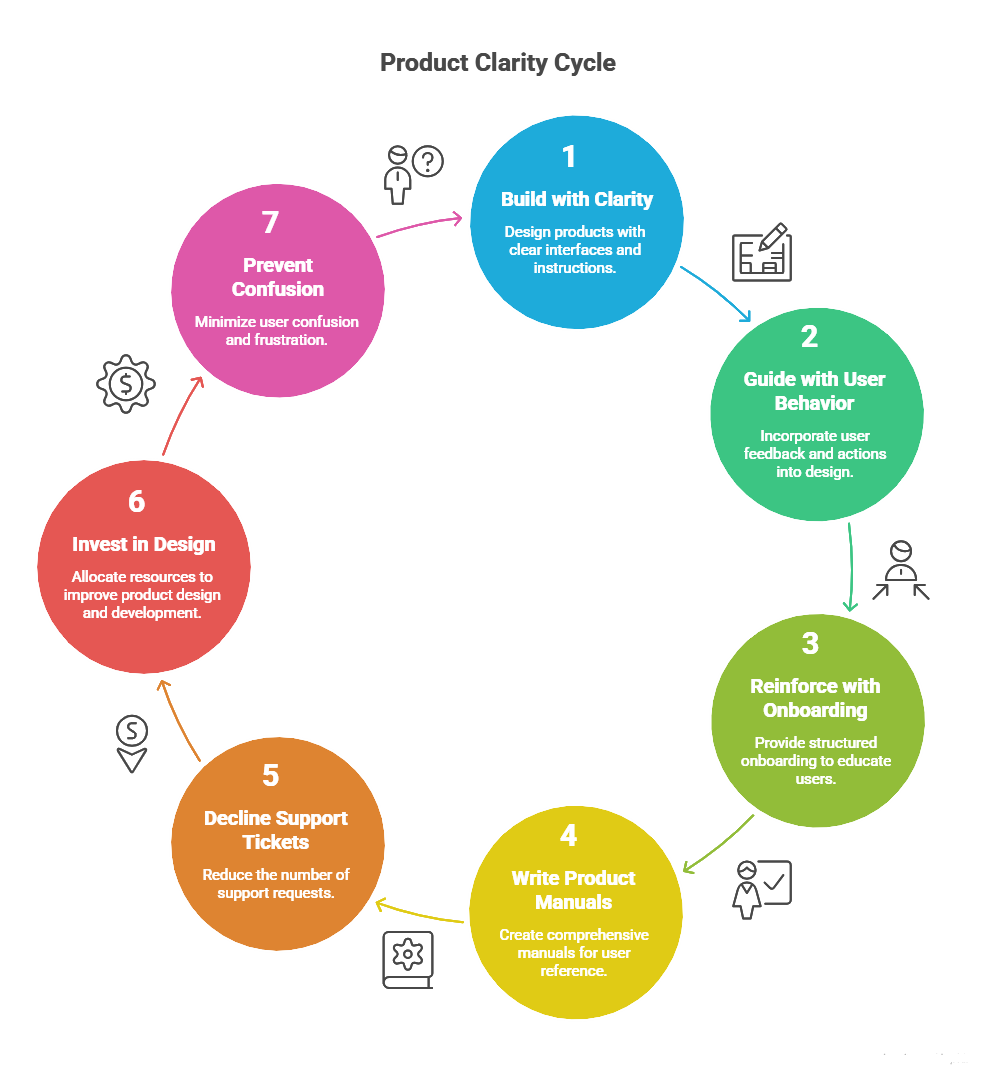 The most efficient support strategy is one your customers rarely need to use.
Organizations that embrace this approach often see benefits that extend well beyond cost reduction. Clearer products accelerate adoption, improve retention, and strengthen customer trust. Documentation and design evolve from afterthoughts into long term strategic assets.
This is where experienced partners like Vserve add meaningful value. By aligning product design, development, and documentation into a single, cohesive framework, businesses reduce friction across the entire user journey without increasing operational complexity.
When clarity is built into the product from the beginning, support costs do not just decrease. They become predictable, manageable, and sustainable.
Frequently Asked Questions
1. Can better documentation really reduce support costs?
Yes. Clear documentation answers common questions upfront, reducing the need for customers to contact support.
2. Do small businesses benefit from user manual design services?
Yes. Even small businesses can significantly lower support volume by providing clear and structured manuals.
3. How often should product manuals be updated?
Manuals should be reviewed whenever product features change or when recurring support issues appear.
4. Are product manuals still relevant for digital products?
Yes. Digital products still require clear guidance, especially for onboarding and advanced features.