


Importance of eCommerce Catalog Management Services For A Business

Last updated on May 22nd, 2026

Many business owners are choosing to set up and operate an eCommerce store. The digital marketplace is no longer just a side experiment. It is the place where there is intense commerce activity. The pandemic years taught people how convenient eCommerce was. It became not just popular, but essential. And now, competition is faster and sharper than ever before.
In this crowded world, good products alone are not enough. You have to have a good presentation too. The structure in which information is presented matters. This is where catalog management services quietly hold the entire system together. Your catalog is not just a list. It is your digital showroom. It is your salesperson working even at midnight.
The global catalog management system market was valued at about USD 2.41 billion in 2025 and is projected to grow to around USD 6.32 billion by 2034. This reflects a strong demand for catalog management capabilities (including services) across industries like retail, e-commerce, telecom, and BFSI.
Table of Contents
eCommerce Catalog Management Services Are Paramount For A Store
What Is eCommerce Catalog Management?
eCommerce Catalog Management Services Can Drive Sales
Why You Should Outsource Catalog Management Services
Why Are eCommerce Catalog Management Services Essential?
eCommerce Catalog Management Services Are Paramount for a Store
For any store, eCommerce catalog management services are paramount. They double up like a window display in a physical shop. Customers glance at your catalog and instantly decide whether they wish to explore further or leave.
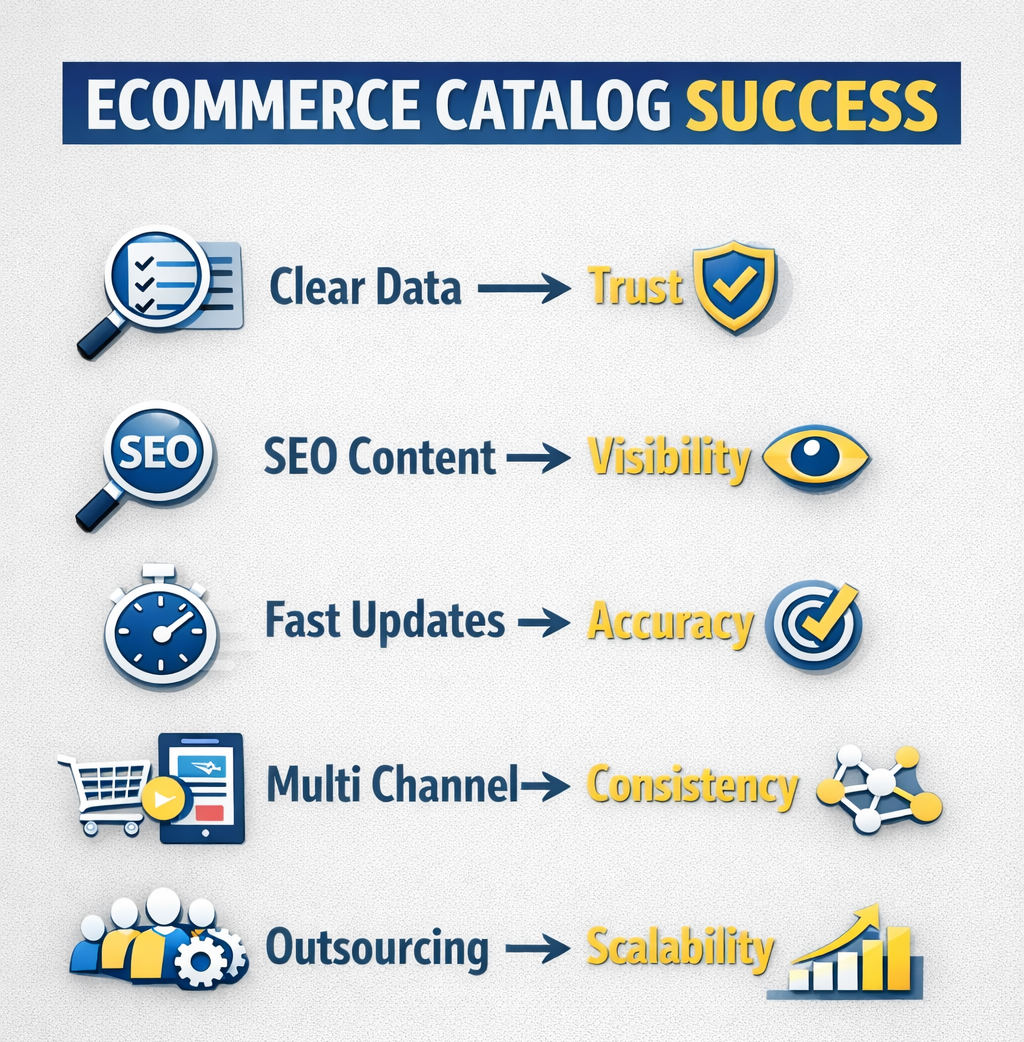
An unorganized catalog feels like a messy shelf. A structured one feels like it belongs to a good brand and wins the trust of the customer. This is why modern businesses invest heavily in eCommerce catalogue management services. They understand that clarity leads to confidence, and confidence leads to conversions.
A well-managed catalog improves navigation and enhances product visibility. It ensures consistency across all marketplaces. Without it, even the best products can remain invisible.
Enhance product visibility by managing catalogs effectively and giving consistent shopping experiences across channels
What is eCommerce Catalog Management?
Every eCommerce store has a catalog. In simple terms, it is a structured collection of product information. It includes product names, descriptions, images, specifications, SKUs, pricing, and categories.
eCommerce catalog management ensures that this information is updated. It keeps it accurate and consistent across all virtual sales channels. Whether you sell on your website, marketplaces, or social platforms, the product details must match everywhere.
eCommerce catalog processing involves tasks such as:
- Product data entry
- Image editing and optimization
- Category mapping
- Attribute tagging
- Price updates
- Inventory synchronization
Without systematic eCommerce catalog processing, data errors multiply. And when data errors multiply, customers leave the page.
eCommerce Catalog Management Services Can Drive Sales
Research consistently shows that online shoppers depend heavily on product content before making a purchase decision. Clear descriptions, sharp images, and detailed specifications influence buying behavior.
If your catalog lacks information or presents it poorly, customers will exit and search elsewhere. That is the silent cost of neglect.
One of the major product catalog management benefits eCommerce businesses experience is improved engagement. A structured catalog enhances browsing experiences. It allows customers to filter, compare, and decide with ease.
Additionally, a refined catalog:
- Reduces product returns
- Improves search engine rankings
- Boosts marketplace performance
- Strengthens brand credibility
In 2026, SEO-friendly catalogs are important. When customers search using specific keywords, your product pages must appear instantly. Optimized product titles, bullet points, and backend keywords support discoverability.

Why You Should Outsource Catalog Management Services
As an eCommerce business owner, you have a lot of work on your hands. You have to deal with marketing campaigns, logistics, vendor coordination, customer queries, and more. The list grows longer and longer each day.
This is why many businesses choose to outsource catalog management services to experienced providers.
Quality Is Maintained
When professionals handle your eCommerce catalog management services, quality remains quite consistent. They understand platform-specific guidelines. They ensure descriptions are unique, SEO-optimized, and quite aligned with brand tone.
Writing product descriptions for hundreds or thousands of products can become quite exhausting. Outsourcing ensures that quality never drops, even when scale increases.
Updates Are Made and Reflected Immediately
Catalog updates must happen in real time. Price changes, stock updates, new product launches, and image modifications must happen in real time.
When eCommerce catalogue management services are outsourced, updates are implemented quickly and quite accurately. This prevents customer dissatisfaction caused by outdated information.
Catalogs Are Created for Multiple Channels Effortlessly
Many sellers operate on multiple platforms such as marketplaces, D2C websites, and social commerce channels. Each platform has its own unique formatting requirements.
An experienced eCommerce catalog processing team can customize listings for each channel while maintaining consistency. This is quite crucial because customers often compare products across platforms before purchasing, and when there is inconsistency, there is doubt in the mind of the consumer.

Why Are eCommerce Catalog Management Services Essential?
A well-crafted catalog gives business owners quite a competitive edge. It becomes the backbone of omnichannel retail strategies.
Strengthens Omni Channel Experience
Modern customers move between devices and platforms quite fluidly. They browse on mobile, compare on desktop, and purchase through an app.
eCommerce catalog management services ensure uniform data across all channels. This strengthens brand identity and creates quite seamless shopping journeys.
Enhances Overall Customer Experience
Customers prefer detailed information. They want specifications, dimensions, materials, usage instructions, and high-resolution images.
Providing complete information reduces confusion. The number of returns reduces. It increases satisfaction. This is one of the strongest product catalog management benefits eCommerce businesses enjoy.
Supports Business Growth
The online marketplace is quite crowded. Competitors sell similar products. What differentiates you is how clearly and confidently you present them.
Accurate and optimized catalog management services help improve organic traffic, marketplace ranking, and conversion rates. They lay a stable foundation for scaling operations.
Good Practices in eCommerce Catalog Management
A thoughtful catalog can make shopping quite smooth and even enjoyable.
Must Contain Relevant Product Information
All product details should be available in one place. Avoid forcing customers to search elsewhere.
Must Be SEO Friendly
Keyword-optimized titles and descriptions help products rank better in search engines and marketplaces. Structured data and backend tags improve visibility.
Avoid Plagiarism
Customers are quite informed. They recognize copied content. Unique descriptions reflect professionalism and authenticity.
Maintain Structured Data
Standardized formats for size charts, attributes, and specifications reduce confusion. Structured data also supports AI-driven search filters in eCommerce platforms.
Regular Audits
Conduct periodic catalog audits. These will bring to notice outdated images, broken links, or inconsistent pricing.

FAQs
1. What are catalog management services?
Catalog management services are needed by businesses for organizing, updating, and optimizing product data across eCommerce platforms.
2. Why are eCommerce catalog management services important?
They ensure quite accurate product information. They improve customer experience and increase sales conversions.
3. What are the product catalog management benefits eCommerce businesses gain?
Benefits include better SEO visibility and reduced returns. Other benefits include higher engagement and a consistent omnichannel presence.
4. Should businesses outsource catalog management services?
Yes, outsourcing ensures professional handling and faster updates. It helps maintain consistent quality across platforms.
5. What does eCommerce catalog processing include?
It includes data entry, image editing, SKU management, categorization, and product optimization.
Conclusion
eCommerce success is not only about selling products. It is about presenting them with precision. Catalog management services provide structure in a digital environment. They prevent errors and improve discoverability.
Today, customers expect clarity and speed. Businesses that invest in eCommerce catalog management services position themselves for long-term growth and operational stability.
If you are ready to simplify your operations and strengthen your online presence, Vserve can help. From eCommerce catalog processing to full-scale eCommerce catalogue management services, Vserve offers expert solutions tailored to your business needs.
Suggested Reads
https://vservesolution.com/blogs/how-the-core-of-e-procurement-which-is-catalog-content-management-will-save-your-business/ – How structured catalog content improves procurement efficiency
https://vservesolution.com/blogs/challenges-and-opportunities-in-building-online-product-catalog/ – Common catalog challenges and practical growth opportunities
https://vservesolution.com/blogs/11-catalog-content-management-tips-to-crush-big-goals/ – Actionable catalog strategies for measurable eCommerce success
https://vservesolution.com/blogs/why-catalog-management-in-eCommerce-is-important/ – Why catalog structure directly impacts eCommerce performance