


eCommerce Marketing – 10 Brilliant Tips to Look out for This Year

Last updated on May 22nd, 2026

If you run an eCommerce business, marketing has become very competitive this year. You cannot sit back and hope your product magically finds the right people. The internet is more active than ever. Every eCommerce marketing company is fighting for the same few seconds under the sun.
Global eCommerce sales are massive and growing. By 2026, global online retail sales are projected to reach around $7.5 trillion, showing the massive scale and importance of eCommerce marketing to capture digital demand.
Competition across online stores has multiplied. Today, ads cost more. Algorithms change moods overnight. Customers scroll fast and forget faster. This is exactly why brands need smarter, more grounded eCommerce marketing strategies.
To help you stay visible, relevant, and quietly persuasive, we have a guide for you. Below are 10 brilliant tips to improve your eCommerce marketing in 2026. Let’s begin.
Table Of Contents
- 10 Amazing Tips to Up Your eCommerce Game
- Give Your eCommerce Website a Facelift
- Review Your Email Metrics for Feedback
- Give Customers a Voice With Social Surveys
- Experiment With New Channels
- Use Exclusive Content as a Hook
- Attract Shoppers With Optimized Blog Content
- Make a Promotional Video Series
- Leverage the Power of Small Influencers
- Find, or Create, More Ways to Personalize the Customer’s Experience
- Try Out Chatbots
- FAQs
- Conclusion
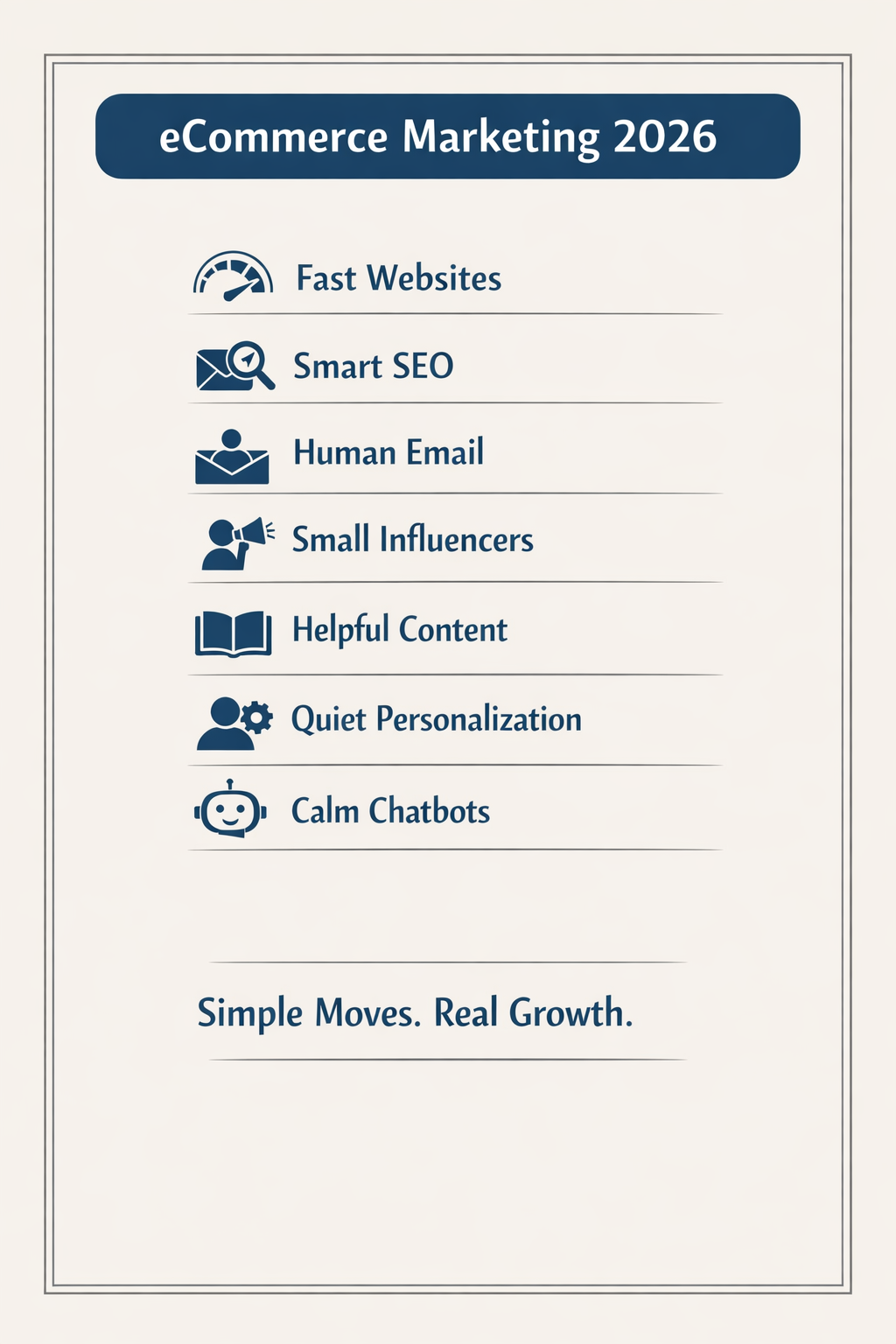
10 Amazing Tips to Up Your eCommerce Game
1. Give Your eCommerce Website a Facelift
First impressions still happen in under a second. That has not changed. What has changed is patience. A slow-loading eCommerce site does not feel good at all.
Even today, a one-second delay on mobile can reduce conversions by nearly 20%. That is a silent revenue loss. There are no alarms and no warnings.
This is where a skilled eCommerce development agency or eCommerce marketing agency can make a difference. They help you sharpen both performance and appearance.
To make your website work harder and quicker, make sure it:
- Uses high-quality brand images that load fast
- Offers clear merchandising paths
- Looks clean and intentional
- Supports real-time personalization
- Feels easy, not clever
Boost eCommerce growth by applying smart marketing tips, increasing traffic, and driving higher conversions consistently
2. Review Your Email Metrics for Feedback
Email is honest and relevant. Email metrics quietly tell stories your ads never will. Open rates, click-through rates, unsubscribe patterns, and conversion timings are behavioral footprints.
Track them over time. Watch how seasons behave. You will notice how people respond differently in November versus March.
If engagement drops after three emails in a week, listen. If holiday-style messaging performs well year-round, reuse the rhythm. Smart eCommerce marketing services adjust timing, not just templates.

3. Give Customers a Voice With Social Surveys
Customers are not just buyers. They can also be unpaid advisors. Yet many eCommerce brands forget to ask them anything, and this is a missed opportunity.
Use social media polls, SMS questions, or email surveys to let customers feel involved. Ask them which product version they prefer. Find out what matters most to them. Is it price, speed, sustainability, or support?
These insights guide design, messaging, and positioning. They can act as powerful signals. They also create emotional investment. People support what they help shape.
4. Experiment With New Channels
In 2026, new platforms appear quietly and then suddenly dominate. Testing new channels early often costs less and teaches more. Whether it is a beta feature on social media, a new ad format, or a community-driven platform, curiosity pays.
Allocate a small monthly budget for experimentation. Expect some failures, but the wins will be worth it.
Strong eCommerce marketing companies treat testing as a habit, not a risk.
5. Use Exclusive Content as a Hook
Gated content still works when it is useful.
Ask for an email only when you offer something meaningful in return:
- White papers
- eBooks
- How-to manuals
- Insider buying guides
For B2C brands, simpler exchanges often perform better:
- Discount vouchers
- Monthly newsletters
- On-site contests
This is simple list-building. There is no pressure on the customer, just an offer with value.
6. Attract Shoppers With Optimized Blog Content
Blogs are slow builders. High-quality, reader-first content positions your brand as a trusted voice. Over time, optimized blog content improves visibility, dwell time, and organic conversions.
In 2026, helpful content beats clever copy always.
An experienced eCommerce SEO agency understands this balance. They write for humans first, and algorithms second.
7. Make a Promotional Video Series
Video builds trust faster than text ever could. Be it product demos, how-to guides, behind-the-scenes clips, they all help. Short and long, polished or raw, they make a difference.
Videos showing real people using real products create the best impact. Especially in a world full of filters and AI-generated perfection.
Video is no longer optional for eCommerce marketing services; it is an expectation.
8. Leverage the Power of Small Influencers
Big influencers are expensive, and small ones are believable. Micro-influencers with 1,000 to 100,000 followers often drive higher engagement and better trust. Their audiences listen and respond.
This cost-to-conversion balance makes influencer marketing more accessible and effective for growing eCommerce brands in 2026.
9. Find, or Create, More Ways to Personalize the Customer’s Experience
Personalization is baseline in eCommerce today.
Segment your audience deeply:
- First-time buyers
- Repeat customers
- VIP shoppers
- Category-specific interests
Send emails that feel written for them, not to them. Offer early access and quiet rewards. Subtle appreciation. Good personalization feels invisible. That is the goal.
10. Try Out Chatbots
Chatbots are tools to guide users, and they are smarter and more human. They answer FAQs, suggest products, and capture leads. All this is done without pressure.
Used correctly, chatbots support the customer journey.
FAQs
1. What is the role of an eCommerce marketing agency in 2026?
An eCommerce marketing agency helps brands navigate platforms, data, and customer behavior with clarity.
2. Why is eCommerce SEO still important today?
Organic traffic compounds over time and builds long-term visibility without rising ad costs.
3. Are chatbots effective for eCommerce stores?
Yes, when designed to assist rather than sell aggressively.
4. How often should eCommerce brands test new marketing channels?
Ideally every quarter, with small budgets and clear learning goals.
5. Do blogs still drive sales for eCommerce businesses?
Yes. Helpful content builds trust, authority, and repeat traffic.
Conclusion
Staying current with eCommerce marketing trends is not easy. It requires a lot of patience and attention, and a determined willingness to adapt.
But when done right, you build something steady. Testing new content formats, refining personalization, and improving performance gives you something lasting.
If you want help refining your eCommerce marketing strategy, improving SEO, or scaling with confidence, Vserve’s eCommerce marketing services are built for exactly that.
From development to optimization, from strategy to execution, we help eCommerce brands grow quietly and consistently.
Visit us to build something that lasts.
Suggested Reads
https://vservesolution.com/blogs/unleash-the-power-of-social-media-marketing-and-boost-your-business-profits/ – How social platforms quietly drive measurable eCommerce revenue
https://vservesolution.com/blogs/smm-service-how-to-build-an-advert-that-works-for-your-business/ – Practical steps for ads that connect and convert
https://vservesolution.com/blogs/top-10-best-advertising-campaigns-of-all-time-and-why-they-stand-out-among-the-rest/ – Lessons from campaigns that shaped modern marketing
https://vservesolution.com/blogs/crafting-a-winning-advertising-campaign-plan-heres-how/ – A clear framework for planning smarter campaigns