


The Ultimate Ecommerce Product Launch Checklist

Last updated on July 27th, 2026

Launching a new digital storefront or introducing a fresh product line requires the precise coordination of dozens of moving operational parts. Online brands can no longer deploy an unverified website or unoptimized product catalog and expect to capture market share in today’s highly competitive digital landscape. Failing to thoroughly prepare your infrastructure before going live frequently leads to broken checkout paths, abandoned shopping carts, and wasted marketing spend.
To ensure your brand achieves maximum profitability from day one, you must replace chaotic, last-minute preparations with a structured, step-by-step roadmap. This comprehensive guide outlines an actionable framework designed to eliminate operational blind spots across design, technical SEO, inventory, and fulfillment operations. Utilizing a comprehensive ecommerce product launch checklist helps brand owners manage their pre-launch workflows cleanly and build a highly sustainable digital retail operation.
Ecommerce Product Launch Timeline
A successful storefront deployment depends entirely on a highly structured timeline that balances technical development with strategic marketing campaigns. Sourcing support from an expert ecommerce outsourcing service provider ensures that your internal teams stay on schedule throughout each phase of the deployment.
- 60 Days Before Launch: Sourcing teams finalize all product manufacturing contracts, secure trademark registrations, and establish clear inventory tracking protocols.
- 30 Days Before Launch: Creative teams upload high-resolution product imagery, optimize sales copy, and begin building targeted pre-launch email waitlists.
- 14 Days Before Launch: Digital marketers initiate targeted teaser campaigns on social media channels while developers deploy the initial beta version of the checkout system.
- 7 Days Before Launch: Quality assurance engineers execute end-to-end user testing across multiple devices to ensure complete system stability before the grand opening.
- Launch Day: System administrators flip the site status to live, broadcast promotional launch emails, and closely monitor live server performance metrics.
- First 30 Days After Launch: Customer support teams resolve incoming inquiries quickly while data analysts track initial conversion rates and optimize paid advertising campaigns.
Product Planning Checklist
Before writing a single line of website code, you must rigorously validate that your proposed products match current market demands. Working alongside professional ecommerce outsourcing companies gives you access to advanced market research capabilities that help clarify customer purchasing habits.
Validate Product Demand
Sourcing specialists analyze historical keyword search volumes and aggregate consumer sentiment data across popular online marketplaces. This rigorous evaluation ensures your brand invests capital exclusively into inventory categories that demonstrate clear, sustainable customer interest.
Define Your Target Audience
Marketing teams build detailed customer avatars that define the exact demographics, income levels, and online habits of your ideal buyers. Understanding these core customer traits allows you to craft highly personalized messaging that resonates deeply across your primary advertising channels.
Analyze Competitors
Researchers study the digital storefronts, pricing strategies, and customer reviews of your direct market rivals to identify critical operational gaps. Uncovering hidden weaknesses in competitor shipping speeds or product features allows your brand to position its new catalog far more effectively.
Set Pricing and Profit Margins
Financial planners calculate total land costs, packaging fees, merchant account rates, and digital marketing expenses to establish accurate base pricing. Maintaining a healthy gross profit margin ensures your business can comfortably absorb future customer acquisition costs and seasonal promotional discounts.
Forecast Inventory
Logistics managers study historical industry sales curves and initial pre-launch email sign-up rates to calculate your initial order volumes. Accurate stock forecasting prevents expensive overstocking scenarios while shielding your brand from the revenue losses caused by sudden stockouts.
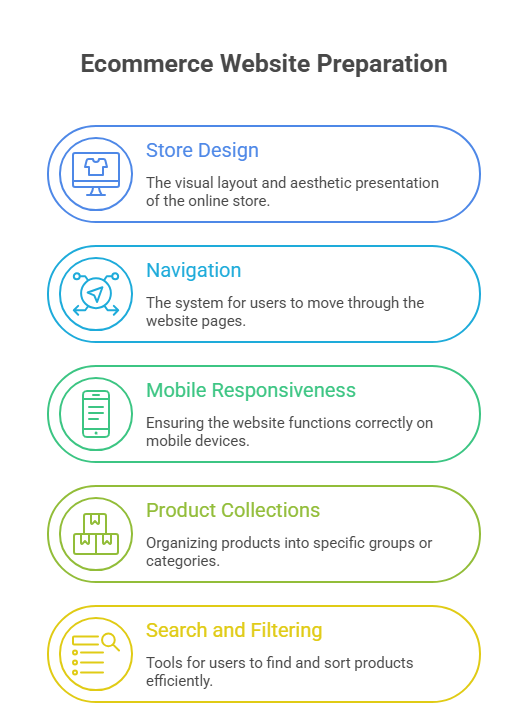
Ecommerce Website Preparation
Store Design
Web designers create a clean visual layout that highlights your core products while maintaining complete consistency with your brand guidelines. Using high-contrast call-to-action buttons guides visitors toward the checkout funnel smoothly and minimizes unnecessary visual distractions.
Navigation
Developers build an intuitive main menu structure that allows users to locate their desired items within three clicks of landing on the homepage. Organizing your catalog categories logically prevents user frustration and encourages visitors to explore additional sections of your store.
Mobile Responsiveness
Technical teams optimize your entire website layout to ensure it renders flawlessly across all modern smartphone and tablet screen dimensions. Since mobile buyers drive the majority of online traffic, your mobile checkout process must remain incredibly swift and free of friction.
Product Collections
Merchandisers organize individual listings into curated product collections based on specific use cases, seasonal themes, or customer demographic profiles. This structured clustering helps search engines index your pages more efficiently while introducing shoppers to highly relevant cross-sell options.
Search and Filtering
Engineers integrate advanced on-site search bars equipped with autocomplete functions and detailed product filtering attributes like size, color, and price. Allowing customers to sort through your inventory effortlessly improves the user experience and boosts overall conversion rates.
 Product Page Optimization Checklist
An optimized product listing page must instantly answer consumer questions, alleviate buying hesitation, and drive shoppers directly toward the checkout button. Leading retail ecommerce outsourcing companies utilize specialized copywriters and optimization tools to ensure every listing maximizes its conversion potential.
By systematically applying this optimization framework to every listing, your brand can rank higher in organic search results while lowering customer acquisition costs. Furthermore, adding an interactive Frequently Asked Questions section directly to your product pages reduces the burden on your customer support desk by resolving buying doubts instantly.
Technical SEO Checklist
Technical search engine optimization ensures that web crawlers can discover, read, and index your digital storefront without encountering dead ends. If your store possesses underlying code structural issues, even the most beautiful web design will fail to capture organic search traffic.
To secure strong search rankings, your development team must continuously optimize your Core Web Vitals to guarantee rapid page loading speeds. You must also generate a clean XML sitemap and configure your robots.txt file to guide search engine bots toward your most valuable content. Implementing canonical URLs prevents duplicate content penalties caused by multi-colored product variants, while structured data codes display your pricing and stock availability directly within organic search results.
Payments, Shipping, and Fulfillment
An online store cannot survive without a secure payment collection architecture and a highly reliable order fulfillment network. Integrating these financial and logistical operations correctly before going live prevents painful shipping billing delays and keeps your customers happy.
Procurement managers must establish flexible payment gateways that accept international credit cards, mobile wallets, and popular buy-now-pay-later financing services. You must also configure localized tax calculation rules and clear shipping cost tiers based on package weights and delivery destinations. Finally, warehouse teams must verify that inventory barcodes sync perfectly with your central management system to ensure same-day order processing readiness.
Customer Experience Checklist
Providing exceptional customer service is one of the most effective ways to convert first-time buyers into lifelong brand advocates. Sourcing your customer support operations from an expert retail ecommerce service provider guarantees 24/7 coverage across all communication channels.
Support administrators must integrate responsive live chat widgets and comprehensive self-service help centers that address common delivery questions. All contact forms must route inquiries directly into a centralized help desk system to ensure your team never misses an urgent customer message. Additionally, you must test automated email notifications, such as order confirmations and shipping updates, to keep shoppers informed at every step of their post-purchase journey.
Marketing Launch Checklist
An exceptional digital storefront still requires a highly targeted marketing launch strategy to drive qualified traffic through your checkout doors. Digital marketers leverage multiple acquisition channels simultaneously to create maximum buzz around your initial product debut.
Your marketing team should prepare segmented email broadcast campaigns to notify your pre-launch waitlists the exact second your store goes live. You must also sync your product catalog with your social media profiles to enable direct shopping features across Facebook and Instagram. Partnering with relevant niche influencers and launching optimized paid search advertisements ensures your brand captures high-intent buyers immediately on launch day.
Analytics and Tracking Setup
You cannot optimize your online storefront effectively if you are not accurately measuring user behavior and tracking conversion performance data. Setting up your data analytics suite correctly before launching guarantees that every marketing dollar spent can be tracked precisely.
Deploying this integrated tracking stack ensures that your growth marketers can easily spot which advertisements are driving actual profits. These clean data streams allow your management team to allocate your advertising budgets intelligently toward the highest-performing consumer demographics.
AI Tools for Ecommerce Launches
Modern artificial intelligence applications allow growing online businesses to automate tedious launch tasks and cut operational costs significantly. Savvy brands integrate these digital tools into their workflows to accelerate their deployment times and improve content consistency.
AI copywriting applications can generate thousands of unique, search-optimized product descriptions within a fraction of the time required by manual workflows. Advanced image editing platforms can transform basic product photos into stunning, professional lifestyle imagery without requiring expensive studio sessions. Furthermore, integrating intelligent AI customer support bots ensures your digital storefront can resolve basic shopper inquiries instantly at any hour of the day.
Quality Assurance Before Going Live
Executing rigorous quality assurance testing is the absolute last line of defense protecting your brand from a disastrous public launch. Sourcing these technical auditing tasks from professional ecommerce outsourcing companies ensures your system undergoes objective, comprehensive testing.
Your QA specialists must conduct extensive functional testing to verify that all discount codes apply correctly and that the checkout funnel processes payments securely. You must also perform comprehensive browser and device testing to guarantee your store displays perfectly on both older smartphones and modern laptops. Finally, load testing engineers must simulate heavy user traffic surges to ensure your hosting servers will not crash during launch day promotions.
Launch Day Checklist
When launch day finally arrives, your internal team must remain completely focused on monitoring system health and processing initial orders. Having a clear, hour-by-hour operational plan ensures that any unexpected technical glitches are resolved before they ruin the customer experience.
1. Final Verification
System administrators run a final live check to ensure all product pricing displays correctly and that all staging website passwords have been completely removed. This quick verification guarantees that public visitors can access every section of your store without encountering access errors.
2. Team Communication
Sourcing managers establish a dedicated communication channel connecting your web developers, inventory managers, and customer support agents in real time. Maintaining this constant connection allows your team to escalate and resolve technical issues before they impact your overall sales volume.
3. Monitor Orders
Ecommerce operators watch the live incoming order queue to verify that payment details sync perfectly with your warehouse management systems. Catching order synchronization errors early prevents shipping delays and protects your initial fulfillment timelines.
4. Monitor Site Health
Technical teams deploy automated server monitoring tools to track real-time website loading speeds and monitor for unexpected page errors. Keeping a close watch on these performance metrics guarantees your storefront remains fast and responsive during heavy traffic surges.
5. Customer Support Readiness
Help desk managers position extra support agents on live chat and email channels to answer product sizing or shipping inquiries instantly. Having a fully prepared support team ready on day one maximizes your conversion rates and reduces shopping cart abandonment.
Post-Launch Optimization
The launch phase represents just the beginning of your e-commerce journey, meaning you must continuously study user data to refine your store design. Implementing a continuous optimization routine allows your brand to steadily improve its profitability over time.
Frequently Asked Questions
1. What should be included in an e-commerce product launch checklist?
A comprehensive checklist must include product demand validation, complete mobile-responsive store design, search engine optimization, secure payment gateway integrations, and strict quality assurance testing. Utilizing a structured e-commerce product launch checklist ensures your internal teams do not overlook critical technical or logistical steps before going live.
2. How long should you prepare before launching an e-commerce product?
Most professional brands dedicate sixty to ninety days of preparation time before officially opening their digital doors to the public. This extensive timeline allows your teams to secure your raw material pipelines, build pre-launch marketing buzz, and thoroughly audit your checkout architecture.
3. What are the biggest mistakes to avoid during an ecommerce launch?
The most damaging mistakes include launching a website that loads slowly on mobile devices, ignoring technical SEO setup, and failing to execute end-to-end checkout testing. You can easily avoid these expensive pitfalls by partnering with a professional retail ecommerce service provider to manage your technical deployments.
4. How do you know if your store is ready to go live?
Your digital storefront is officially ready once your QA teams complete cross-browser functional testing, verify payment system security, and confirm warehouse inventory synchronization. Executing a successful mock launch using test credit cards provides the final confirmation needed to open your doors confidently.
5. Which metrics should you monitor after launch?
Procurement and marketing teams must closely track conversion rates, average order values, shopping cart abandonment rates, customer acquisition costs, and total bounce rates. Monitoring these data points through a centralized dashboard allows you to make smart adjustments that maximize your long-term profits.
6. Can AI help streamline an ecommerce product launch?
Yes, modern artificial intelligence software can quickly generate search-optimized product descriptions, automate lifestyle photography editing, and manage initial customer support inquiries. Integrating these advanced digital tools alongside experienced ecommerce outsourcing companies allows your business to scale operations rapidly while maintaining low overhead costs.